Camera in Fitting Room? Spot Hidden Cams & Stay Safe
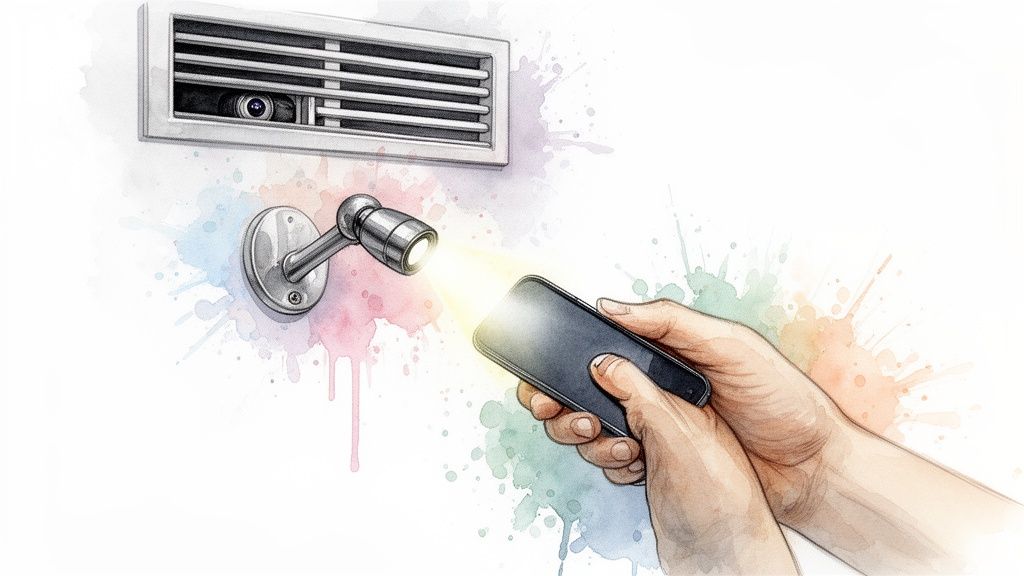
You step into a fitting room, pull the curtain, and suddenly the space feels wrong. Maybe it is a weird dome on the ceiling. Maybe it is a vent pointed at an odd angle. Maybe it is nothing, but your body notices the discomfort before your brain does.
That reaction is not dramatic. It is self-protection.
That Unsettling Feeling in the Fitting Room
Shoppers generally do not walk into a store expecting a camera in fitting room situations. They expect privacy, a mirror, and five quiet minutes to decide whether a jacket works. When the room feels off, the whole shopping trip changes.

That anxiety is grounded in real incidents. Incidents of illicit hidden cameras persist, such as a Dick's Sporting Goods case where a shopper discovered a recording device leading to employee charges, and a Target incident involving a man using a phone under a shopper's skirt, as discussed in this overview of dressing room recording incidents and consent issues.
Why your gut reaction matters
A fitting room is one of the few places inside a store where people expect a real boundary. You close a door or curtain because you are changing clothes, not because you want to be on alert.
When that privacy feels shaky, it affects more than comfort. It changes how fast you shop, what you try on, and whether you trust the store at all. Even nonfunctional dome fixtures can make people feel watched.
If a room makes you hesitate, trust that signal first and investigate second.
Some shoppers respond by rushing through the try-on. Others avoid fitting rooms completely. That is not irrational. It is a practical response to uncertainty.
You are not stuck with guesswork
You do not need to become paranoid, but you should have a routine. A quick scan takes less than a minute. Knowing what to do if you spot something suspicious matters even more.
If store fitting rooms already make you uncomfortable, it also helps to understand alternatives to the whole process, especially if you already struggle with fitting room sizes and privacy tradeoffs. Shopping should not require you to ignore your instincts.
Your Practical Guide to Spotting Hidden Cameras
The goal is not to perform a forensic sweep. The goal is to do a fast, calm check before you change.
Start with the room itself, not your phone. Walk in, pause, and scan the obvious surfaces first.
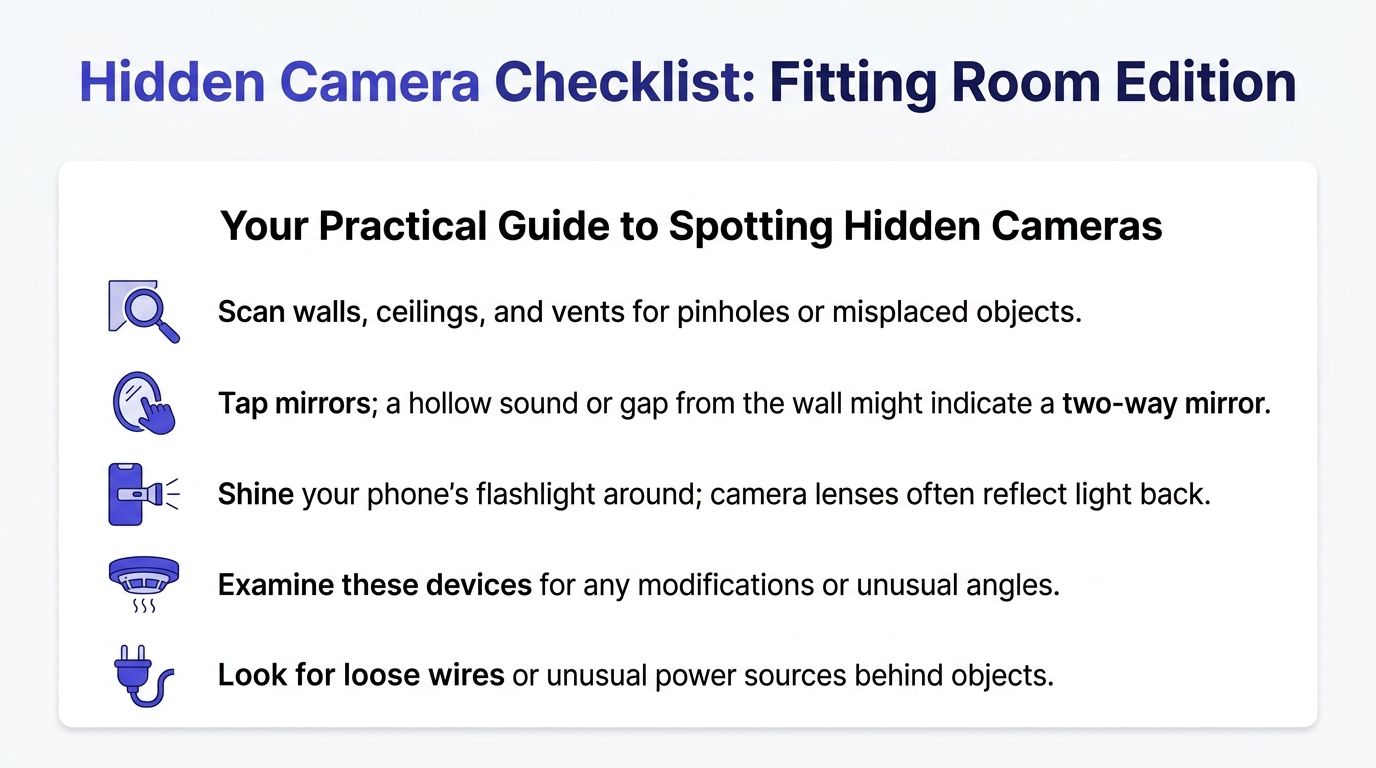
Do the 60 second scan
Look at the places where a tiny lens can blend in.
- Check fixtures at eye level: Coat hooks, wall pegs, screws, and small plastic caps deserve a second look if one seems oddly placed or different from the others.
- Look up next: Smoke detectors, speakers, vents, and ceiling corners can hide small devices or modified housings.
- Notice angle and symmetry: If one object points directly toward the changing area while everything else looks standard, treat that as suspicious.
- Inspect mirrors casually: You are not trying to crack a case on the spot. You are checking whether the mirror looks poorly mounted, oddly recessed, or out of place.
A lot of hidden devices rely on people being in a hurry. Slow down just enough to notice what does not belong.
Use light to force a reflection
Your phone flashlight is the fastest tool you already have. Turn it on and sweep it slowly across reflective surfaces, vents, hooks, and dark corners.
Camera lenses often reflect light back in a way that catches your eye. You are looking for a tiny glint that does not make sense in the context of the fixture.
A normal hook looks like hardware. A hidden lens often looks like a dark dot or glossy point where no opening should be.
Do this from more than one angle. A suspicious reflection that appears only from one side is worth paying attention to.
A quick visual demo can help you build the habit before you need it in a store.
<iframe width="100%" style="aspect-ratio: 16 / 9;" src="https://www.youtube.com/embed/-b0M0jxDFuU" frameborder="0" allow="autoplay; encrypted-media" allowfullscreen></iframe>Watch for physical clues
A hidden camera still needs power, placement, and a line of sight. That creates tells.
| What you notice | Why it matters |
|---|---|
| A tiny hole in plastic or metal | Could be a lens opening |
| Loose wire or added cable | Hidden devices often need power or charging |
| Blinking light in a dark fixture | Some devices show activity indicators |
| A vent or detector aimed strangely | Placement may be designed for recording, not ventilation or safety |
Do not overthink every object. Stores have plenty of ugly fixtures. You are looking for combinations that feel wrong, not random imperfections.
Keep your routine low key
You do not need to announce what you are doing. Walk in, hang your clothes, glance around, use your flashlight for a few seconds, and make a decision.
If the room feels clean and ordinary, proceed. If something keeps bothering you, leave and ask for another room. Privacy is reason enough.
What to Do If You Find a Suspected Camera
The worst move is touching it. Do not pull it down, cover it, or start poking at it.
Treat the device like evidence.
Leave the room first
Grab your belongings. Get dressed if needed. Exit the fitting room without making a scene inside that space.
That protects you and keeps the device where it is. If the room is being monitored, spending extra time there helps no one.
Report it clearly and specifically
Find a manager, not just the nearest employee if you can avoid it. Keep your wording direct.
You can say something simple like this:
- State what you saw: “There is an object in fitting room three that looks like it may be a recording device.”
- State what you need: “Please secure that room immediately.”
- State your next step: “I am contacting local law enforcement.”
Be specific about location. Mention the wall, hook, vent, mirror, or ceiling fixture.
Document without disturbing anything
If it is safe, take a photo or short video from outside touching distance. Include enough of the room to show where the item is placed.
Also note:
- The time
- The store location
- The fitting room number or description
- The name of the manager you spoke to
Do not argue with staff about whether the device is “probably nothing.” That is not your call, and it is not theirs either.
If you suspect illegal recording, call local law enforcement yourself. Do not rely on the store to decide whether the situation is serious.
Protect yourself after you leave
If you changed clothes in that room before noticing the device, tell police that clearly. If you were shopping with someone, ask them to write down what they saw while it is still fresh.
If the store has surveillance in hallways or entrances, that footage may later help establish who accessed the area and when. Your job is not to investigate. Your job is to preserve facts and get the right people involved fast.
Understanding Store Policies and Your Legal Rights
There are two very different issues people often lump together. One is visible store surveillance for loss prevention. The other is hidden recording in a private changing area. Those are not the same thing.
Why stores monitor so much
Retailers did not become surveillance-heavy by accident. According to this review of dressing room surveillance laws and retail loss pressures, retail stores in the United States suffered approximately $44 billion in inventory losses in 2014, and stores widely adopted cameras in main sales areas and other loss-prevention tactics in response.
That same source notes that only 13 U.S. states explicitly prohibit surveillance in dressing rooms. That patchwork matters. Some states draw a hard line. Others create murkier rules around notice, consent, or related privacy standards.
So yes, stores often have a reason for obvious cameras near entrances, sales floors, and checkout areas. No, that does not mean anything goes inside a changing room.
The line between notice and intrusion
A visible sign saying a store uses surveillance does not automatically make every type of recording acceptable. A posted notice may cover ordinary public areas. A fitting room is different because people undress there and expect privacy.
That is why the legal issue turns so quickly from “store policy” to “possible privacy violation.” If a retailer crosses that line, the matter can move beyond customer service and into police reports, civil claims, and broader questions of responsibility.
If you are trying to understand how a business can be held responsible when unsafe conditions or privacy violations happen on-site, this guide to premises liability gives useful context.
What your rights depend on
Your rights can vary by state, but a few practical rules hold up well:
- If recording is hidden in a space used for changing clothes, treat it seriously.
- If a store relies on notice for surveillance practices, read the signs before using the room.
- If staff dismiss your concern without checking, document that response.
- If you believe your privacy was violated, contact local law enforcement and consider legal advice in your state.
You do not need to memorize statutes while holding jeans and a sweater. You just need to know this: obvious security in public areas is one thing, secret recording where people undress is another.
What to ask before you use the room
When a store setup feels aggressive or unclear, ask direct questions:
| Ask this | Why it helps |
|---|---|
| “Are there any cameras monitoring this fitting room area?” | Forces a clear answer |
| “Is there store signage about surveillance?” | Clarifies whether notice exists |
| “Can I use a different room?” | Gives you a simple exit |
| “Who is the manager on duty?” | Useful if the answer feels evasive |
A good store should be able to answer calmly. If the response is slippery, irritated, or dismissive, take that as useful information.
Skip the Risk and Visualize Styles from Home
The cleanest solution is simple. Stop relying on a physical fitting room when you do not have to.
The bigger shopping shift is already heading that way. According to Fortune Business Insights on the virtual fitting room market, the global virtual fitting room market was valued at USD 6.86 billion in 2025 and is projected to reach USD 30.41 billion by 2034. That growth reflects demand for safer, contactless ways to preview clothing without stepping into a private stall at all.
Why visual try-on makes sense
You do not need a changing room to decide whether a style suits you. For most online shoppers, the primary question is not exact sizing. It is visual.
How does that trench coat look with your proportions? Does that neckline suit your vibe? Is the color flattering, or does it wash you out?
That is where virtual try-on tools make sense. They help you see how it looks, preview the appearance, and compare styles quickly from home.
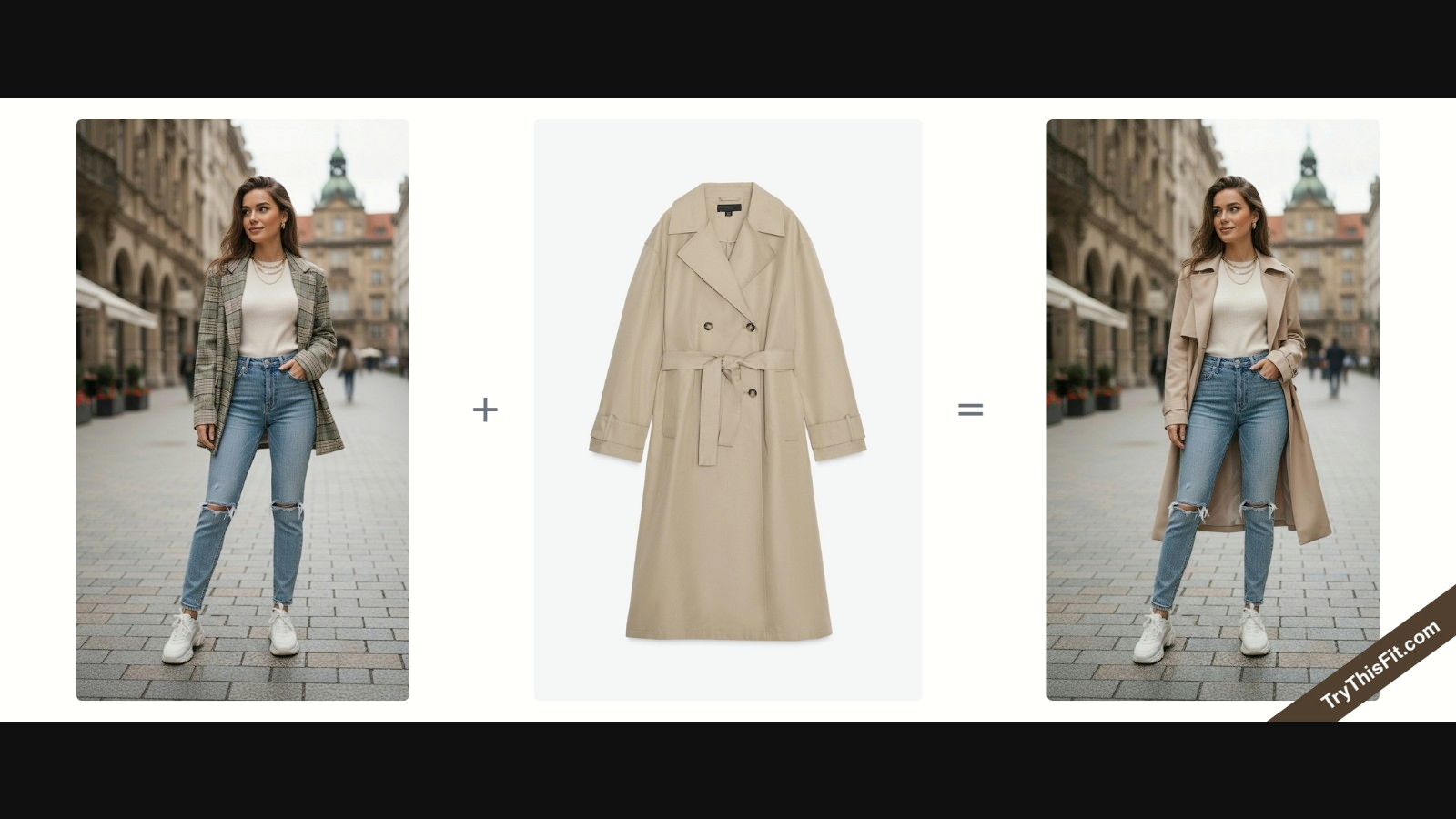
Ready to see how new styles look on you from the safety of home? Try it now at trythisfit.com!
What works best
If you use a virtual try-on app, flat-lay clothing photos work best for a clean style preview. That gives the system a straightforward view of the garment shape and details.
You upload a photo of yourself, choose the clothing image, and get an instant visual of the style. No changing room. No awkward store lighting. No wondering whether that weird object on the wall is harmless.
This is also why people use these tools for more than mall shopping. They are handy when browsing secondhand listings, comparing jackets across sites, or narrowing down costume ideas without ordering a pile of maybes.
If you want a broader sense of this technology's place in the industry, this roundup of practical Augmented Reality applications is a useful read.
A privacy first shopping habit
A privacy-first shopping routine is not complicated:
- Browse from home
- Use clear garment images
- Preview the style on yourself
- Buy only what still looks right after comparison
That approach cuts stress fast. If you want to start with the core experience, take a look at virtual try-on options here.
Trying On Anything from Anywhere Instantly
The easiest version of this is the browser route. You are already shopping online anyway, so it makes sense to preview styles where you browse.
The practical tool for that is a Chrome extension. It lets you right-click product images and try them on without turning shopping into a whole side project.
How it feels in real life
You are on Zara. You spot a long coat. Right-click, preview it, keep browsing.
You are on H&M comparing two dresses. Same move. You can judge the look fast instead of juggling tabs, screenshots, and wishful thinking.
If you shop on Amazon, use the affiliate link at Amazon through this link. If you shop secondhand on Vinted or Depop, this gets even more useful because you usually cannot test the style in person before buying.
Install the free Chrome extension in 5 seconds and start trying on outfits from any store you love!
Best use cases for the extension
- Fast fashion browsing: Zara, H&M, Shein, and similar stores move quickly. A right-click preview helps you sort good ideas from impulse buys.
- Secondhand shopping: A one-off jacket on Depop or Vinted does not come with a dressing room. You can still preview the appearance before deciding.
- Costumes and event looks: Halloween outfits, themed parties, and bold pieces are easier to judge visually than by product thumbnail alone.
- Everyday outfit planning: Sometimes you are not buying anything yet. You just want to figure out your style.
The free Chrome extension installs in a couple of seconds at this Chrome extension page. If you want to start with a broader walkthrough, this page on trying clothes on online is a good place to begin.
If you end up doing lots of comparisons, keep your favorites organized in your saved try-ons at https://trythisfit.com/history.
Fitting Room Safety FAQs
Are dome cameras in fitting room areas always real
No. Some shoppers mistake nonfunctional dome fixtures for active cameras. That still does not make the experience comfortable, so ask the store directly if a fixture concerns you.
Is the two way mirror test reliable
Not fully. People often use mirror tapping as a rough check, but it is not a definitive test. Treat it as one clue, not proof.
What hidden camera spots should I check first
Start with vents, smoke detectors, hooks, screws, wall fixtures, and anything pointed toward the changing area. Those spots deserve the fastest visual scan.
Should I confront the person I suspect installed it
No. Leave, report it to a manager, and contact local law enforcement. Preserve your safety and the evidence.
If you are tired of worrying about a camera in fitting room spaces, skip the whole mess and shop more privately. TryThisFit lets you see how clothes look on you in seconds, with no account needed. Use clear flat-lay product photos for the best previews, or install the free Chrome extension to right-click and try styles from almost any shopping site instantly.
Try Virtual Try-On Now
See how clothes look on you before you buy - works with any online store
Get Started Free