Fashion Personality Quiz: Find Your Style and Try It On
You're standing in front of a packed closet, and somehow nothing feels right. The jeans look fine, the dresses look fine, and the tops are fine in that frustrating, useless way that still leaves you getting dressed, undressing, and scrolling for ideas five minutes later.
That's exactly where a fashion personality quiz earns its keep. It gives you a fast, opinionated shortcut to the styles that feel like you, then lets you preview those looks on your body before you spend a cent.
If you want a deeper starting point for the whole process, a good companion read is this personal style guide. And if you already know you need a practical next step, the TryThisFit style finder is built for the moment after the quiz, when you're ready to turn a label into something you could wear tomorrow.
Why Your Closet Feels Stuck and How a Quiz Fixes It
The usual closet problem is not having too few clothes. It is having too many almost-right choices, so every outfit starts to feel like a compromise.
A fashion personality quiz cuts through that stall because it gives you a clear style direction instead of a pile of vague maybes. Clothing also carries identity, not just function, and studies on dress psychology show that people often use what they wear to signal personality and style preference. Style categories such as Classic, Dramatic, and Natural are useful because they give shape to choices that otherwise stay fuzzy and hard to act on.
That is why quizzes feel helpful even when they are simple. They do not invent your taste, they reflect it back with enough structure to stop the constant second-guessing.
The shortcut is the point
A good quiz gives you a starting vocabulary. Instead of asking whether you like everything, it pushes you toward the sharper question of what you reach for when you feel most like yourself. That is the question that matters when you want to shop with more intention.
If you are new to style, the quiz keeps you from buying random pieces that never get worn. If you already shop too often, it helps you stop confusing trend hopping with actual taste.
Practical rule: If a quiz result makes you feel seen, use it. If it makes you feel boxed in, use it as a clue, not a verdict.
The smartest next move is to test the result visually, not just mentally. A label on its own can stay abstract, which is why seeing the look on your own body changes the decision fast. For a more hands-on next step, use TryThisFit's guide to finding your fashion style after you finish a personal style guide, then compare the result to what feels right on you.
What a Fashion Personality Quiz Actually Asks You
Most quizzes look playful on the surface, but the mechanics are usually pretty straightforward. They ask about the parts of style that repeat across your wardrobe, then score those patterns into a result.
The questions usually cluster around a few things
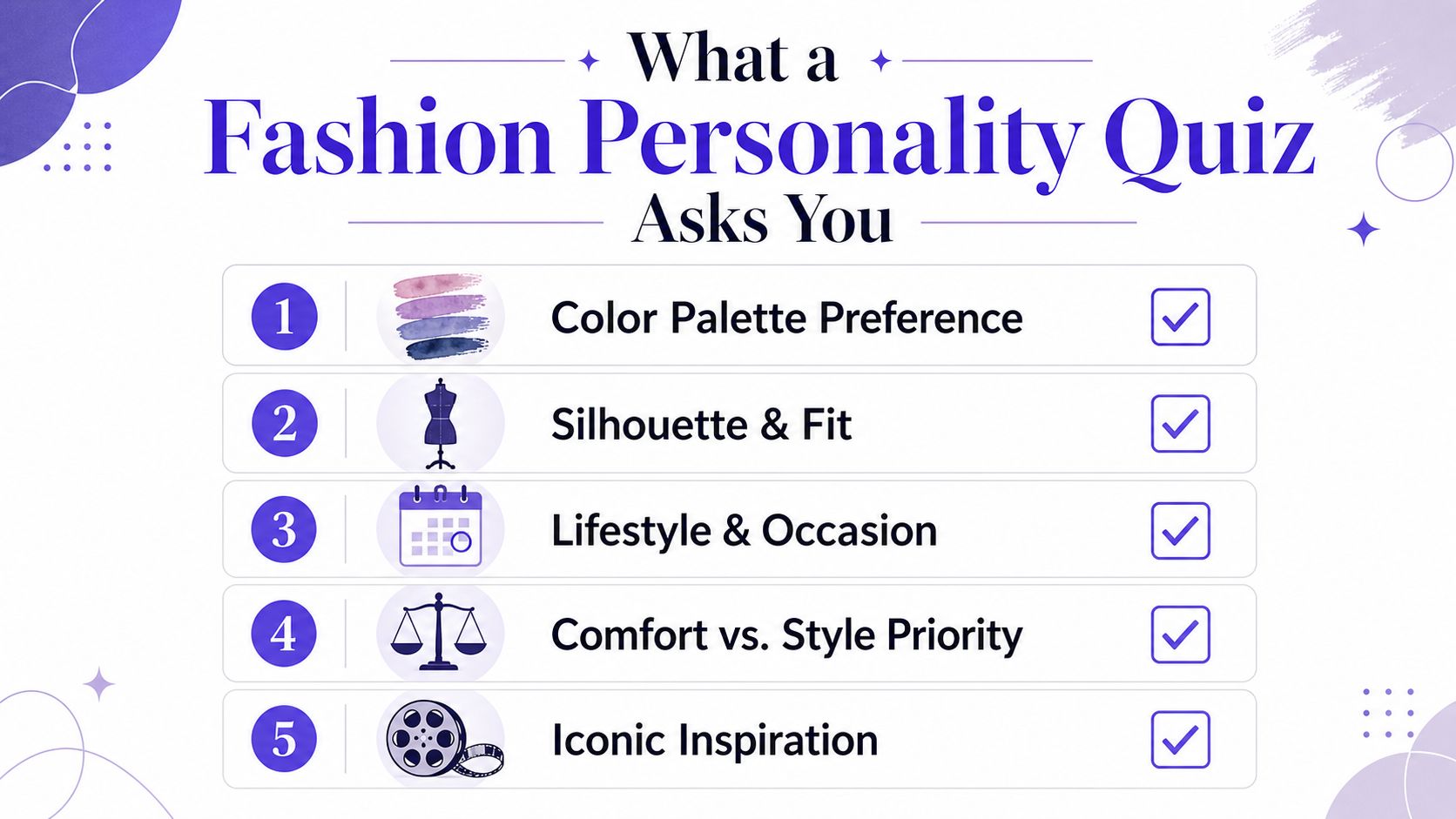
You'll usually get prompts about colors, silhouettes, lifestyle, comfort level, and occasion. Some quizzes also toss in mood, inspiration, or shopping preferences, but those five categories do most of the work.
A concrete example helps here. A TAUW style-personality quiz tells people to add up your responses in each category, A, B, C, D, E, F, then use the back of the flyer to match the totals to major style personalities (TAUW quiz flyer). The London College of Style uses a similar pattern, asking people to pick the option that feels most accurate and then interpret repeated answers as style archetypes like Classic, Bohemian, Dramatic, Romantic, and Natural (London College of Style quiz).
The smart move is simple. Answer for the life you live, not the Pinterest version of yourself.
- Choose weekday truth over fantasy: If you wear jeans four days a week, don't answer like you live in satin sets and heels.
- Match your closet reality: Pick the option that fits what you'd repeat, not what looks clever in a quiz result.
- Ignore the urge to perform taste: The most honest answer is usually the one you almost skip past.
Pick the answer that sounds boring if boring is what you actually wear. That's the answer that will help your wardrobe.
The scoring logic is usually less mystical than people think. Quizzes build a pattern out of repeated preferences, then hand you the archetype that shows up most often. That's useful because style is rarely one dramatic choice, it's a recurring set of habits.
Decoding the Six Style Archetypes You'll Meet
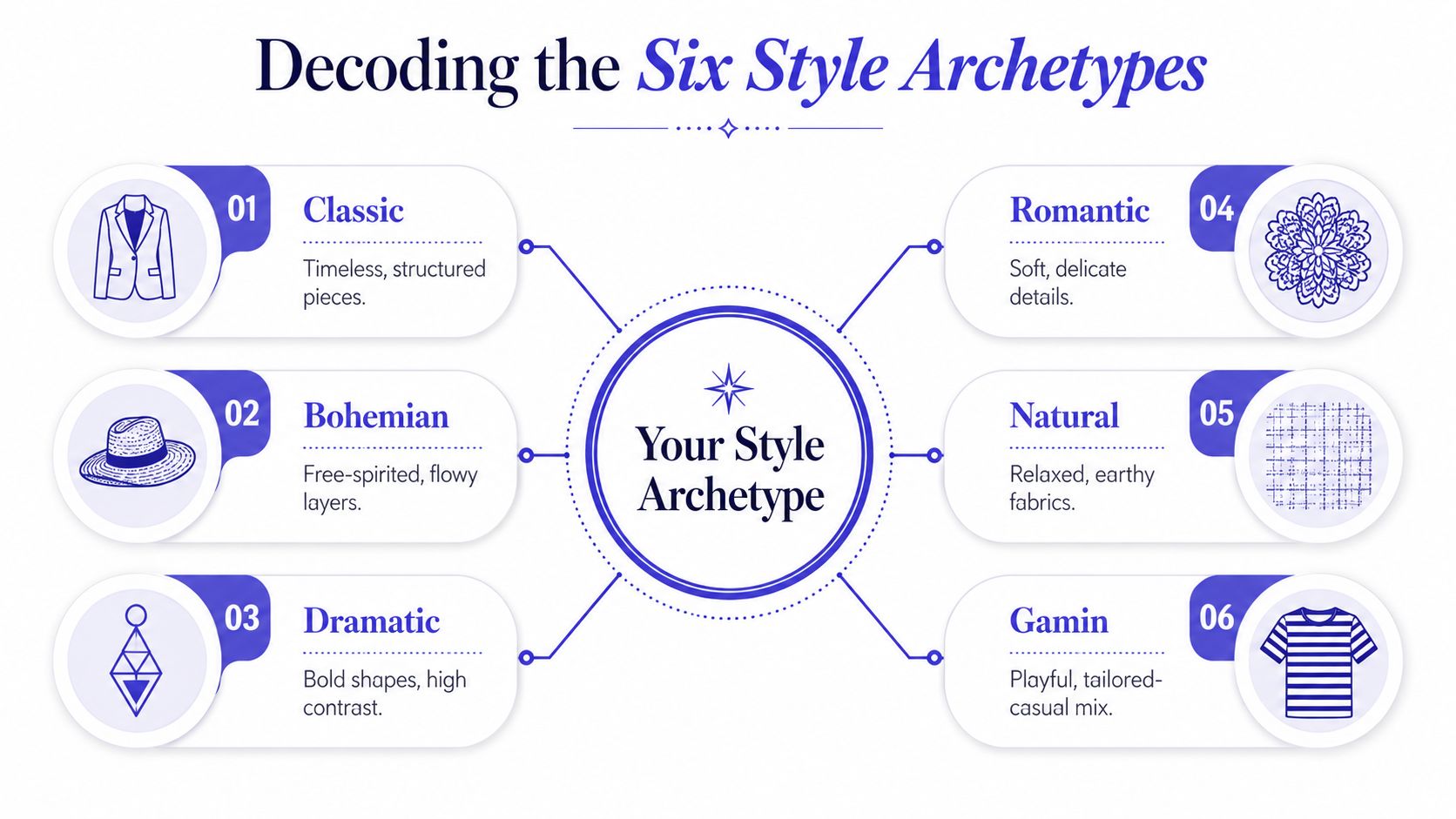
The six archetypes only feel rigid if you treat them like destiny. They are shorthand for patterns that keep showing up in your choices, and the clothes attached to each one are usually easier to wear than people expect.
What each one looks like in real life
Classic is clean and polished. Crisp blazers, well-fitted trousers, neat buttons, and pieces that look intentional without trying too hard all fit this style.
Bohemian reads softer and more fluid. Flowing textures, layered jewelry, relaxed prints, and that slightly undone feel belong here.
Dramatic wants sharp shape and contrast. Strong shoulders, bold silhouettes, high-contrast color pairings, and one statement piece doing the heavy lifting make sense for this style.
Romantic usually favors softness. Lace, gentle drape, delicate details, and fabrics that feel feminine without being fussy tend to work well.
Natural is built around ease. Relaxed denim, breathable fabrics, earthy colors, and unfussy shapes define the look.
Gamin brings in playful contrast. Cropped proportions, stripes, casual mixes, and a little visual surprise keep it lively.
That basic logic holds up in research, too. In a clothing-and-personal-identity study, Classic, Dramatic, and Natural scored higher on the personal-identity questionnaire than Romantic, Ingénue, and Gamin. That does not make the lower-scoring types less useful, it just means some archetypes feel more immediately decisive than others.
Don't treat the result like a costume assignment
The quiz page already points to the core rule. Repeated patterns matter more than one dramatic answer. A result should help you spot what you keep circling back to, not push you into a narrow costume rack. The quiz page makes more sense if you read it that way.
Good use of an archetype: Let it guide your next purchase.
Bad use of an archetype: Treat it like the only thing you're allowed to wear.
I'd use the result as a vocabulary builder. If you get Classic, start noticing structure. If you get Bohemian, pay attention to texture. If you land on Natural, watch how comfort changes the rest of your outfit choices.
And if you see a little bit of yourself in two or three labels, that is normal. Good wardrobes are mixed, not pure.
Treat Your Result as a Starting Point, Not a Label
The most useful style results don't lock you down. They point you toward combinations you'd wear, then leave room for the rest of your life to show up.
Vogue Business has noted that shoppers are mixing references across “-core” aesthetics more than staying inside one tidy box, and that's exactly how real style works now (Vogue Business note referenced in recent fashion reporting). One person can pull from Classic at work, Bohemian on weekends, and Dramatic for dinner without any contradiction.
That's the smarter way to read a quiz result. Use it as a base layer, then adjust for context.
Build around your actual week
- Work: Keep the most reliable parts of your result, the pieces that make you look intentional.
- Weekends: Let the style loosen up, because errands and coffee runs don't need a full thesis.
- Dates or events: Add the detail that makes the outfit feel special, not overworked.
Labels fall apart if you cling to them too tightly. A result can tell you the kind of visual energy you like, but it can't tell you how that energy behaves in a blazer, on a Tuesday, under bad lighting, or with shoes you forgot to plan around.
The better mindset is simple. Style is a living wardrobe, not a fixed identity card.
Once you start treating the result that way, you stop buying clothes just because they match a label. You start choosing pieces that make sense in motion, which is where visual try-on becomes especially useful.
Preview Each Archetype On You With TryThisFit
The quickest way to judge a quiz result is to put it on your own body. Open TryThisFit Chrome extension or go straight to the TryThisFit outfit preview page, upload a photo, and test pieces that match your archetype so you can see the fit before you buy.
Use flat-lay clothing photos whenever you can. Clean product shots give the preview better source material, and the result lines up more closely with the style you're considering in real life.
The Chrome extension makes the process even faster. Install the free extension from TryThisFit Chrome extension in a couple of seconds, then right-click product images on Zara, H&M, Amazon, Shein, Vinted, and Depop to try them on instantly.
If you're comparing marketplace listings or secondhand finds, that right-click flow is the point. You do not need accounts, and you do not need to open a pile of tabs just to compare one jacket against another.
Use case that matters: If a quiz places you in Classic or Dramatic, you can test a structured blazer, a sharper top, or a different silhouette on yourself in seconds and decide what feels right to wear.
For shoppers who want to compare visual options in one place, this preview is more useful than another abstract style description. It helps you separate style preference from purchase readiness, because seeing the look on your own photo answers a different question than reading the label.
If you want a related workflow for online outfit testing, the TryThisFit outfit preview page gives you a clear place to start. And if you're curious about adjacent visual-shopping tools, the ai clothing model generator shows how broad this category has become.
Here's the part people like most. The app gives you an instant preview, so you can decide faster and keep moving.
Try it now at TryThisFit.
<iframe width="100%" style="aspect-ratio: 16 / 9;" src="https://www.youtube.com/embed/y7Uu65GSSJg" frameborder="0" allow="autoplay; encrypted-media" allowfullscreen></iframe>Build a Wearable Style Plan From Your Quiz Result
A quiz result is useful only when it turns into outfits you would wear. I'd start with one archetype, then build three versions of your life around it, and preview all three before you buy a single piece.
Work, weekend, and event gives you a clean framework. If you want a more visual reference for how pieces change the mood of a look, browse the style catalog and compare the combinations that feel closest to your taste.
Turn one result into three outfits
If your result is Classic, your work outfit can be a fitted blazer and clean trousers, your weekend look can swap in straight-leg denim, and your event version can use a sharper dress with structured accessories.
If your result is Bohemian, start with flowing layers for daytime, add softer denim and textured tops for casual plans, then build a more dressed-up version with movement and texture for evening.
The same method works for every archetype. You are not chasing perfection, you are building repeatable outfits that fit the places you go.
Save the try-ons that look promising to your history page so you can compare them side by side later. That keeps you from reopening the same tabs, and it makes it easier to spot which version belongs in your closet.
For a structured approach to organizing these looks, use our wardrobe planning tool. It helps you turn a quiz label into a short, usable shopping plan instead of a vague style idea.
When you want to compare Amazon finds, use Amazon through TryThisFit so the visual preview stays tied to the item you are considering. That is the cleanest way to shop across your usual stores without losing track of what you chose.
Install the Chrome extension in seconds, open your next product page, and start previewing your archetype on real outfits today.
TryThisFit lets you see how clothes look on you in seconds, so a fashion personality quiz becomes something you can wear tomorrow. Visit TryThisFit, try a few archetypes on your own photo, and use the result to shop with less guesswork and fewer regrets.
Try Virtual Try-On Now
See how clothes look on you before you buy - works with any online store
Get Started Free