Changing Rooms Cam: Your Guide to Privacy & Safe Shopping
You know that split-second pause before you change in a public fitting room. You close the door, glance at the mirror, notice a vent, a hook, a smoke detector, maybe a dark dot in the wall, and your brain asks a question you didn’t invite.
Is this private?
That’s why so many people search for changing rooms cam. Not because they’re overreacting, but because modern shopping has added a new kind of background stress. A fitting room is supposed to help you decide whether you like a look. Instead, it can leave you scanning the ceiling and second-guessing the room itself.
Most advice online doesn’t help much. It either tells you to “trust your instincts” or throws around scary stories without explaining what’s legal, what’s illegal, what warning signs matter, and what you can realistically do in the moment.
A better approach starts with clarity. Some cameras are visible and installed for security. Some are hidden and criminal. Some situations sit in a legal gray area that shoppers wrongly assume doesn’t exist. That confusion is exactly what makes this topic feel so unsettling.
By the time you finish reading, you’ll know the difference between retail surveillance and voyeurism, how to check a room more intelligently, and why more shoppers are deciding that the safest changing room is the one they never have to step into at all.
That Unsettling Feeling in the Changing Room
A lot of people know this feeling without having a name for it. You bring in two dresses, a jacket, maybe a pair of jeans, and suddenly the room feels smaller than it should. You’re not thinking about color or style anymore. You’re thinking about privacy.
That’s what makes the phrase changing rooms cam so charged. It captures a fear that sounds niche until you’re standing there half-dressed, looking at the mirror frame and wondering whether you’re alone.
Why this fear sticks
Changing rooms create a strange mix of trust and exposure. The store invites you into a private space, but it’s still a public business, managed by strangers, built with fixtures you didn’t inspect, and used by dozens of people every day.
That uncertainty is enough to make ordinary details feel suspicious:
- A misplaced hook can look like a disguised lens
- A tiny hole in a wall panel can suddenly seem important
- A mirror can make you wonder whether it’s really just a mirror
- A visible dome camera outside the stalls can make you question what’s inside them too
None of that means every changing room is dangerous. It does mean your discomfort has a real basis.
You don’t need to feel silly for checking a room before you undress. Basic caution is a normal response to a private moment in a semi-public place.
The problem isn’t only paranoia
What confuses people is that “camera” covers more than one situation. A visible security camera near the store entrance is one thing. A hidden recording device aimed into a stall is something else entirely. Between those two extremes sits a legal and practical mess that most shoppers never get taught.
That’s why the topic deserves more than a quick viral warning. If you only know the scary version, you feel helpless. If you understand how the rules, risks, and detection methods work, you can make much calmer choices.
And once you see the bigger picture, one thing becomes obvious. Privacy-conscious shopping isn’t just about spotting danger. It’s about reducing how often you need to gamble with it.
The Shocking Legal Reality of Surveillance
You walk into a fitting room expecting a simple rule: if people undress here, cameras must be banned here.
That expectation is understandable. The legal reality is less tidy.
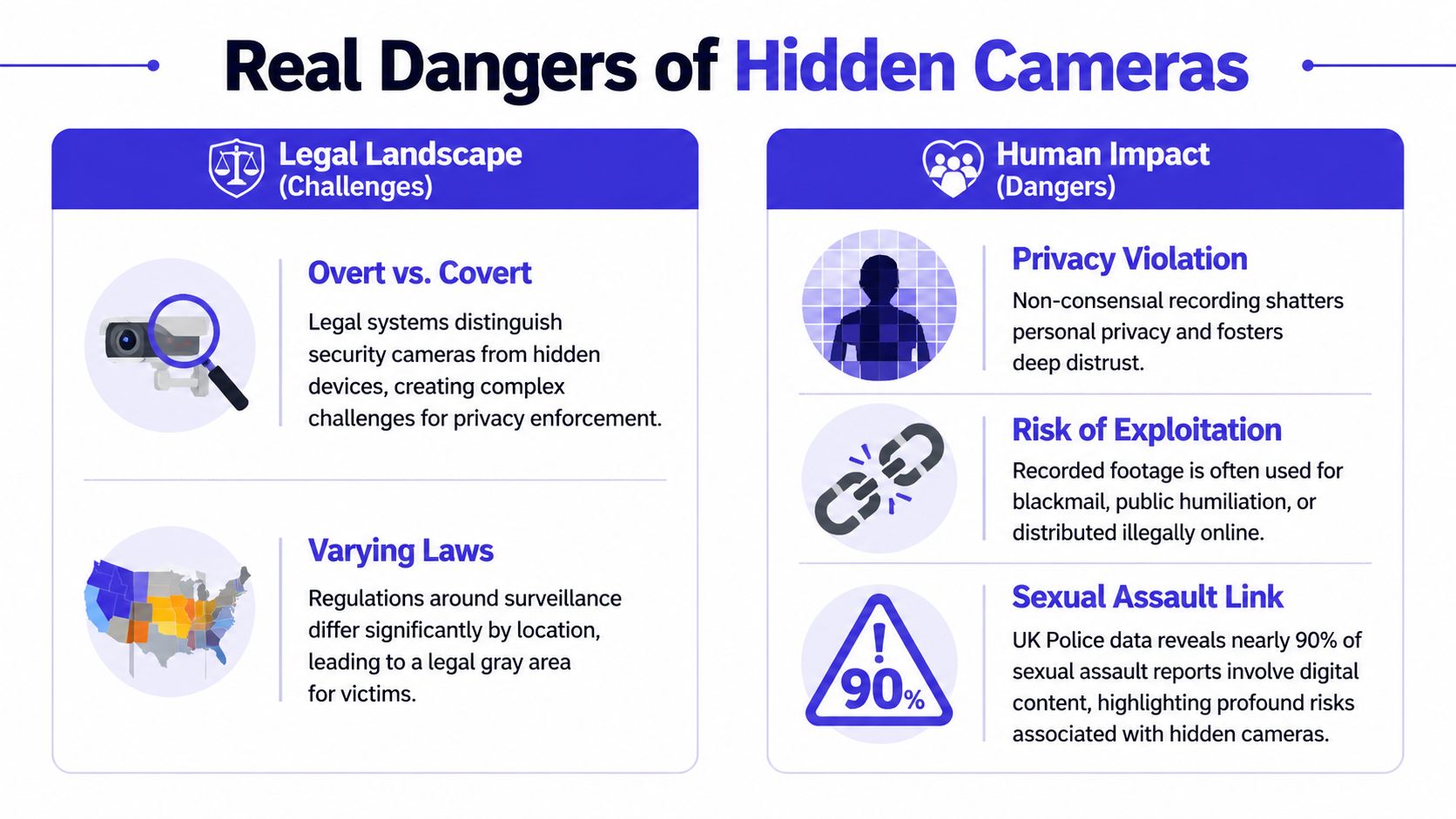
Reporting summarized by Big Frog 104 on dressing room camera laws says only 13 states in the United States explicitly prohibit cameras in dressing rooms, including California, Michigan, and Utah. In many other states, the law does not spell the rule out as clearly as shoppers assume. That gap creates room for store policies, security arguments, and confusion about what is allowed.
Visible security versus hidden voyeurism
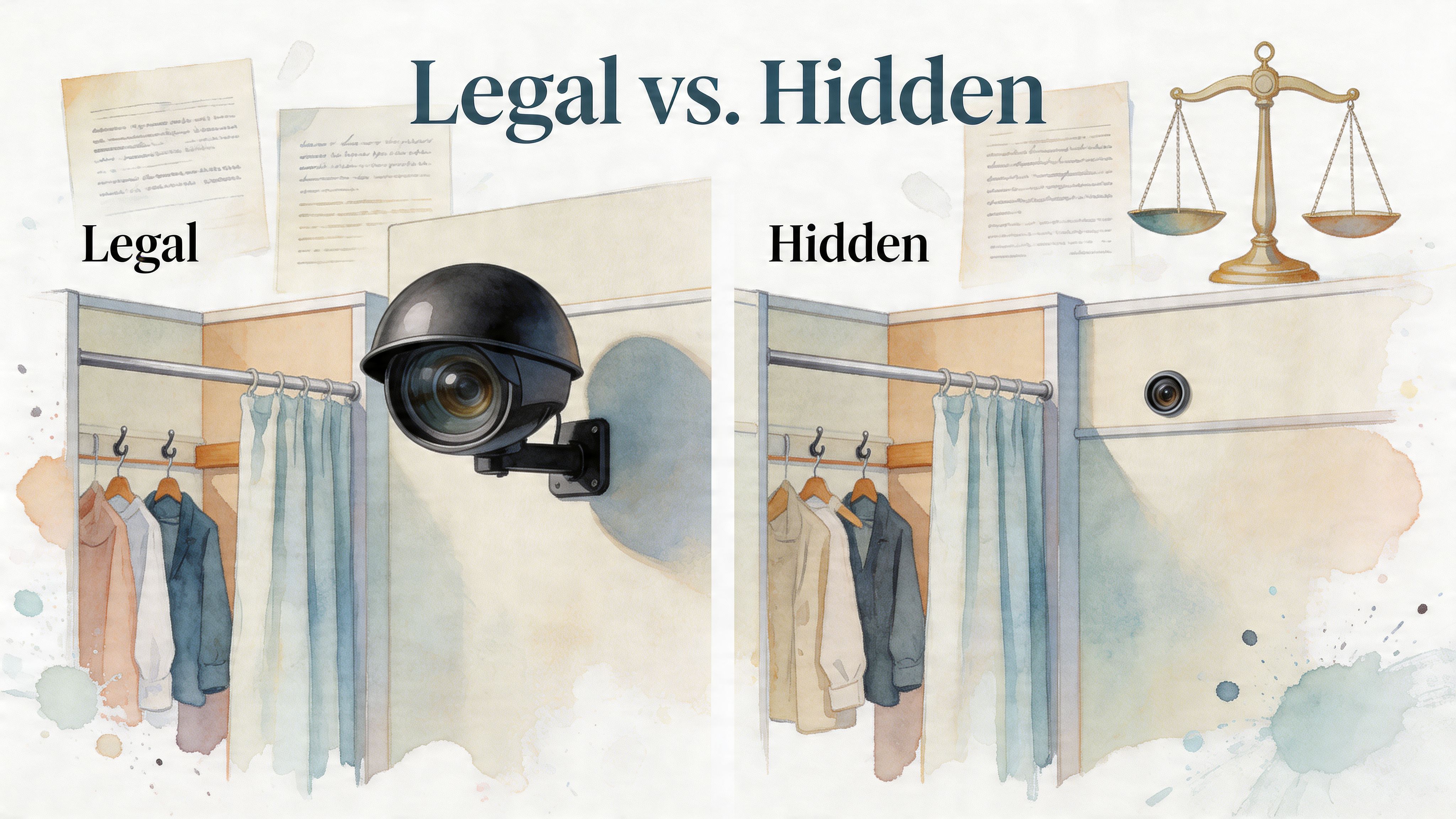
The easiest way to understand the problem is to separate three very different situations. A hallway camera that watches entrances is treated differently from a device aimed into a private stall. A hidden recorder is different again.
| Situation | How it’s usually viewed |
|---|---|
| Visible camera outside stalls | Often presented as store security or loss prevention |
| Visible camera inside private undressing space | Far more disputed and often more restricted |
| Hidden device placed to record people undressing | Voyeuristic and potentially criminal |
That distinction may make sense to lawyers and store operators. It does not feel reassuring when you are half-dressed behind a thin door.
Retailers often defend surveillance by pointing to theft and store safety. As noted earlier, the same report describes heavy retail use of cameras and other anti-shoplifting measures. That helps explain why surveillance has become normal in stores, even though shoppers and retailers are talking about two different kinds of privacy. Stores may mean inventory control. You mean your body, your image, and whether a private moment stays private.
What this means for shoppers
The practical lesson is simple. Do not assume every fitting room gives you the same legal protection.
That matters because uncertainty benefits the wrong people. A careless business may rely on vague policies. A malicious person may rely on the fact that shoppers rarely know where the line is.
A good mental model is a phone’s permissions screen. If an app has camera access, you want that to be explicit, limited, and visible. Changing room privacy should work the same way, but often it does not. You are entering a space where the rules may be weaker, less consistent, or poorly enforced.
If footage from a hidden device ever gets shared online, the risk changes fast from store privacy to digital abuse. In that situation, resources on online revenge porn takedowns can help explain what removal options may exist if intimate imagery is distributed without consent.
This is also why a modern alternative matters. Virtual try-on tools like TryThisFit are not just a fun shopping shortcut. They reduce how often you need to undress in a semi-public space at all. That turns privacy from something you hope a store protects into something you control yourself.
Real Dangers Beyond the Legal Gray Area
You close the curtain, reach for a new size, and notice how exposed the room is. A gap near the hinge. A mirror angled wider than expected. A bench placed in direct view of the door. Even without a hidden device, that setup can make your body feel like public information.
That reaction is not overthinking. It is your brain doing a fast risk check in a space where you are temporarily less protected, less dressed, and less able to respond.
Why the risk is bigger than a single hidden lens
People often picture one specific threat. A tiny camera hidden in a hook or smoke detector. That risk is real, but the wider problem is exposure itself.
A poorly designed changing area works like a laptop with too many permissions turned on. It creates multiple ways for privacy to leak. Someone can peek through a gap, slide a phone under a partition, misuse a mirror angle, or record from a shared area where staff oversight is weak. The harm starts before any video is uploaded.
Physical layout matters more than many shoppers realize. Shared entrances, low partitions, floor gaps, bright lighting aimed the wrong way, and cluttered fixtures all give a bad actor cover. If you want a practical overview of common warning signs and safer habits, this guide on camera risks in fitting rooms breaks them down clearly.
Once footage exists, control gets much harder
A private image can spread fast. One recording can be copied, reposted, saved to private groups, or used for threats long after the original moment is over.
That is what makes changing room abuse different from ordinary retail discomfort. The event may last seconds. The uncertainty can last years.
The same UK report noted earlier also references cases from South Korea involving secretly filmed intimate footage shared online. The point is not that every store or every country works the same way. The point is that tiny cameras and instant sharing have changed the scale of the risk. A violation that once stayed local can become permanent and searchable.
Why this changes how people shop
For many women, girls, and privacy-conscious shoppers, fitting room stress affects behavior long before they buy anything. They avoid trying on certain clothes. They shop only with someone else nearby. They rush decisions because staying in the room feels worse than guessing the fit.
That tradeoff is unfair. You should not have to choose between checking how clothes look and protecting your privacy.
Traditional security advice helps reduce some risk, and the ABCO Security Services Australia recommendations are useful for understanding how cameras should be placed responsibly in legitimate settings. But there is a bigger shift worth noticing. The safest changing room is often the one you never need to enter.
That is why virtual try-on feels different from a simple shopping extra. It gives you a way to check style, fit, and outfit combinations without undressing in a semi-public room at all. Privacy stops being something you hope a store respected. It becomes something you keep in your own hands.
Your Practical Guide to Detecting Hidden Cameras
If you do need to use a public fitting room, a quick check can help. It won’t make the space perfect, and it won’t catch every threat, but it can reduce the chance that you miss something obvious.
The strongest advice is to keep your process simple enough that you’ll do it. Panic-scanning every inch of the room usually makes people less effective, not more.
Start with the fastest visual sweep
Before you change, look for anything that feels out of place. Focus on items that already have a reason to be mounted in a room.
Check these first:
- Smoke detectors and alarm housings that seem unusually low, oddly angled, or pointed toward where someone would undress
- Wall hooks or screws with a dark center hole
- Air vents and mirror edges where a tiny lens could hide
- Power adapters, tissue boxes, signage, or decorative fixtures that don’t seem to belong
This isn’t about becoming a detective. It’s about noticing objects that have both a view and concealment.
Use light and your phone intelligently
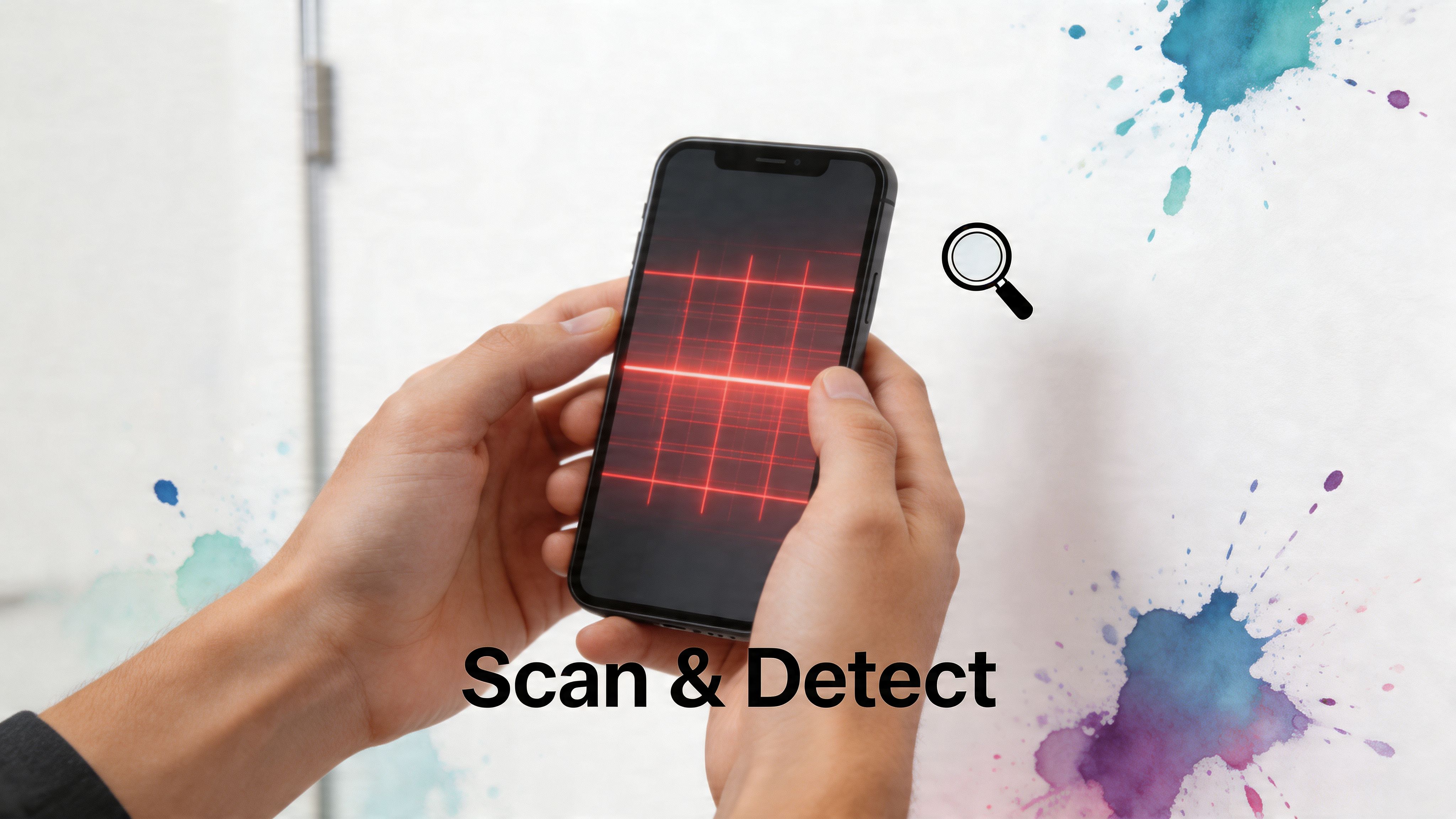
According to Reolink’s overview of hidden camera detection methods, professional protocols include scanning for Wi-Fi signals in the 2.4/5GHz bands with apps like Fing, which can find 80% of consumer-grade spy cams. The same source says a bright flashlight can reveal reflections from pinhole lenses with 95% efficacy on small apertures.
A practical sequence looks like this:
- Dim your screen and use your flashlight to sweep slowly across mirrors, hooks, vents, shelves, and wall holes.
- Watch for a tiny, sharp glint that stays suspiciously consistent from one angle.
- Open a Wi-Fi scanning app and look for unusual nearby devices if the room is small and enclosed.
- Pause before undressing if a device name or object seems off.
A flashlight check is fast, low effort, and worth doing even if you don’t use any app.
If you want broader home and personal surveillance context, the ABCO Security Services Australia recommendations offer useful background on how cameras are commonly installed and concealed.
Don’t forget mirrors and room behavior
A basic mirror check still matters. Pressing a fingertip to the glass is often discussed as a quick way to think about two-way mirror concerns, though it isn’t a complete test and shouldn’t be treated as proof by itself.
You should also pay attention to the room’s social signals:
| Sign | Why it matters |
|---|---|
| Staff resist switching rooms | It may be worth asking for a different stall |
| A fixture looks recently placed or loose | Temporary objects deserve extra attention |
| You feel rushed to enter | Haste makes unusual details easier to miss |
If anything feels wrong, leave. Ask for another room, bring a friend closer to the stall, or skip the try-on.
For more on the specific privacy concern itself, this guide on camera risks in fitting rooms breaks down the issue in plain language.
The limitation people need to understand
Detection methods help, but they aren’t foolproof. A wired device may not appear on Wi-Fi. A well-hidden lens may not reflect light clearly. A harmless object may look suspicious, while a dangerous one may look ordinary.
That’s the hard truth. Checking a room is smart. Relying on room checks as a guarantee isn’t.
Escape the Room The Safe Way to See How Clothes Look
There’s a simpler answer than becoming a part-time surveillance inspector every time you shop. You can stop treating the fitting room as mandatory.
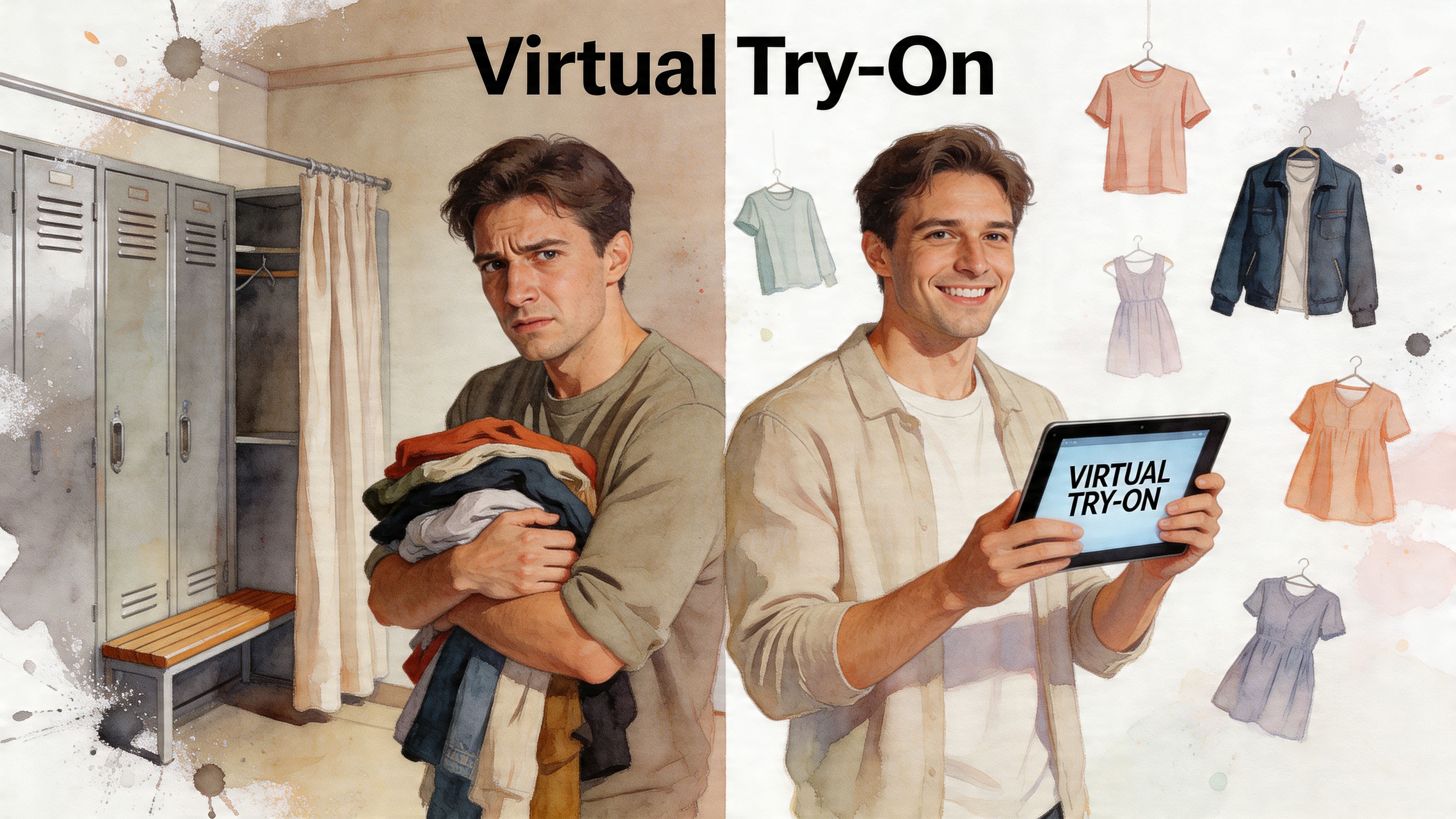
Modern virtual try-on tools let you preview the appearance of clothing without stepping into a public stall at all. For anyone who’s tired of that changing-room tension, this is less a gimmick than a privacy upgrade.
What virtual try-on actually does
Many readers find this confusing, so it helps to keep the promise narrow and honest. Virtual try-on doesn’t need to tell you exact sizing to be useful. Its real value is visual.
It helps you:
- See how a style looks on you
- Preview the appearance of colors and silhouettes
- Compare outfits before you buy
- Decide whether a piece matches your vibe
According to Wikipedia’s overview of virtual dressing room technology, modern AI can generate photorealistic previews from simple flat-lay clothing photos, allowing apps to reconstruct the garment’s appearance on a user’s body in seconds.
That’s a very different experience from fluorescent lighting, awkward curtains, and the low-grade stress of wondering who might walk past or what might be mounted on the wall.
Why flat-lay photos work so well
If you’ve ever saved a product image from a store listing, you’ve probably already seen the best kind of input. Flat-lay clothing photos usually give the cleanest view of the garment shape, sleeves, neckline, length, and pattern.
That makes them especially useful for:
- online shopping from brand sites
- secondhand listings with a single clear garment photo
- planning outfits ahead of events
- trying playful looks like Halloween costumes before buying
Here’s a visual example of the kind of styling preview people look for.
You can also see the concept in motion here.
<iframe width="100%" style="aspect-ratio: 16 / 9;" src="https://www.youtube.com/embed/ciOqwo6Q4RI" frameborder="0" allow="autoplay; encrypted-media" allowfullscreen></iframe>Privacy feels different when the room is yours
The strongest part of virtual try-on isn’t novelty. It’s control. You’re using your own space, your own timing, your own lighting, and your own boundaries.
That shift matters. Instead of asking whether a room is safe enough, you’re deciding whether you even want to involve a public room in the process.
If you want to explore this approach more directly, a virtual changing room experience shows how this kind of styling preview works without the stress of an in-store stall.
Visualize Any Outfit From Zara to Vinted Instantly
A private try-on is only useful if it fits into the way people already shop. That is why browser-based preview matters so much. You are not leaving the store page, uploading files into a complicated tool, or turning shopping into a project. You stay in your normal browsing flow and get a quick visual check before a purchase starts to feel risky.
That matters even more after all the anxiety tied to changing rooms cam stories. A virtual try-on is not just a convenience feature. It works like a privacy buffer between curiosity and exposure. Instead of stepping into a public stall to answer, “How would this look on me?”, you can answer that question from your own room.
The right-click habit that makes online shopping feel safer
The best tools disappear into the routine. You open a product page, spot a clear clothing image, right-click, and preview the garment on yourself. It feels less like using special software and more like adding one smart shortcut to a habit you already have.
That works well across very different shopping situations:
- Zara and H&M when you want to compare shape, length, or how a jacket changes the whole outfit
- Shein when you want a faster reality check before buying a trend piece on impulse
- Amazon through the Amazon shopping shortcut when product photos vary wildly from one seller to the next
- Vinted and Depop when secondhand listings move fast and there is no fitting room waiting for you
Clear garment photos still give the best preview. Flat-lay images are especially helpful because they show the neckline, sleeves, hem, and pattern without a model pose getting in the way.
Why this matters so much for secondhand
Secondhand shopping asks you to make faster decisions with less certainty. The item may be one of a kind. Returns may be limited or not offered at all. A seller might only provide one usable photo.
That is exactly why virtual try-on feels practical here. It reduces one layer of guesswork before you message the seller, place an offer, or miss the item entirely. For people who care about both privacy and resale value, that is a better trade than relying on a public fitting room later.
It also fits a broader retail reality. Stores keep balancing customer privacy with loss prevention, and that tension is part of understanding retail integrity risks. Shopping from home sidesteps that pressure altogether.
A smarter way to judge fit and style
Virtual try-on does not replace tailoring or size charts. It answers a different question first. Does this shape suit you? Does the color work near your face? Does the oversized blazer look polished on you, or just bulky?
That first visual pass saves time.
If you want more context for how digital previews connect to body shape, this guide to 3D body measurements for clothing visualization explains the idea clearly without turning it into a technical exercise.
Everyday shopping moments where it helps
People use this for ordinary decisions, not just big wardrobe overhauls.
A Zara trench coat. A Vinted blouse with no returns. A costume idea you may only wear once. A final-sale jacket that looks great on the model but could feel wrong on you. In each case, the value is the same. You get a quick visual answer in private.
| Shopping moment | Why visual preview helps |
|---|---|
| Late-night browsing | You can check the look right away instead of saving items for later doubt |
| Secondhand listings | You can decide faster on unique pieces before someone else buys them |
| Final sale items | You get a clearer style read before committing to a no-return purchase |
| Outfit planning | You can compare options for an event without pulling clothes in and out of a store stall |
The easiest way to start
If you want the fastest setup, install the free Chrome extension for instant try-ons and use the right-click option on clothing images while you browse. That is what makes the tool feel useful in real shopping, not just in a demo.
If you prefer to start in the browser first, you can also try the main app directly, then switch to the extension once you want the quicker flow.
And if you like comparing looks over time, it helps to know you can review past previews in saved try-on history instead of starting from scratch each time.
Shop Smarter Safer and More Stylishly in 2026
You spot a piece you love, then hesitate for a different reason than fit or price. The question is privacy. That hesitation is a significant cost of a changing rooms cam risk. It pulls attention away from your style and turns a simple try-on into a trust test.
A better routine starts with a simple shift. Treat privacy the way you treat fabric, sizing, and returns. It is part of a smart shopping decision. Keep the camera-check habits you learned earlier for situations where a fitting room is unavoidable. If you want more context on why stores monitor spaces and products so closely, read about understanding retail integrity risks.
The stronger move is to preview more clothes without entering the room at all.
Virtual try-on works like a private mirror you control. Instead of wondering who installed what, where a device might be hidden, or whether a policy is being followed, you can check the look from your own phone or laptop and make the style decision first. That changes the mood of shopping. Less tension. More clarity.
As noted earlier, TryThisFit gives you a fast way to see how pieces from Zara, H&M, Amazon, Shein, Vinted, Depop, and other stores may look on you before you commit. Start with the option that fits your routine best, whether that is the browser app or the Chrome extension mentioned above.
The goal is simple. Buy with better information, keep the most personal part of trying on clothes in your own space, and enjoy fashion without carrying changing-room anxiety into every purchase.
Try Virtual Try-On Now
See how clothes look on you before you buy - works with any online store
Get Started Free