Fashion and AI: Your Guide to a Smarter Wardrobe in 2026
You're scrolling late at night, half-looking for a dress, half-looking for a mood shift. Zara has something close. H&M has a cheaper version. Amazon has ten more that all look oddly convincing on the model and completely unknowable on you.
That's the exact moment where fashion and AI starts to feel useful instead of abstract. Not “future runway tech.” Not “robots replacing designers.” Just a simple question with a smarter answer: can I preview how this style looks on me before I buy it?
The AI Revolution in Your Wardrobe Starts Now
Online fashion has always had one big gap. Product pages can show fabric, color, price, and close-ups, but they rarely answer the question shoppers most care about. How will this look on me?
That's why AI is becoming part of everyday shopping. In fashion, AI helps people discover items, preview styles visually, and move from vague inspiration to a clearer decision without guessing from studio photos alone.
The shift is bigger than one app or one feature. According to The Business Research Company's AI in fashion market report, the market is estimated at $1.75 billion in 2025, rising to $2.47 billion in 2026, and projected to reach $9.45 billion by 2030. The same report says North America is the largest regional market in 2025, while Asia-Pacific is forecast to be the fastest-growing region.
Why shoppers are feeling this change
A few years ago, “AI shopping” mostly meant vague recommendations like “you may also like.” Now it's much more visual.
You can search from a photo. You can get outfit suggestions based on style cues. You can preview the appearance of clothes on your own image instead of relying only on a brand's model shots.
Big shift: Fashion AI is moving from background software to front-row shopping help.
For shoppers, that means less blind buying. For brands, it means fewer moments where a customer leaves a page because they can't picture the item in real life.
The exciting part is how normal this is starting to feel. Fashion and AI now shows up in the same places people already shop every day, from fast fashion sites to secondhand marketplaces.
What Is AI in Fashion Anyway
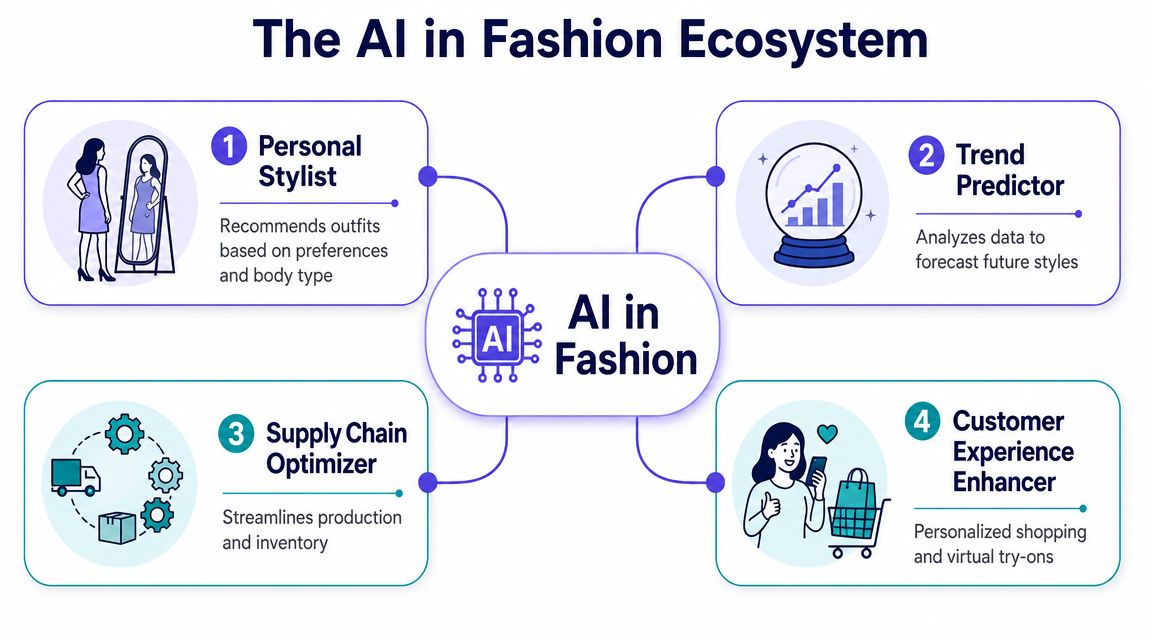
The simplest way to think about AI in fashion is this: it's software that helps fashion businesses and shoppers make better visual decisions faster.
If that still sounds fuzzy, use this analogy. Think of AI as a very fast assistant with an excellent memory. It can scan huge catalogs, notice patterns in images, connect words to visual details, and help turn “I want something like this” into actual options.
What AI does for shoppers
For a shopper, AI usually appears in a few familiar forms:
- Visual search: You start with a photo instead of a keyword.
- Personalized recommendations: Stores surface items based on browsing behavior and style signals.
- Virtual try-ons: You preview how a garment looks on your photo.
- Smarter discovery: Search gets better at understanding vague requests like “quiet luxury cardigan” or “boots like this Pinterest look.”
People often get confused. They assume AI in fashion is mainly about dramatic digital runways or futuristic design labs.
It isn't only that. A lot of it is much more practical. It helps you narrow options, compare styles, and avoid buying something that looked amazing on a model but doesn't match the look you wanted.
What AI does for brands
On the business side, AI has a wider job. It can help brands:
| Area | What AI helps with |
|---|---|
| Design | Generate concepts, explore patterns, organize inspiration |
| Merchandising | Tag products, improve search, connect similar items |
| Inventory | Forecast demand and reduce overproduction |
| Customer experience | Personalize pages, recommendations, and shopping flows |
One useful way to frame fashion and AI is to separate creative help from decision help.
Creative help supports design ideas, campaign imagery, or concept development. Decision help supports things like what to stock, how to rank products, and how to make discovery easier for shoppers.
Fashion AI doesn't replace taste. It supports the steps around taste, including finding, comparing, previewing, and choosing.
That's why it feels less like a sci-fi takeover and more like a new layer on top of shopping and style discovery. The clothes are still the clothes. AI just changes how clearly you can see them before you commit.
The AI Technologies Behind the Trends
Two technologies do a lot of the visible work in fashion and AI. One helps computers “see.” The other helps them “create.”
Computer vision is the visual engine
Computer vision is the part of AI that reads images. It can look at a clothing photo and recognize details such as shape, neckline, sleeve style, texture cues, or whether something is a trench coat, slip dress, or cargo pant.
That matters because fashion shoppers don't always search like databases. People rarely think in perfect product taxonomy. They think in looks.
They say things like:
- “I want boots like this.”
- “Find me a dress with this vibe.”
- “Show me jackets that look like the one in this reel.”
Computer vision helps platforms respond to that. It turns images into searchable information, which is why visual search and image-led browsing are becoming more useful.
Business of Fashion reported that 50% of fashion executives named product discovery as the key application for generative AI, and that shoppers are increasingly using image-based search, prompting platforms such as Zalando and Pinterest to invest in AI assistants and visual search tools, as covered in its report on generative AI, search, and discovery.
Generative AI is the creative layer
Generative AI creates new outputs from prompts or inputs. In fashion, that might mean concept sketches, marketing visuals, styling ideas, product descriptions, or transformed images.
If computer vision says, “this image contains a floral midi dress with puff sleeves,” generative AI can take that understanding and produce something new around it. It might generate a campaign mockup, help explore a design direction, or build a virtual styling preview.
For people curious about the wider toolkit brands are experimenting with, this guide to AI tools for fashion brands is a helpful overview of the category's scope.
Why these two technologies work so well together
Fashion is unusually visual. That's why this pairing matters so much.
Computer vision identifies what's in the image. Generative AI uses that understanding to extend, remix, simulate, or present it in a new way.
A simple breakdown looks like this:
-
See the garment The system reads the product image and notices visual attributes.
-
Understand the intent It connects the image to language, context, and shopper behavior.
-
Generate or rank an output It can return similar products, build a styling suggestion, or create a visual preview.
If you want a closer look at how these tools connect specifically to retail use cases, AI for fashion gives a practical consumer-facing angle.
How AI Is Remaking the Fashion Industry
AI in fashion isn't just about prettier shopping pages. It's changing how clothes are imagined, produced, marketed, and sold.
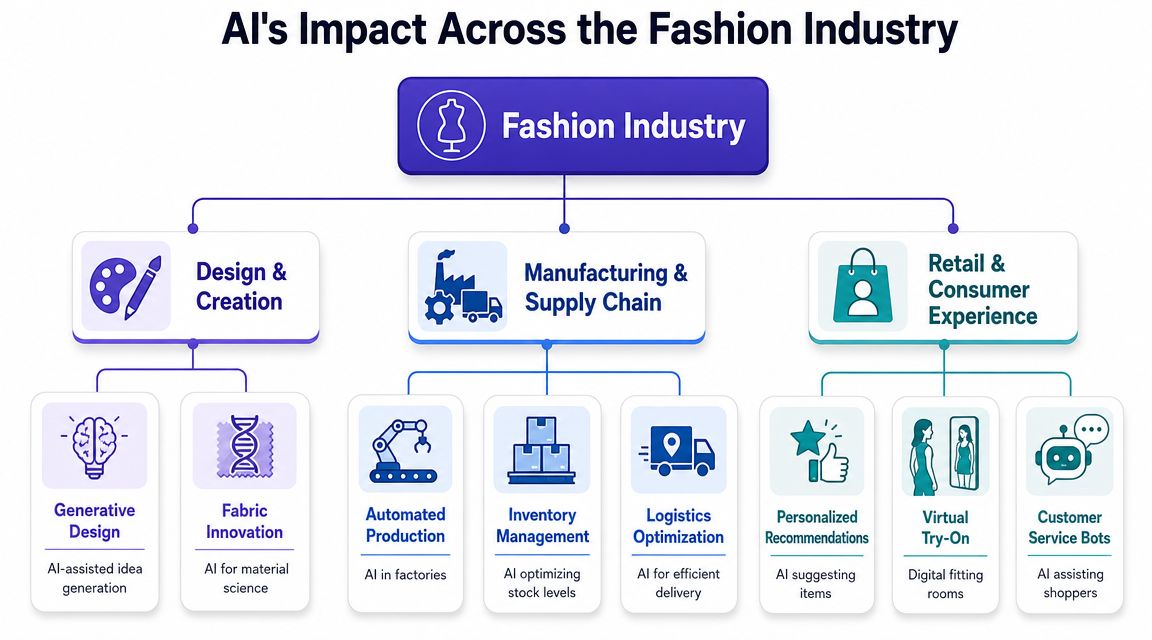
Design is getting faster and more exploratory
Generative systems can help designers test directions quickly. A team can move from references, sketches, and prompts to multiple concept variations without starting each version from scratch.
That doesn't mean AI becomes the designer. It means designers can spend more time judging, refining, and selecting.
For a more hands-on look at how creatives are approaching idea generation, this piece on creating fashion designs with AI shows how AI can support concept development without replacing the human eye.
Production gets smarter when data connects
A lot of fashion waste starts before a shopper ever sees a product. Brands guess what people will want, make too much or too little, and then deal with markdowns, leftovers, delays, or rushed replenishment.
Industry coverage summarized in the verified research describes AI systems that can generate garment patterns, forecast demand using social and sales data, optimize fabric use, and support automated quality control. The practical chain is straightforward: better forecasting can reduce overproduction, pattern optimization can reduce offcuts, and earlier defect detection can reduce waste and returns.
Here's where AI matters most behind the scenes:
- Demand forecasting: Brands analyze signals from sales, trends, and consumer behavior to make more informed production decisions.
- Pattern optimization: Software can help reduce material waste during cutting and planning.
- Inventory management: Teams can connect merchandising and stock data instead of treating each part of the workflow separately.
Better fashion AI often comes from better connected data, not just flashier interfaces.
The business case is already huge
McKinsey estimated that generative AI could add $150 billion to $275 billion to the operating profits of the apparel, fashion, and luxury sectors over the next three to five years, as detailed in its analysis of generative AI in fashion. The same source says 73% of fashion executives ranked generative AI as a top priority, while only 28% were actively using it in product development.
That gap matters. It suggests many companies believe the opportunity is real, but they're still figuring out how to turn scattered experiments into practical systems.
Marketing is becoming more adaptive
AI also changes how brands present products. Teams can create more versions of content, test visual directions faster, and personalize which items appear first for different shoppers.
This is especially important in fashion because buying decisions often depend on context. A shopper isn't only asking, “Is this nice?” They're asking, “Is this me?”
That's why the biggest shifts in fashion and AI often show up in places where taste meets uncertainty. Search, styling, imagery, and discovery all get stronger when AI helps translate inspiration into clearer options.
See Your Style Instantly with Virtual Try-Ons
You're shopping late at night, flipping between Zara, Depop, and Amazon tabs. A jacket looks great on the model. A costume piece looks fun. A dress might work. The problem is familiar. You are still guessing how any of it will look on you.
Virtual try-on turns that guess into a preview.
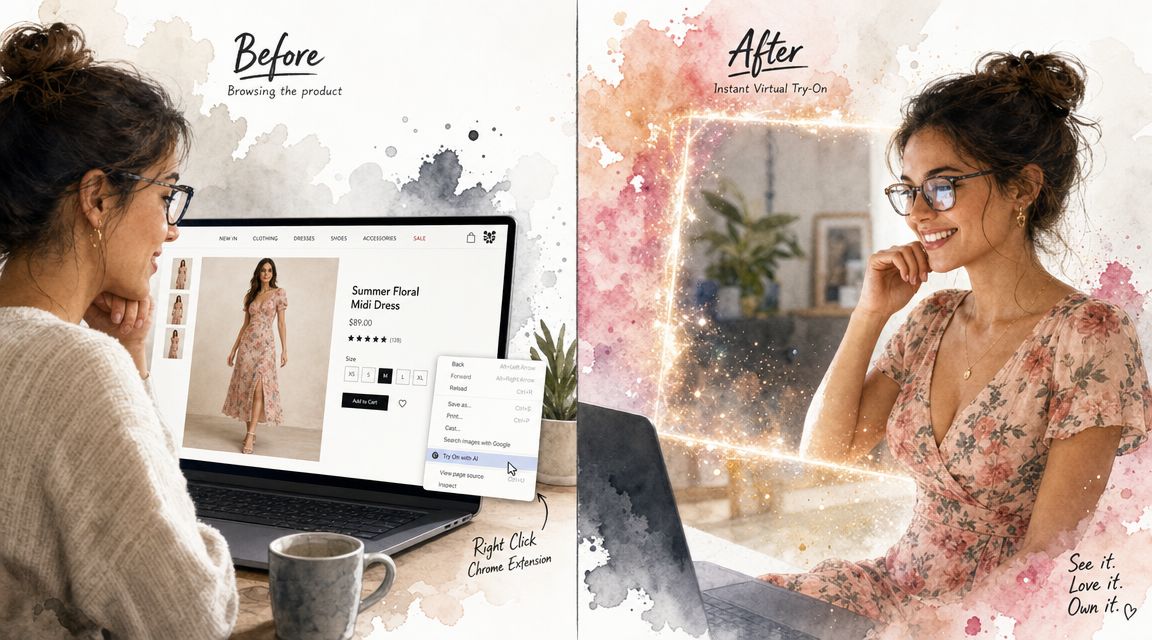
That is why this part of fashion AI feels so immediately useful for shoppers. Instead of asking an algorithm to recommend something based on trends or past clicks, you upload your photo, add a garment image, and check the visual result. It works like holding a digital fitting-room mirror up to your screen.
What virtual try-on is actually useful for
The clearest use case is simple. You want help deciding faster.
Virtual try-on is especially handy in situations where returns are annoying, sizing is inconsistent, or the product photo leaves too much to the imagination.
Some common examples:
- Fast fashion browsing: You are comparing silhouettes across Zara and H&M and want to see which shape suits you better.
- Secondhand shopping: You are browsing Vinted or Depop, where try-before-you-buy usually is not an option.
- Marketplace hunting: You are sorting through options on Amazon fashion and need a quicker visual filter.
- Costume planning: You want to test a Halloween look before buying every piece.
A small detail makes a big difference here. Flat-lay clothing photos usually produce cleaner previews because the shape of the garment is easier for the AI to read. If the item is folded, wrinkled, or photographed at an awkward angle, the result can look less convincing. Good input gives you a better preview, much like better lighting gives you a better mirror selfie.
A practical way to use it right now
One consumer tool built for this is TryThisFit. It lets you upload your own photo with a clothing image and generate a style preview in seconds, without creating an account.
If you are new to the category, what a virtual try-on app is gives a clear explanation of how these tools fit into everyday online shopping.
The easiest way to picture the process is to follow a normal shopping habit:
-
Open a product page
Browse any store or marketplace as usual. -
Grab the clothing image
Use the product photo you want to test. -
Generate the preview
The tool creates a visual mockup so you can judge the vibe before you buy.
This short demo shows the flow in action.
<iframe width="100%" style="aspect-ratio: 16 / 9;" src="https://www.youtube.com/embed/g9ICLvwyGgk" frameborder="0" allow="autoplay; encrypted-media" allowfullscreen></iframe>Why this matters beyond novelty
The primary benefit is not spectacle. It is decision-making.
Online fashion shopping often fails at one specific moment. You can find the item, read the description, and still feel unsure because your brain is doing all the styling work. Virtual try-on reduces that mental load. You stop building a look entirely in your head and start reacting to something visible.
That can save time, cut impulse buys, and help you spot mismatches earlier. A color may clash with your tone. A coat may feel too oversized. A costume accessory may look better in theory than in practice. Seeing that early is useful.
For readers who enjoy the more stylized visual side of AI fashion imagery, the cinematic AI tool is an interesting contrast. It leans toward mood and visual storytelling, while try-on tools focus on practical shopping choices you can make right now.
The Human Side of AI in Fashion
The fun part of AI in fashion is easy to spot. The harder part is knowing what questions to ask.
When a product image looks polished, was it lightly edited or heavily generated? When recommendations feel personal, what data shaped them? When a design appears online, did a human review it or did software push it straight into the shopping flow?
Trust matters as much as convenience
Recent reporting highlighted a growing transparency gap around AI-made and AI-assisted fashion content. As discussed in North Carolina State University's coverage of how the fashion industry is using AI, shoppers often don't get clear answers to basic questions such as whether a product image was AI-edited, whether a recommendation is based on personal data, or whether a human approved a design.
That matters because trust in fashion is already fragile online. People are making decisions from images, descriptions, and recommendations they can't physically verify in the moment.
The more realistic AI visuals become, the more clearly brands need to explain what shoppers are looking at.
How to be a more mindful AI shopper
You don't need to reject AI tools to be thoughtful about them. You just need a few habits.
- Check privacy basics: Look for a clear explanation of how photos and personal data are handled.
- Read the context around recommendations: If a site is personalizing results, it should be understandable that your behavior affects what you see.
- Treat ultra-polished visuals with curiosity: Campaign imagery may be enhanced, generated, or hybrid.
- Use previews as guidance, not certainty: AI can help you visualize style, but it doesn't replace your own judgment.
If you're curious how these experiences compare to older digital fitting concepts, changing rooms on camera is a useful reference point for how the category is evolving.
A healthy future for fashion and AI won't come from pretending the technology is neutral. It'll come from clearer disclosure, better consent practices, and tools that respect the shopper as much as they impress them.
The Future of Your Closet Is AI
The next phase of fashion and AI won't feel like a separate tech layer. It'll feel like shopping finally becoming more visual, more responsive, and less wasteful.
Instead of bouncing between tabs, screenshots, saved posts, and half-remembered product names, shoppers will increasingly move through a smoother loop. See a look. Find similar pieces. Preview the appearance. Save favorites. Compare styles. Decide faster.
That also changes what a wardrobe means online. A try-on history can become a style memory. A saved image can become a future outfit idea. A browsing session can become less about endless searching and more about sharper personal discovery.
For shoppers, that's the promise. AI doesn't need to make fashion colder or more generic. Used well, it can make shopping feel more personal because it helps you see your own taste more clearly.
If you want to keep experimenting with that idea, it helps to save and revisit the looks you test. A simple try-on history page turns one-off previews into a more useful record of what styles you liked.
The future of your closet probably won't arrive as one dramatic invention. It'll arrive in small, practical moments that make fashion easier to explore and easier to choose.
If you want a quick way to start, try TryThisFit to preview how clothing looks on your photo, or install the free Chrome extension to right-click items on shopping sites and see the style in seconds.
Try Virtual Try-On Now
See how clothes look on you before you buy - works with any online store
Get Started Free