How to Buy Extensions: A Complete 2026 Buying Guide
You're probably staring at a dozen tabs right now. One brand says clip-ins are easiest, another pushes tape-ins, a salon recommends keratin bonds, and suddenly buying hair feels more complicated than buying a car.
That confusion makes sense. Hair extensions used to feel like a niche salon add-on, but the category is now enormous. The global human hair extension market was valued at USD 5.36 billion in 2025 and is projected to reach USD 13.36 billion by 2034, according to Fortune Business Insights on the human hair extension market. More options sounds good, but it also means more mediocre products, more mixed advice, and more expensive mistakes.
Your Journey to Longer Fuller Hair Starts Here
The first mistake I see is people shopping by fantasy first. They pick a length, save a celebrity photo, and buy before they've thought about upkeep, attachment method, or whether their own hair can comfortably support that choice.
That's backwards.
Buy extensions the same way a good stylist chooses them for a client. Start with your real hair, your real schedule, and your real budget. Then narrow down the method. Only after that should you obsess over color, length, and glam transformation.
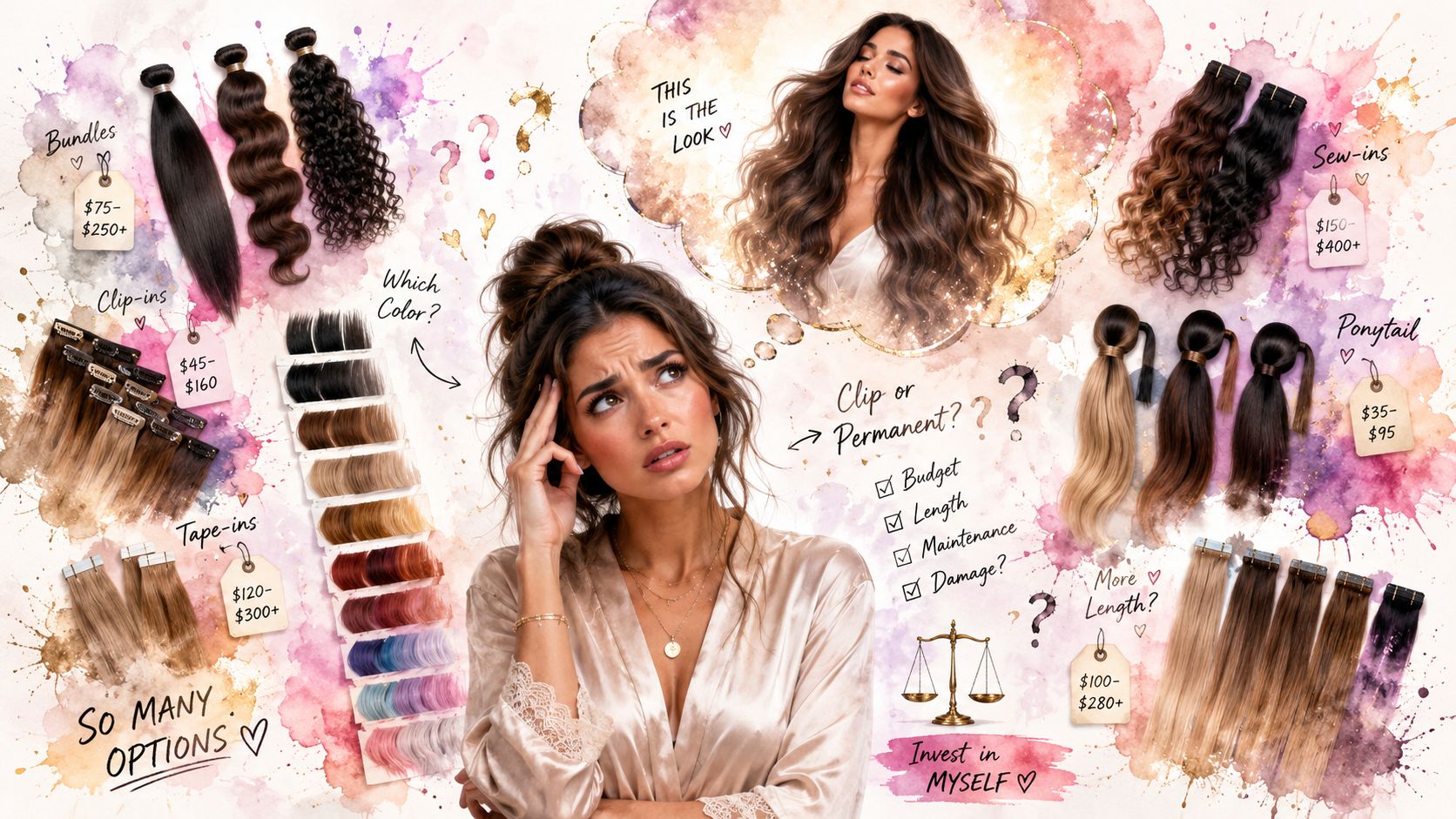
If your goal is fuller hair without sabotaging what you already have, pair extension shopping with habits that encourage supporting natural hair growth processes. Extensions can add length and volume fast, but healthy natural hair still matters because it's the base carrying everything.
What buyers get wrong first
Most first-time buyers focus on three things too early:
- Length obsession: Longer isn't always prettier if the blend looks stringy.
- Lowest price hunting: Cheap hair often gets expensive when it tangles, sheds, or needs replacing too soon.
- Method copying: Your friend may love tape-ins, but her hair density and routine might be completely different from yours.
Practical rule: The right extensions should make your routine easier to love, not harder to survive.
There's also a style-planning angle people overlook. If you're someone who likes seeing the final appearance before buying beauty or fashion items, a more personalized shopping experience can help you make cleaner decisions overall. That mindset matters with extensions too. You're not just buying hair. You're buying how you want to look every day.
My direct advice before you spend anything
Use this order:
- Assess your hair strength and density
- Choose the attachment method
- Set a full budget
- Vet the seller or salon
- Then match texture, color, and length
Do it in that order and you'll avoid most beginner mistakes.
Decoding the Main Types of Hair Extensions
Not all extensions behave the same way. Some are made for occasional wear. Some are meant to stay in. Some are beginner-friendly. Some absolutely require a skilled installer.
Clip-ins
Clip-ins are the easiest place to start if you've never worn extensions before. They're wefts of hair with clips attached, and you put them in and remove them yourself.
The practical workflow matters here. A solid method is to detangle both your natural hair and the extension first, part the target area, match the extension width to the section, insert the comb, and close the clip, as outlined by Donna Bella Hair's extension method guide. That sequence improves blending and helps reduce tension from clipping a piece into the wrong-sized section.
Clip-ins are ideal if you want flexibility. You can wear them for events, weekends, or occasional volume without committing to salon maintenance.
Tape-ins
Tape-ins are thin wefts attached with adhesive tabs that sandwich sections of your natural hair. When installed well, they can lie very flat and look polished.
They're a strong choice for people who want semi-permanent wear and a more natural-looking daily result than clip-ins. They do require upkeep, and if you hate appointments, you'll get annoyed fast.
Sew-ins or weaves
Sew-ins involve attaching extension hair to a braided base or sewn foundation. This method can feel very secure and is often chosen by people who want fullness and longer-term wear.
This is not a casual DIY buy. The install, the tension, and the removal all matter. A bad sew-in can be uncomfortable, bulky, or hard on your scalp.
Keratin or fusion bonds
Keratin extensions attach small strands to your own hair using a bonded method. They can create a very natural movement because the pieces are small and customizable.
They also demand commitment. This method usually costs more, takes longer, and leaves no room for sloppy work. If the installer is careless, your hair pays for it.
Microlinks
Microlinks attach small extension pieces using tiny beads or links, without adhesive. They can look very natural and allow movement, but they still depend heavily on correct placement and hair suitability.
If your hair is fragile, very fine, or prone to breakage, microlinks can be the wrong fit. They're not automatically damaging, but they're also not universally gentle.
Hair Extension Type Comparison
| Type | Application Time | Average Lifespan | Maintenance Level | Best For |
|---|---|---|---|---|
| Clip-ins | Fast, self-applied | Temporary wear | Low | Beginners, occasional styling, low commitment |
| Tape-ins | Salon-applied | Semi-permanent | Medium to high | Flat, natural-looking daily wear |
| Sew-ins | Salon-applied | Longer-term wear | Medium to high | Fuller looks and secure wear |
| Keratin bonds | Salon-applied | Longer-term wear | High | Natural movement and customized placement |
| Microlinks | Salon-applied | Semi-permanent to longer-term wear | High | Clients wanting flexible strand placement |
Don't choose by trend. Choose by how often you want to deal with your hair.
My blunt ranking for first-timers
If you're brand new, I'd steer you like this:
- Safest beginner experiment: Clip-ins
- Best polished daily option for many people: Tape-ins
- Best only with a trusted specialist: Keratin bonds or microlinks
- Best if you already know you like installed hair: Sew-ins
A lot of extension regret starts when someone buys a professional method before they've even learned whether they enjoy the feeling of extra hair.
Choosing the Right Extension for Your Hair and Lifestyle
Most buying guides miss the core issue. They tell you how to match shade and texture, but they don't answer the question that matters: what should you buy for your hair, your routine, and your tolerance for maintenance?
That gap is real. A major underserved angle in buying guides is choosing an extension type for your hair and lifestyle, not just color or texture, as noted in Perfect Locks' texture match guide.
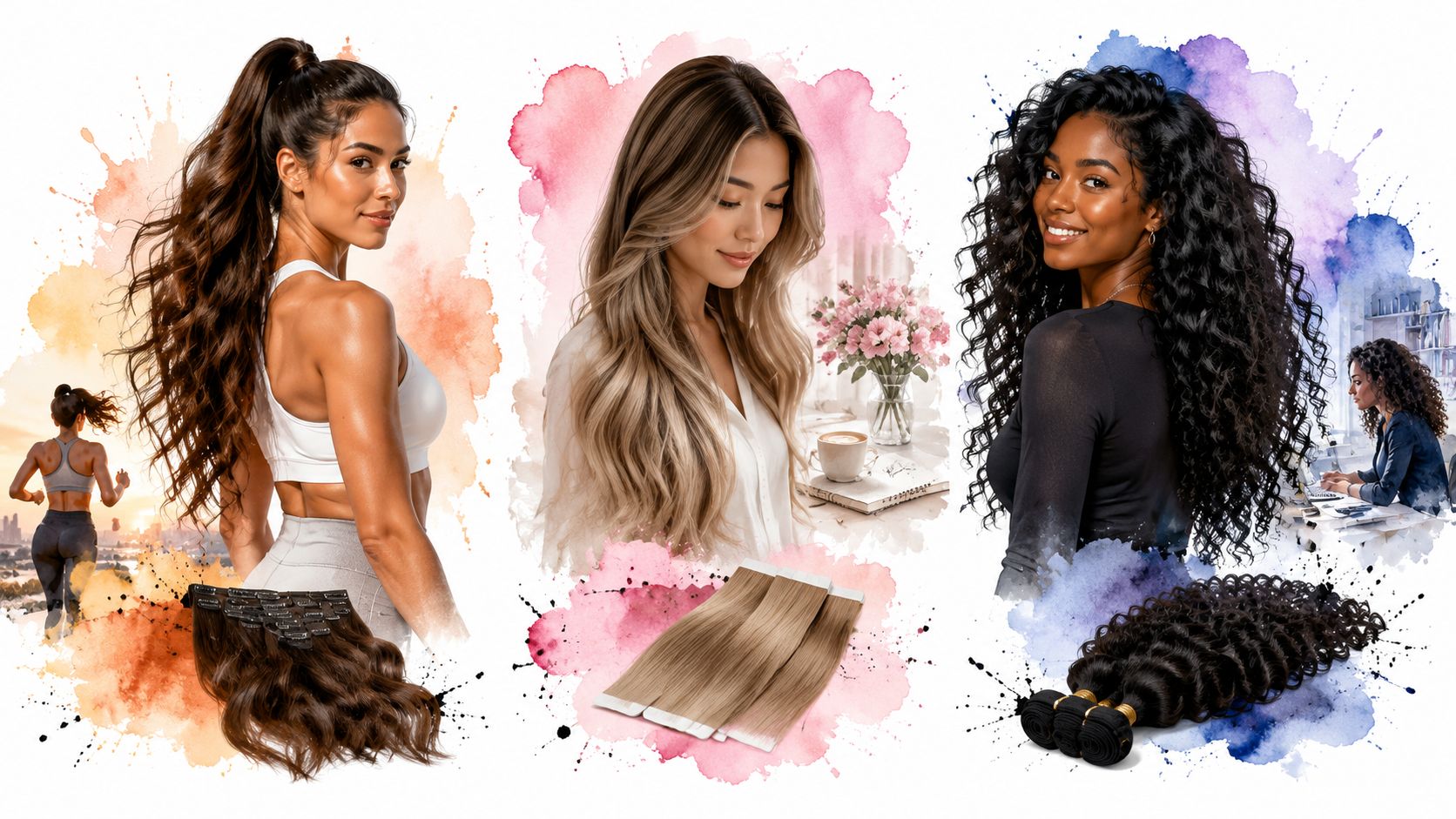
Start with your daily life, not your dream hair
Ask yourself these questions before you buy anything:
- Do you style your hair every day? If not, don't choose a method that demands constant blending and upkeep.
- Do you work out often? Semi-permanent options can be convenient, but sweat, washing frequency, and drying time matter.
- Do you wear your hair up a lot? Some methods hide better in ponytails and half-up styles than others.
- Are you impatient with beauty maintenance? Then don't buy a high-maintenance method because it looked pretty on social media.
If you want the simplest routine, clip-ins or a lightweight temporary option usually makes more sense. If you want wake-up-and-go fullness, salon-installed methods can be worth it, but only if you're honest about follow-up appointments.
Match the method to your hair's tolerance
Fine, fragile hair needs caution. Heavy extensions can expose every weakness in your natural hair if the method is too dense, too long, or too poorly distributed.
Thicker, stronger hair usually handles more options. That doesn't mean anything goes. It means your stylist has more room to build fullness without making the attachment points obvious.
For buyers learning how to buy extensions, I recommend filtering methods like this:
- Fine or delicate hair: Start light. Prioritize low tension and clean placement.
- Medium density hair: You have flexibility, but blending still matters more than length.
- Dense hair: Don't underbuy. Thin extension sets disappear inside thick natural hair.
Your hair type decides what can look natural. Your lifestyle decides what you'll actually keep up with.
A lot of people also benefit from reading broader advice on selecting quality hair extensions, especially when they're trying to balance realism, comfort, and appearance.
A quick self-screen before you buy
If you want a more practical decision filter, use this:
Buy clip-ins if
You want low commitment, you're still experimenting, or you only need volume and length sometimes.
Buy tape-ins if
You want a sleeker everyday result and you're willing to keep maintenance appointments.
Here's a useful visual explainer before you decide on a method:
<iframe width="100%" style="aspect-ratio: 16 / 9;" src="https://www.youtube.com/embed/QtBwXh2-OBc" frameborder="0" allow="autoplay; encrypted-media" allowfullscreen></iframe>Be cautious with bonded or linked methods if
Your hair breaks easily, your scalp is sensitive, or you haven't found a true extension specialist yet.
One more note. If you're the kind of shopper who likes precise prep before making appearance decisions, guides on taking accurate body measurements can build the same useful habit of buying based on your own reality, not generic product photos. Different category, same smart mindset.
Human Hair Versus Synthetic and Understanding Quality
If you can afford human hair and you want the most natural result, buy human hair. That's my opinion, and I don't soften it for first-time buyers.
Synthetic hair has its place. It can work for occasional wear, costume looks, or very short-term use. But if you want softness, movement, better blending, and styling flexibility, human hair is the standard you should compare everything against.
What changes in real life
Human hair generally behaves more like your own hair. It tends to blend better, move better, and style more naturally. Synthetic hair often looks fine in the package and less convincing once you've worn it, brushed it, or tried to make it match your everyday texture.
That doesn't mean every human hair product is good. Plenty of low-quality human hair still tangles, dries out, or sheds badly.
What quality actually looks like
Ignore dramatic grade labels when a seller can't explain the hair clearly. Marketing terms can sound impressive while telling you almost nothing useful.
Instead, check for signs that affect wear:
- Cuticle alignment: Hair that stays aligned is typically easier to manage and less likely to snarl.
- Consistent fullness: Thick-looking ends matter. If the bottom looks thin, the finished style looks weak.
- Texture realism: The extension should resemble your natural pattern, not force you into daily heat styling.
- Transparency: A credible seller should explain the hair type and care expectations in plain language.
If a listing sounds luxurious but avoids specifics, keep scrolling.
My personal filter for quality shopping
I care more about these questions than buzzwords:
- Does the hair look full from top to bottom?
- Does the texture match the client's actual hair pattern?
- Does the seller give clear care guidance?
- Can the brand explain what you're buying without hiding behind jargon?
If the answer is no to two or more, I'm out.
Also, don't let “natural look” trick you into buying too much shine. Extensions that are overly glossy in photos often look less believable in person. I'd rather see soft texture and realistic density than a perfect studio image.
Nailing the Perfect Match in Length Density and Color
You buy 22-inch extensions because the model looks incredible. Two days later, the ends look wispy, the color sits flat against your natural hair, and the whole thing feels like hair you have to manage instead of hair that fits your life.
That usually comes down to three choices. Length, density, and color.
Length should fit your real hair and your real routine
Start with your haircut. Then decide how much change you want.
If your hair is fine, blunt, or shoulder-length, jumping to dramatic length without enough supporting fullness almost always looks disconnected. The bottom gets thin fast. If your goal is believable hair you can wear daily, add length in stages. A modest increase usually blends better, styles faster, and puts less stress on your natural hair.
Texture changes the visual result too. Curly and wavy extensions shrink up once the pattern sets, so the finished look will read shorter than the number on the package. Layered cuts matter as well. The more shape you already have, the more carefully your extension length needs to follow it.
A good question to ask is simple. Do you want thicker hair, a little extra length, or a full before-and-after change? Each one needs a different plan.
Density is what makes extensions look expensive
Clients obsess over inches. Stylists look at fullness first.
Density controls whether the result looks polished or pieced together. Too little hair leaves gaps and see-through ends. Too much hair can feel heavy, obvious, and hard to blend with your own texture and haircut. This is why a lifestyle-first choice matters more than chasing a dramatic result from a product photo. If you wear your hair up often, work out most days, or want quick styling in the morning, moderate density usually serves you better than a huge install.
Use this rule:
- Volume at your current length: choose lighter density that fills out the perimeter
- Added length that still looks natural: choose enough density to keep the ends from turning stringy
- Big transformation: commit to the fullness required, or skip the extra inches
If you are unsure, buy for the look of the ends. Thin ends expose a bad extension purchase immediately.
Color has to match your mids and ends, not just your roots
Root matching is where first-time buyers go wrong.
Extensions live through your mid-lengths and ends, so that is the area that has to blend. Check your hair in natural light. Look at the warmth, the depth, and whether your color is solid or dimensional. Many clients need a blend, not a single flat shade. That is especially true if your hair has highlights, balayage, sun-lightened ends, or fading from old color.
Do not chase a perfect swatch if your hair naturally has variation. Chase a believable blend.
Photos can still mislead you, especially if you are shopping online. Use clear product images, compare them against your hair in daylight, and follow practical smart online shopping tips for beauty purchases before you commit. If you want help in person, a stylist from different types of hair salon businesses can guide you through color matching, cutting, and blending based on how much upkeep you can realistically handle.
Preview the full result, not just the shade card
Color alone is not the decision. You are buying a finished look.
Ask whether the final result will suit your haircut, styling habits, and maintenance tolerance. A shade can be correct and still fail if the length fights your layers or the density overwhelms your natural hair. That is why visual planning matters. As noted earlier, tools that help shoppers preview appearance can improve buying decisions in style categories because they reduce guesswork before you spend.
The best extension match should look like your hair on a very good day. Not like hair you have to wrestle with every morning.
Budgeting for Extensions and Finding Reputable Sellers
If you only budget for the hair, you're not budgeting correctly.
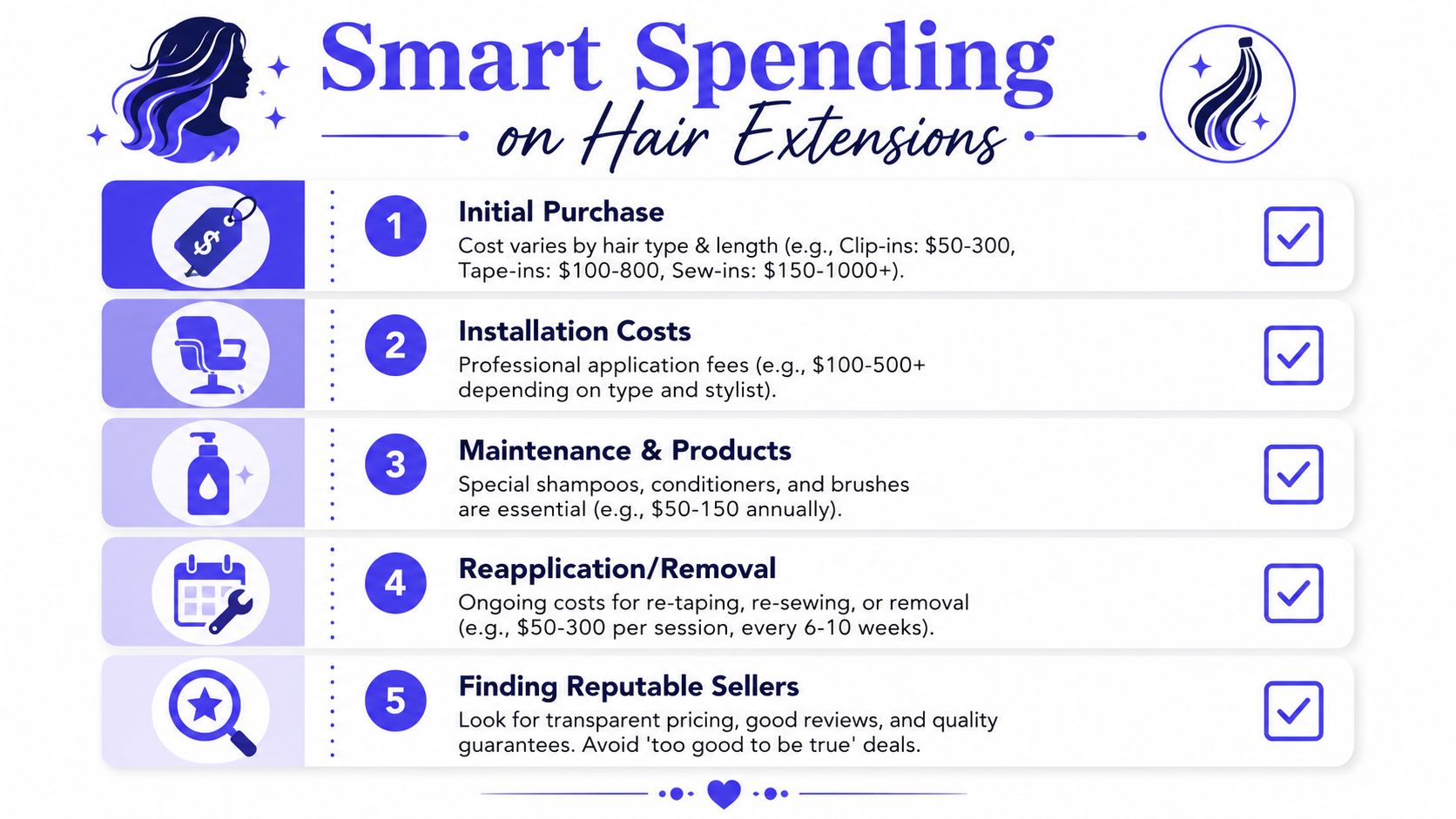
The true cost includes the product, the installation if the method requires it, and the maintenance that follows. According to this 2026 hair extension price guide from Milk + Honey The Hair Lounge, first-time costs for many professional semi-permanent options can range from USD 400 to 1,400+, with hair at USD 200 to 800 and installation at USD 200 to 600. The same guide says temporary options like clip-ins are often USD 100 to 500 for the product alone.
Build your budget the smart way
Don't ask, “How much is the hair?” Ask, “What will this method cost me to own?”
Use this checklist:
- Hair cost: The extension itself
- Install cost: Salon application if needed
- Upkeep cost: Refits, repositioning, removal, or replacement
- Care products: Brushes, shampoos, conditioners, and storage
- Time cost: The appointments and styling effort you'll keep repeating
That last one matters. A method can be technically affordable and still wrong for you if you resent the upkeep.
Know what pricing usually signals
Very low prices can mean lower-grade hair, misleading photos, weak customer support, or all three. Price alone doesn't prove quality, but pricing that looks too good compared with the rest of the market should make you slow down.
Another useful benchmark comes from Perfect Locks' beginner's guide to hair extensions, which notes that human-hair clip-ins or tape-ins commonly start around $300 to $500, while labor-intensive semi-permanent methods such as keratin-bonded or sew-in extensions can push total cost much higher. The same guide also notes that lower-cost clip-ins can be found online for under $100 to about $400.
Cheap hair can still cost you premium money once install, maintenance, and replacement pile up.
Vet the seller before you check out
A reputable seller or salon should make basic trust easy.
Look for these signs:
- Clear return policy: If returns are vague or missing, that's a warning.
- Realistic photos: Consistent images, not stolen-looking glam shots from all over the internet.
- Reachable support: You should be able to ask questions and get direct answers.
- Method honesty: A trustworthy brand won't claim one method suits everyone.
- Care instructions: Good sellers tell you how to maintain the hair after purchase.
If you're booking a service instead of buying product only, it also helps to understand the broader range of types of hair salon businesses. A specialist extension studio, a general salon, and an independent stylist can all operate differently. That affects consultation quality, pricing style, and aftercare support.
My red-flag list
Walk away if you see any of this:
- No meaningful consultation
- No visible policy on returns or exchanges
- Photos that don't match from listing to listing
- Claims that the hair never tangles or never sheds
- Pressure to buy fast
- A method recommendation that ignores your natural hair condition
If you also shop carefully in other categories, practical guides on smart online shopping tips can sharpen the same instincts. Good buying is usually the same skill everywhere. Slow down, compare details, and don't reward vague sellers.
Your Final Checklist and Frequently Asked Questions
Before you buy, stop and run through this list. If you can't answer these clearly, you're not ready to spend yet.
Final pre-purchase checklist
- Method match: Does this extension type suit your real lifestyle?
- Hair suitability: Can your natural hair comfortably support it?
- Quality check: Do you understand what the hair is made of and how it should behave?
- Blend plan: Have you thought through texture, density, length, and color together?
- Budget reality: Can you afford the full ownership cost, not just the first payment?
- Seller trust: Does the brand or stylist look transparent, reachable, and honest?
- Maintenance tolerance: Will you keep up with the care this method needs?
Frequently asked questions
Will extensions damage my hair
They can if the method is wrong for your hair, the install is sloppy, or the upkeep is neglected. The safest path is choosing a method your hair can support and avoiding too much weight or tension.
What's the best option for beginners
Clip-ins are usually the easiest first purchase because they let you test the look and feeling of extensions without long-term commitment.
How long do extensions last
That depends on the method, the quality, and your aftercare. Some methods are meant for temporary wear, while some semi-permanent options stay in longer and need regular maintenance.
Can I dye or heat-style extensions
Human hair usually gives you more styling flexibility than synthetic hair, but that doesn't mean every set should be aggressively processed. If you can buy the closest match from the start, do that instead of planning a corrective color job.
What matters more, color or method
Method. A perfect shade in the wrong attachment system is still the wrong purchase.
Buy for your daily life first. Then buy for your mirror.
If you remember only one thing from this guide on how to buy extensions, let it be that. The prettiest option on the model is not automatically the right option for you.
If you like previewing the appearance of things before you buy, try TryThisFit. I built it to help you see how clothing looks on you in seconds, with no account needed, and the free Chrome extension lets you right-click product images on sites like Zara, H&M, Amazon, Shein, Vinted, and Depop for an instant try-on preview. Flat-lay clothing photos work best, and you can review saved looks anytime in your try-on history.
Try Virtual Try-On Now
See how clothes look on you before you buy - works with any online store
Get Started Free