Measurement Accuracy a Guide to Visualizing Style Online
You're scrolling Zara late at night, you spot a dress you love, and then the hesitation starts. The product photo looks great on the store page, but you still can't tell how that pattern, color, or silhouette will look on you.
That gap is where most online shopping stress lives. Not just “Will this technically fit?” but “Do I even like how this style looks on me?” Those are different questions, and mixing them together causes a lot of second-guessing.
Measurement accuracy sounds like something from a lab manual, yet it's surprisingly useful for shopping. Once you understand what accuracy really means, it gets much easier to judge what a visual shopping tool can do well, where it has limits, and how to get a preview that helps you decide.
Shopping Online Should Be Fun Not Guesswork
You find a jacket during a late-night scroll. On the product page, it looks sharp. On your screen, the color feels right. Then the real question shows up. Will it look like you, or will it feel like a costume once it is on your body and in your mirror?
That moment is where online shopping stops being fun. You are not only checking size. You are trying to predict shape, balance, color, and overall vibe from a few flat photos.
Clothing makes this harder because brand sizing is inconsistent, and why sizes vary so much between labels is its own problem before style even enters the picture. A shirt can match your measurements and still miss your taste. A coat can be technically wearable and still look too boxy, too long, or too loud for the look you want.
Visual tools help by answering a different question. They are not trying to act like a tailor with a measuring tape. They are trying to give you an accurate style preview, something close enough to the actual appearance that you can say yes, no, or maybe with a lot less hesitation.
That shift matters.
Accuracy in this context does not mean perfect size-and-fit measurement from a single product photo. It means a preview that represents the color placement, silhouette, and visual impact well enough to support a shopping decision. The goal is not laboratory perfection. The goal is better judgment before you click buy.
A good comparison comes from photo printing. Small framing choices can change how a picture reads, which is why guides on avoiding cropping 3x5 client prints matter. Virtual try-on works in a similar way. The preview does not need to measure your body like scientific equipment. It needs to preserve the look well enough that your eye can judge the style.
That makes shopping faster, more playful, and a lot less like guesswork.
What Is Measurement Accuracy Really
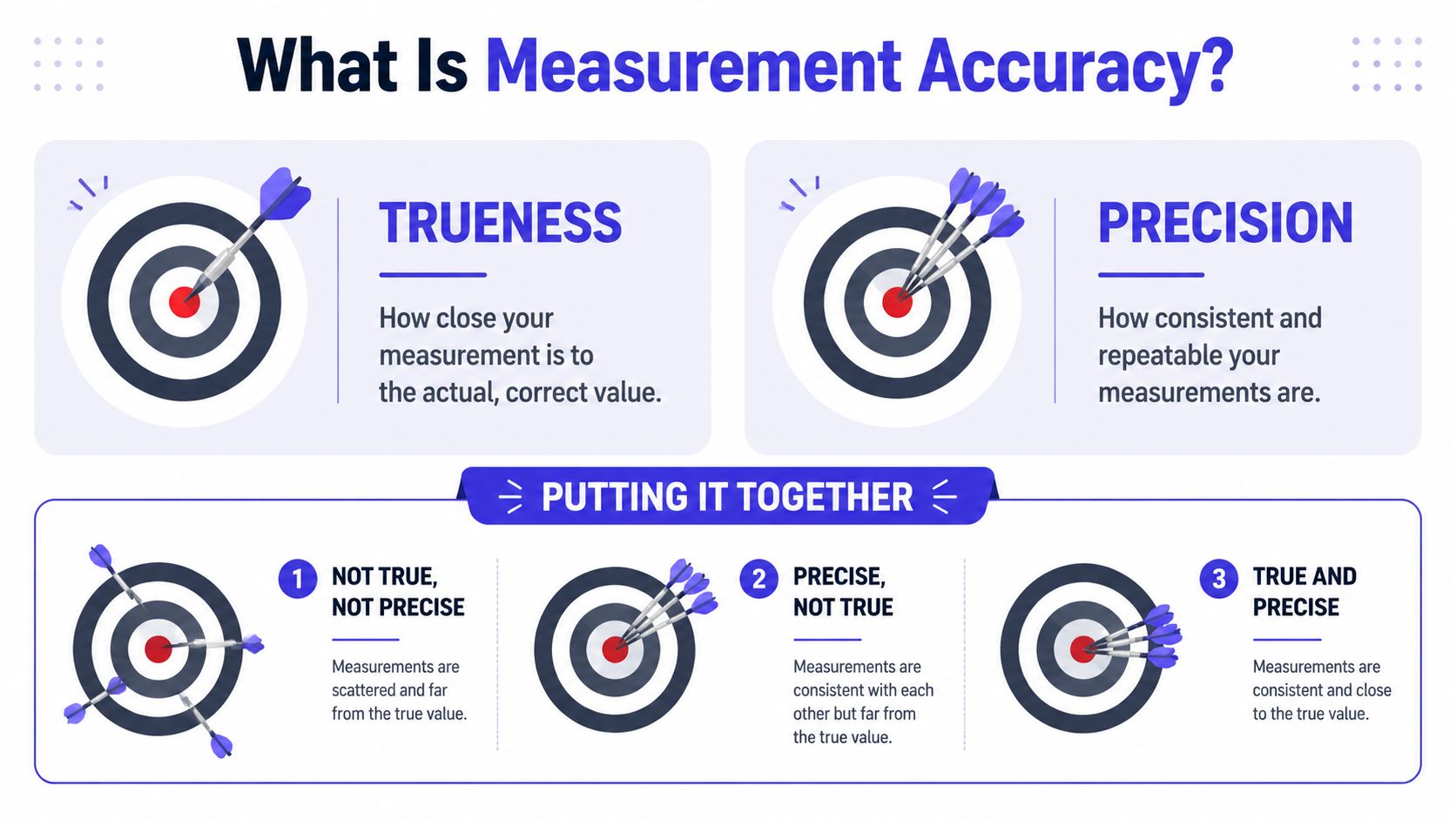
Measurement accuracy has a formal definition. It's the closeness of agreement between a measured quantity value and a true quantity value, and the International Vocabulary of Metrology treats it as a combination of trueness and precision according to this metrology explanation of accuracy.
Trueness means close to the real answer
Think of a dartboard. If your darts land around the bullseye on average, your throws have good trueness. You're close to the true target.
In measurement, that “bullseye” is the actual value you're trying to capture. A system can miss that center in a consistent way, which creates bias. That's why trueness is tied to systematic error.
Precision means consistent results
Now think about throwing three darts that land tightly together, but off to the left side of the board. Those throws are precise because they agree with each other, even though they aren't true.
Precision is about repeatability. If repeated results stay close together, the system has low random variation. That's useful, but precision alone doesn't guarantee accuracy.
Practical rule: Accuracy needs both parts. A result should be close to the true value, and it should be consistent when repeated.
Why people confuse the two
A lot of everyday language treats “accurate” and “precise” like synonyms. Metrology doesn't. That difference is why a tool can feel reliable while still being wrong in a consistent direction.
You see the same confusion in clothing discussions. People often expect one digital tool to tell them everything about shape, drape, proportion, and body-specific outcome. That's part of why debates around sizing can get messy, including topics like vanity sizing and what it does to shopping expectations.
A simple comparison helps:
| Idea | Plain meaning | Dartboard version |
|---|---|---|
| Trueness | Close to the real value | Near the bullseye |
| Precision | Consistent across repeats | Darts clustered together |
| Accuracy | Both at once | Tight cluster on the bullseye |
Visual examples matter here too. If you've ever prepared a photo for printing, you already know small framing errors can ruin the result. That's why guides on avoiding cropping 3x5 client prints are useful. A tiny mismatch in framing changes the final output, even when the image itself seems fine.
Once you understand trueness and precision, the rest of measurement accuracy stops sounding abstract. It becomes a practical way to judge whether a system is giving you a result that is both dependable and close to what you want to know.
From Lab Coats to Laptops How Errors Happen
Errors don't appear because a system is “bad.” They appear because every measurement setup has weak points.
In industrial systems, overall measurement accuracy is limited by the least accurate component in the chain, whether that's the sensor, amplifier, or calibration standard, as explained in this overview of accuracy specifications. That same logic applies far beyond factories.
Two kinds of error show up everywhere
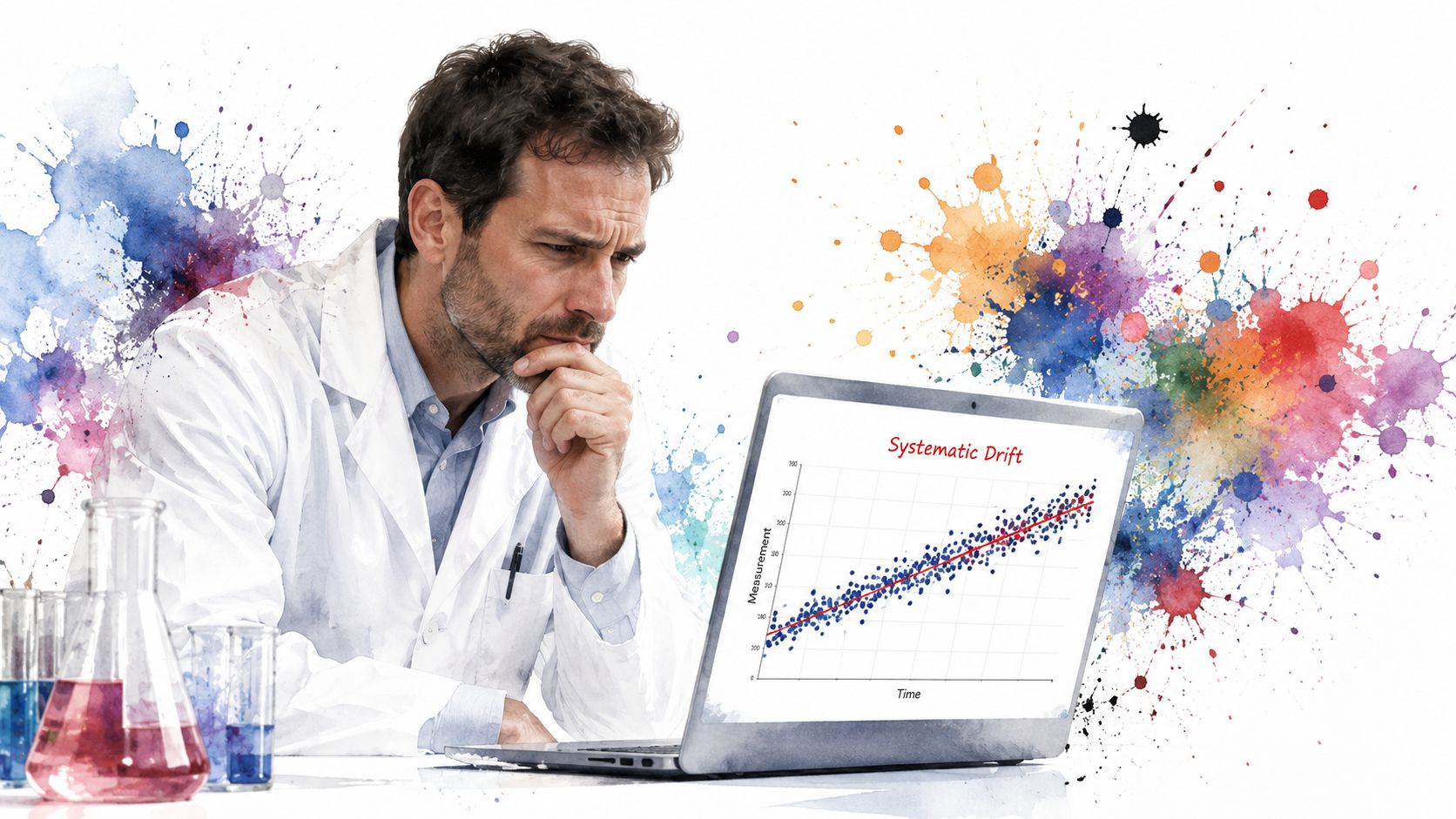
A systematic error is a repeatable push in the wrong direction. If a bathroom scale always reads heavy, that's not random noise. It's a built-in bias.
A random error is the small wobble. One reading is slightly high, the next is slightly low, and the spread comes from inconsistency in the process.
Here's how that looks in daily life:
- Camera angle issues: A photo taken from a strange angle can consistently distort what you see.
- Blur and motion: A shaky image adds unpredictable variation.
- Cropping: Missing part of the object removes useful information before the system even begins.
The weakest link sets the ceiling
People often assume a powerful model can rescue weak input. Sometimes it helps, but it can't fully undo a poor source image.
If the clothing photo is blurry, partially cut off, or visually cluttered, that weakness travels through the entire pipeline. If the user photo has awkward lighting or a confusing pose, the preview has less reliable information to work with. If both images are clean, the result gets much stronger.
A polished result usually starts with ordinary basics done well.
That's why “accuracy” isn't just about one algorithm. It's about the whole chain from source image to final preview. Labs call this a measurement system. Shoppers just feel it as “this preview looks right” or “something seems off.”
Why this matters for digital visuals
Laptops, phones, and shopping tools don't escape measurement problems just because they look sleek. They still depend on signal quality, consistency, and reference points.
A useful way to think about it is this:
| Part of the chain | What can go wrong | What it affects |
|---|---|---|
| Clothing image | Blur, clutter, cut-off edges | Garment shape and detail |
| User photo | Poor lighting, awkward pose | How natural the preview looks |
| Processing step | Inconsistent interpretation | Overall visual believability |
Once you start noticing the chain, a lot of digital confusion clears up. Better input usually beats stronger hype.
How Accuracy Powers Your Virtual Try-On Experience
You open a product page, like the dress on the model, and still hesitate. The question is usually not, “Will this app measure me perfectly?” It is, “Will this style still feel like me once I can see it on my own photo?”
That is the kind of accuracy a virtual try-on can deliver well.
Accurate style preview is the real win
Online shopping decisions often happen at a glance. Two pieces can belong to the same category and still send completely different signals. One blazer looks sharp and structured. Another reads soft and relaxed. A print that seemed fun on the product page can feel too busy once it appears on your image.
Those choices depend on visual judgment, not exact tailoring data.
So it helps to redefine accuracy in the right way. For virtual try-on, accuracy often means a believable preview of color placement, silhouette impression, and overall style mood. It does not mean a guaranteed answer about sleeve length, waist tension, or how a fabric will drape on your specific body in motion.
That distinction matters because it sets a fair expectation. A style tool is strongest when it helps you answer, “Do I like this look on me?”
Why a good preview still depends on measurement ideas
The word measurement can sound clinical, but the basic idea is simple. A system observes something, interprets it, and produces a result. In a lab, that result might be a number. In virtual try-on, it is a visual preview.
A camera and AI model work a bit like a measuring instrument for appearance. They read edges, color regions, garment outlines, and body position, then assemble a new image from those cues. AI Image Detector's guide gives a useful overview of how image-recognition software reads visual inputs.
If those visual cues are clear, the preview tends to feel believable. If the cues are incomplete, the system can still create something helpful, but you should treat it as a style reference rather than a fit promise.
Why fit is a different question
Many shoppers find this aspect challenging. A flat-lay photo can show the garment clearly, which makes it strong for style preview. But a flat-lay does not show how the fabric stretches, where it grips, or how it hangs on your exact frame.
That is why style accuracy and fit accuracy should stay separate in your mind. If you want more context on the sizing side, this guide to AI body measurements and their limits explains what these tools can and cannot estimate.
A good virtual try-on earns trust by staying honest about its job. It helps you preview the look. It gives you a clearer sense of whether a piece matches your taste, your vibe, and the rest of your wardrobe.
That is real accuracy too.
Get Visually Accurate Previews with This One Tip
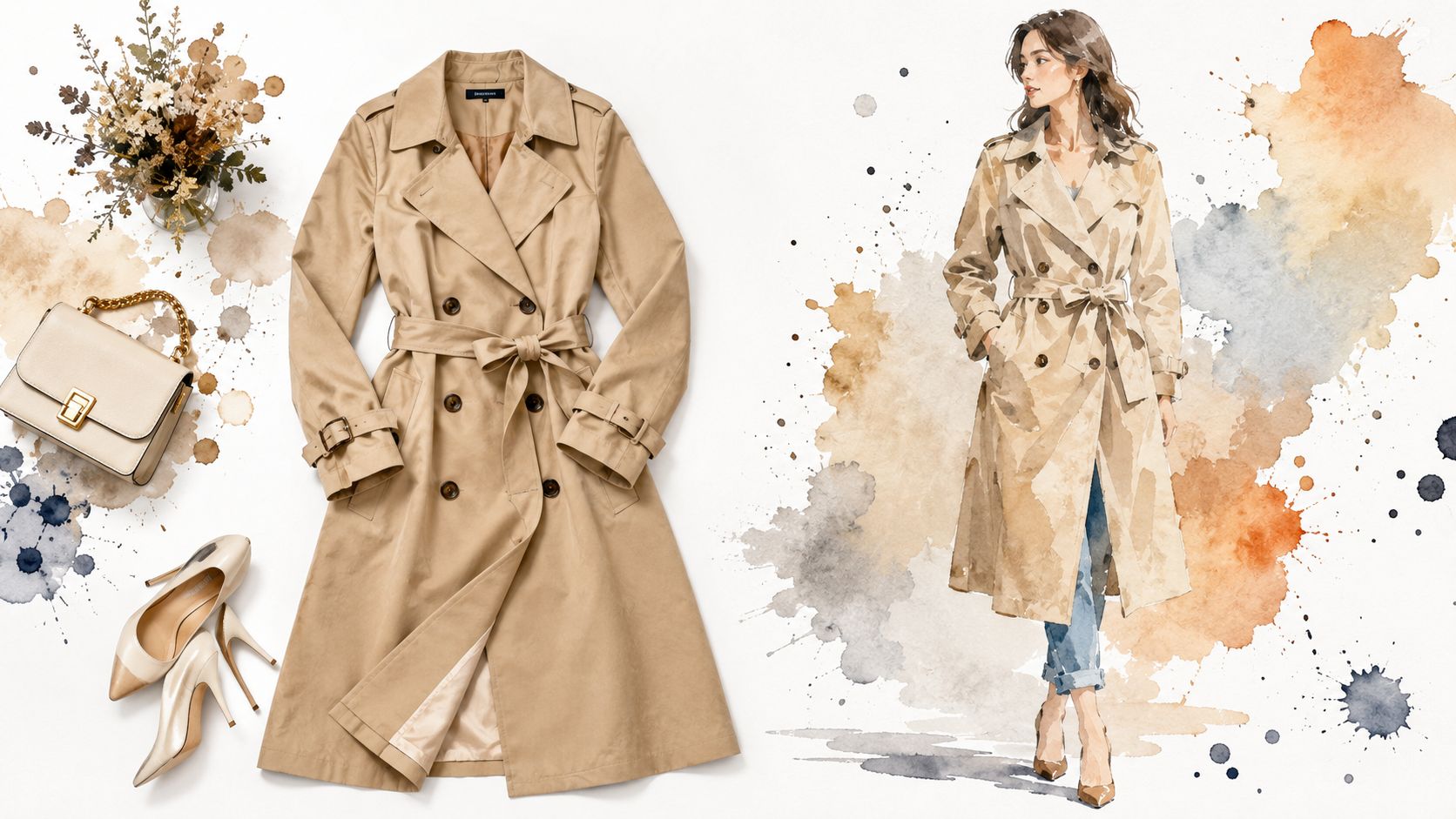
You open a product page, spot a jacket you love, and want one quick answer before you buy. Will this look right on me? The fastest way to get a trustworthy preview is to use a flat-lay clothing photo, because it shows the garment clearly and keeps the focus on style, shape, and color, as explained in this flat-lay clothing photography guide.
Why this one tip matters so much
A flat-lay photo works like a clean blueprint. The system can read the garment's outline, color areas, neckline, sleeves, and overall silhouette without also trying to untangle a model's pose, hair, or background.
That improves the kind of accuracy that matters most in virtual try-on. You get a better style preview.
That distinction matters. The goal here is not a perfect measurement of how fabric will cling, stretch, or drape on your exact body. The goal is a believable visual mockup that helps you judge taste, proportions, and outfit direction before you spend money.
A few habits make that preview stronger:
- Show the whole garment: Cropped sleeves or missing hems give the tool less to work with.
- Use even lighting: Cleaner light keeps colors closer to what the item really looks like.
- Keep backgrounds simple: Visual clutter can compete with the clothing details.
- Choose sharp images: Crisp edges help the system separate one part of the garment from another.
If you photograph your own garments, image sharpness matters too. Product photos often lose detail during editing or enlargement, so MyImageUpscaler's advice on sharp text is a helpful reference for preserving clean visual information.
A quick way to use this while shopping
This tip is practical because it fits real shopping behavior. You are comparing a few listings, checking colors, and deciding whether a piece matches your style. A clear flat-lay lets the tool spend more effort on showing you the look, not guessing where the garment begins and ends.
If you want a practical walkthrough, this guide on how to take accurate body measurements helps clarify the line between body measurement tasks and visual style previews. Keeping those jobs separate makes the results easier to judge and more useful.
A short demo makes the flow easier to grasp:
<iframe width="100%" style="aspect-ratio: 16 / 9;" src="https://www.youtube.com/embed/R_dezdfe4XQ" frameborder="0" allow="autoplay; encrypted-media" allowfullscreen></iframe>Find Your Style with Confidence Today
You spot a jacket late at night, open a virtual try-on, and want one clear answer before you buy. Does this look like you?
That question addresses the core meaning of measurement accuracy in online fashion. Here, accuracy means a preview that represents the style in a believable way on your image. It does not mean a product photo can deliver perfect size, fabric behavior, or tailor-level fit. Once you separate those jobs, the tool becomes much easier to judge and much more useful.
A good virtual try-on works like a dressing-room mirror for style decisions. It helps you check the visual story first. Does the color suit you? Does the neckline feel right? Does the silhouette match the mood you want, whether you are testing a secondhand jacket from Vinted or Depop, comparing basics from Zara or H&M, or trying out a costume idea for one night?
That kind of accuracy changes how shopping feels:
- You decide faster: A visual preview gives you more to work with than a small product thumbnail.
- You screen out weak options earlier: Styles that clash with your taste are easier to spot before checkout.
- You try more interesting looks: A preview lowers the risk of experimenting.
- You feel calmer while shopping: You are choosing with clearer context, not pure guesswork.
A style preview is not a final verdict. It is a better starting point.
If you already have a few looks in mind, comparing them side by side can help more than staring at separate product pages. Saved previews are handy for event planning, wardrobe updates, or those moments when two options both seem right until you see them on the same person, you.
If you want to start with your own images, revisit past results, or compare looks you've already tested, it helps to use tools that keep the process simple. You can try clothes from store pages, upload your own image, and check saved previews later when you want to compare looks side by side.
If you want the fastest way to visualize style online, try TryThisFit. You can preview how clothes look on you in seconds, use the free Chrome extension for right-click try-ons on shopping sites, and revisit saved looks anytime in your history. No account is needed to get started, so you can jump in right away and see how it looks.
Try Virtual Try-On Now
See how clothes look on you before you buy - works with any online store
Get Started Free