What Is Sustainable Fashion and How Does It Work
So, what is sustainable fashion, really? It's more than just a trend; it's a whole new way of thinking about our clothes. It’s a movement dedicated to completely rethinking how fashion is made and consumed, aiming for a system that’s kinder to our planet and its people.
At its heart, sustainable fashion looks at the full lifecycle of a product. I'm talking about everything from the seed planted in the ground to the shirt on your back, how you care for it, and what happens when you’re done with it. It's the powerful antidote to the ‘wear it once, then toss it’ mentality that fast fashion has championed for far too long.
Decoding Sustainable Fashion and Its Growing Importance
Think about the story behind two different t-shirts. One is cranked out by a fast fashion giant, designed to be disposable and destined for a landfill. The other is crafted with care, built to last, and made with total respect for the hands that made it and the earth it came from.
That’s the difference. Sustainable fashion isn't just a catchy phrase; it's a commitment to a better way. And it’s catching on, big time. The sustainable fashion market is expected to explode, reaching an incredible USD 17,769.2 million by 2032! Why? Because shoppers are waking up.
More Than Just Materials
When people hear "sustainable fashion," they often jump straight to organic cotton. While that’s part of it, the real picture is so much bigger. It’s a holistic philosophy that balances three crucial pillars:
- Environmental Impact: This is all about treading lightly on our planet. It means slashing water usage, cutting carbon emissions, ditching toxic chemicals, and embracing materials that are either renewable or recycled.
- Social Responsibility: This is the human side of the equation. It demands fair wages, safe working conditions, and ethical treatment for every single person in the supply chain.
- Economic Viability: This is about creating a system that can thrive without exploitation. It’s about supporting local artisans and building a circular economy where clothes are endlessly reused, repaired, or recycled.
Sustainable Fashion vs Fast Fashion at a Glance
To really get a feel for the difference, let’s put these two models side-by-side. It’s a classic tale of quality versus quantity, mindfulness versus mindlessness.
| Aspect | Sustainable Fashion | Fast Fashion |
|---|---|---|
| Production Speed | Slow, thoughtful, seasonless | Rapid, trend-driven, 52+ "micro-seasons" |
| Material Sourcing | Organic, recycled, low-impact materials | Synthetic, resource-intensive fabrics |
| Labor Practices | Fair wages, safe conditions, transparency | Often exploitative, low wages, unsafe |
| Product Lifespan | Designed for durability and longevity | Built to be disposable after a few wears |
| Environmental Focus | Minimal waste, circularity, conservation | High waste, pollution, overconsumption |
| Consumer Mindset | Buy less, choose well, make it last | Impulse buys, disposability, trend-chasing |
Seeing them laid out like this makes the choice pretty clear, doesn't it? One path leads to a healthier planet and happier people, while the other continues a destructive cycle.
A Mindful Approach to Consumption
Ultimately, sustainable fashion is an invitation to become a more conscious consumer. It encourages us to pause and ask the important questions: Where did this come from? Who made it? What impact is it having?
The consequences of mindlessly buying into fleeting trends are staggering. You can dive deeper into the real cost of our shopping habits by exploring the environmental impact of fast fashion.
This mindful mindset isn't just about your closet. The same principles apply to all areas of our lives. For another great example, check out how Refurbished iPhones and Sustainability are connected, showing how smart choices can reduce our overall environmental footprint.
The Three Pillars of Sustainable Fashion
To really wrap your head around sustainable fashion, picture a sturdy, three-legged stool. If you kick out even one of those legs, the whole thing topples over. The three legs—Environmental, Social, and Economic—are all essential.
Real sustainability is so much more than just switching to organic cotton. It’s a complete vision for an industry that supports both the planet and its people.
The Environmental Pillar: Planet First
When most of us hear "sustainable," our minds jump to the environmental side of things, and for good reason. This pillar is all about protecting our planet by shrinking fashion's massive ecological footprint.
This means a pretty radical shift in how we make clothes. Forget about water-guzzling crops and toxic chemical dyes; this is all about championing resource conservation and slashing pollution.
This shift involves:
- Slashing water consumption: Traditional cotton is notoriously thirsty. Sustainable alternatives like organic linen or hemp need a fraction of the water to grow.
- Ditching toxic chemicals: Choosing natural dyes and avoiding nasty pesticides is a huge win. It protects our waterways and keeps our soil healthy.
- Boosting biodiversity: Organic farming practices help maintain the complex, healthy ecosystems that our planet depends on to thrive.
- Cutting down on waste: The goal is to keep textiles out of our overflowing landfills. This means designing patterns more efficiently or creating new pieces from recycled materials.
The Social Pillar: People Over Profit
Next up is the social pillar, and honestly, this is the real heart and soul of the sustainable fashion movement. This leg of the stool demands that we put people first. It’s about ensuring every single person involved in making our clothes is treated with dignity, fairness, and respect.
This is the polar opposite of the exploitative labor practices that have been the dirty secret of the fast fashion industry. It’s about finally acknowledging the humanity behind our clothes. Fair wages aren't a perk; they are a non-negotiable human right.
This pillar champions ethical labor, demanding safe working conditions, fair pay, and the empowerment of garment workers everywhere. It’s about building a fashion industry where exploitation simply has no place.
This chart really drives home the difference between the two models, highlighting how sustainable fashion focuses on people, the planet, and creating things that last.
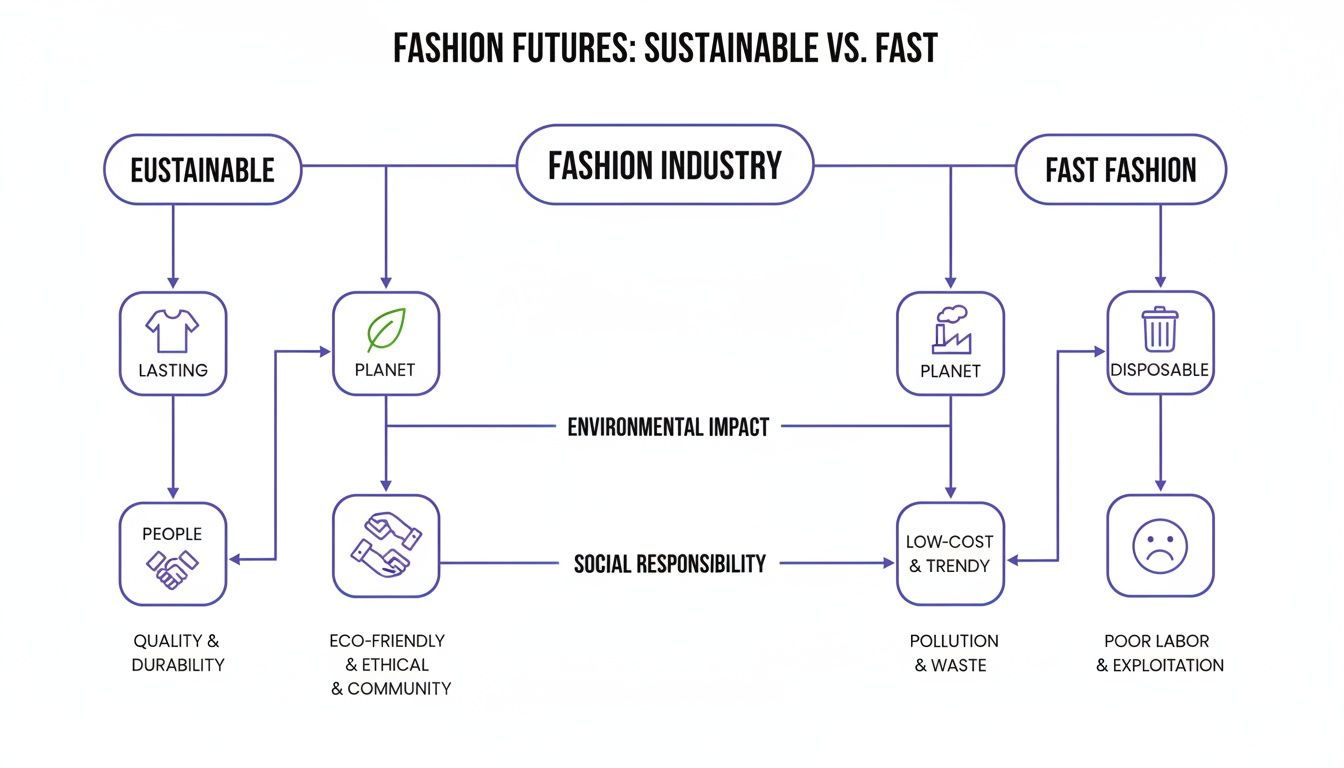
It’s a simple but powerful comparison. Sustainability isn't just about a single product; it's about an entire system built on lasting quality and ethical treatment.
The Economic Pillar: Purposeful Profit
Finally, we land on the economic pillar. This is where sustainability gets down to business, proving that you can absolutely run a profitable company that also does good in the world. This isn't about rejecting profit; it’s about reimagining it.
A massive part of this is the push for a circular economy. Instead of fast fashion’s destructive "take-make-waste" pipeline, a circular approach designs waste out from the very beginning. Clothes are made to be durable, easily repairable, and eventually, recyclable.
This approach also breathes life back into local economies by supporting small-scale artisans and nearby production. When we make thoughtful choices about where we spend our money, we’re casting a vote for a system that values longevity over fleeting trends.
A Guide to Sustainable Materials and Certifications
Ready to become a savvy, conscious shopper? This is your field guide to decoding clothing labels like a pro. Understanding the fabrics and certifications that go into your clothes is one of the most powerful things you can do.
Let's dive into the world of sustainable fabrics. Think of these not just as materials, but as brilliant innovations designed to lighten fashion's heavy footprint on our planet.
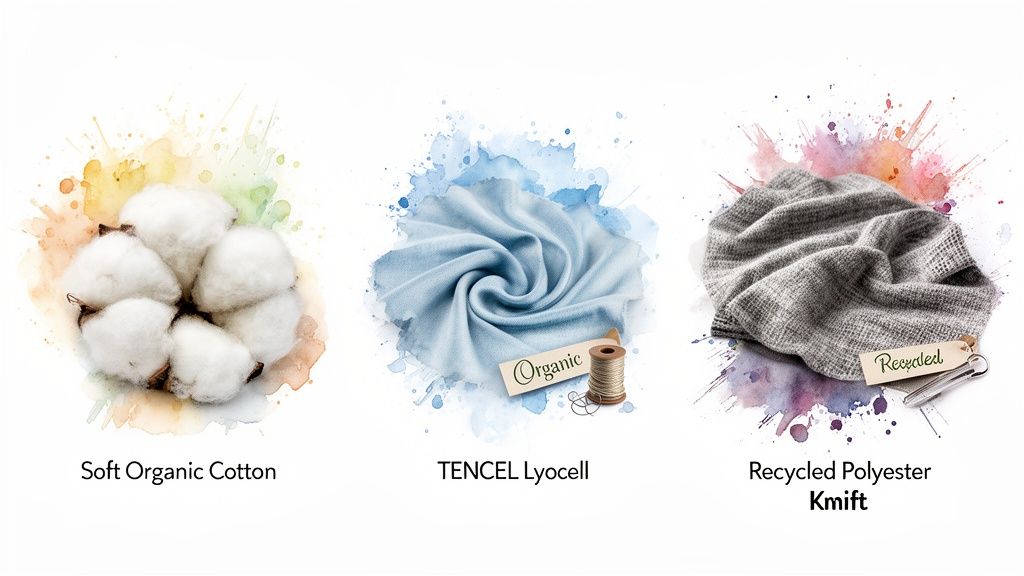
Next Generation Sustainable Fabrics
Keep an eye out for these game-changers next time you're shopping. They represent a huge leap forward from the materials we're used to.
- TENCEL™ Lyocell: This fabric is an absolute superstar. It's made from sustainably sourced wood pulp in a "closed-loop" system, which means over 99% of the water and solvents get captured and reused.
- Hemp: This is one of the toughest natural fibers out there. Hemp is amazing because it barely needs any water to grow, thrives without pesticides, and even returns nutrients to the soil it grew in.
- Recycled Polyester (rPET): This clever material gives old plastic bottles a fantastic second life, keeping them out of our landfills and oceans. By using rPET, we drastically cut down our dependence on virgin petroleum.
Decoding Fashion Certifications
Okay, let's talk about those little logos you see on clothing tags. They can seem confusing, but think of them as your trusted allies. They’re proof that a product meets high standards for both environmental and social responsibility.
To really get a handle on ethical sourcing, understanding important textile certifications like the Oeko-Tex Standard 100 certification is key to knowing a product is safe and truly sustainable.
A certification isn't just a label; it's a promise. It represents a brand's commitment to being transparent and accountable, all the way from the farm to the finished garment.
Navigating all the different labels can feel like learning a new language. To make it easier, here's a quick-reference guide to some of the most trustworthy certifications you'll come across.
Common Sustainable Fashion Certifications
| Certification | What It Guarantees | Look For It On |
|---|---|---|
| GOTS (Global Organic Textile Standard) | Ensures textiles are made with at least 70% certified organic natural fibers and meet strict environmental and social criteria throughout the entire supply chain. | Cotton t-shirts, denim, bedding |
| Fair Trade Certified | Guarantees that workers receive fair wages, work in safe conditions, and can invest in their communities through a Community Development Fund. | Apparel, coffee, chocolate |
| B Corp Certification | Verifies that a company meets high standards of social and environmental performance, accountability, and transparency across all areas of its business. | Entire brands (e.g., Patagonia) |
| Cradle to Cradle Certified® | Assesses products for safety to humans and the environment and designs for a circular economy, focusing on material health and reuse. | Innovative fabrics, dyes |
Spotting these labels is a fantastic way to support brands that are genuinely doing the right thing. It’s a small action that makes a big difference.
Making informed choices starts with knowing what to look for, but it ends with feeling confident in what you buy. Before you click "buy," why not see how the style actually looks on you? Try it now at trythisfit.com and make sure your next sustainable purchase is also your best one yet.
How to Build a Sustainable Wardrobe You Love
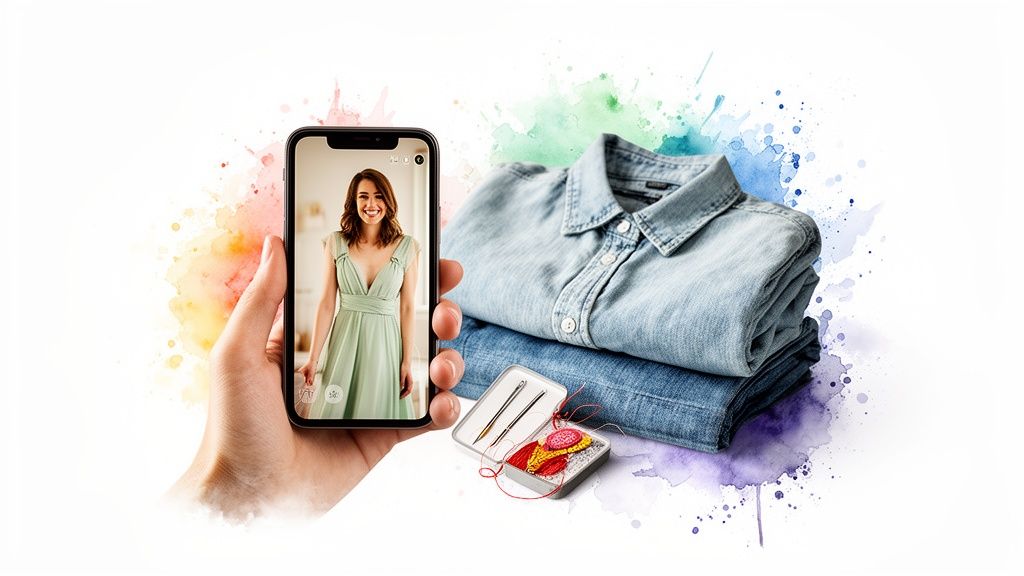
Let's dive into building a sustainable wardrobe you'll actually love to wear, and let's make it fun and completely overwhelm-free! This is all about progress, not perfection. It’s about making small, mindful changes that add up to a huge impact.
Honestly, the most sustainable clothes are the ones already hanging in your closet. When you shift your mindset from chasing fleeting trends to cherishing pieces you truly feel great in, you’re already taking a massive step.
Mindful Shopping Starts Before You Buy
The golden rule of a sustainable wardrobe is simple: buy less, but choose better. Before you even think about adding something new, it pays to pause and ask a few key questions to shut down those impulse buys.
A fantastic mental tool is the '30 Wears Test.' Before you pull the trigger on a purchase, ask yourself: "Will I honestly wear this at least 30 times?" This one little question forces you to think about longevity and versatility.
Another huge part of making fashion more sustainable is cutting down on waste from returns. We’ve all been there—ordering something online, only to find the style just isn't right. That's why being able to visualize how an item looks before you buy is a total game-changer.
Visualize Your Style and Reduce Waste
I actually created the TryThisFit app for this very reason. It’s a tool designed to help you make confident decisions, avoiding that wasteful cycle of buying and returning. You just upload a photo of yourself and a flat-lay photo of a garment to see how the style looks on you in seconds.
Whether you're eyeing a dress on Amazon, a top on Zara, or a unique find on Vinted, you can preview its appearance without ever leaving your home. It’s an amazing way to make sure you'll absolutely love how it looks.
By seeing how an item looks first, you’re not just saving yourself time and money—you’re actively preventing a perfectly good piece of clothing from potentially ending up in a landfill.
Ready to make smarter shopping decisions? Try it now at trythisfit.com and see your next favorite outfit before you buy.
Master the Art of Secondhand Shopping
Speaking of Vinted and Depop, secondhand shopping is one of the most exciting and sustainable ways to refresh your wardrobe. You're giving beautiful clothes a second life, keeping them out of the waste stream.
The global appetite for ethical options is booming, with clothing expected to command a 48% market share in the sustainable fashion world. If you want to dive deeper, you can explore detailed insights on the sustainable fashion market.
Shopping secondhand has never been easier, especially with tools that take out the guesswork. You can find incredible, high-quality pieces from brands like H&M or even Shein for a fraction of the original price. The only real downside is you can't try them on—until now.
The TryThisFit Chrome extension I built makes secondhand shopping a breeze. It installs in a couple of seconds, and then you can just right-click on any clothing photo on any site—like Zara, H&M, Vinted, or Depop—to instantly see how the style looks on you. It works perfectly for those flat-lay images you see all over secondhand sites.
You can install the free Chrome extension in seconds and start browsing with total peace of mind. For more inspiration, check out our guide on awesome alternatives to fast fashion.
Simple Tricks to Care for Your Clothes
Once you’ve curated a wardrobe you adore, the next step is making it last. Proper care is sustainability in action.
Here are a few simple tips that make a world of difference:
- Wash Less and on Cold: Most clothes don't need a wash after every single wear. When you do run a load, use cold water to save energy and keep your colors from fading.
- Air Dry Everything: Ditch the dryer whenever you can. It's harsh on fabrics and uses a ton of energy. Line-drying keeps your clothes looking newer for so much longer.
- Learn Basic Mending: A loose button or a tiny tear doesn't have to be the end of a garment. Learning a few simple sewing skills is incredibly empowering and can extend the life of your favorite pieces for years.
The Hidden Environmental Cost of Online Returns
Let's pull back the curtain on a massive source of fashion waste: the endless cycle of online shopping returns. It feels so simple, right? Just click a button and send it back. But every time we do, we trigger a chain reaction that leaves a surprisingly large carbon footprint.
Think about the journey that package takes. That whole trip—what the industry calls "reverse logistics"—relies on trucks, planes, and vans, all guzzling fossil fuels.
Here's the really shocking part: a huge number of returned items never even make it back on the shelf. For many brands, it’s actually cheaper to just throw perfectly good clothes away than to pay someone to inspect, steam, repackage, and restock them.
The Staggering Impact of Returns
When you start looking at the numbers, the scale of the problem is just mind-boggling. Each return doesn't just create transport emissions; it also generates a mountain of packaging waste.
And it gets worse. This system feeds a broken model where less than 1% of clothing is ever actually recycled into new garments. With fast fashion already accounting for 10% of global CO2 emissions, we have to stop the waste before it starts. If you want to dive deeper into these figures, you can discover more insights on fast fashion statistics.
This is where you—yes, you!—can make a massive difference. The single most powerful thing you can do is prevent that return from ever happening.

How to Break the Cycle with Smart Shopping
By using a virtual try-on tool, you can tackle this waste head-on. It’s all about making a confident, informed choice from the get-go. Before you add that H&M dress or Shein top to your cart, you can see how its style actually looks on your body, taking all the guesswork out of the equation.
That's exactly why I created TryThisFit. The app lets you visualize the cut and style on yourself, helping you avoid a purchase that was destined to become another wasteful return statistic. When you're curious about a piece, you can learn more about how a virtual try-on works.
A confident purchase is a sustainable purchase. When you know an item’s style will work for you, you’re less likely to return it, directly reducing emissions and the risk of that item ending up in a landfill.
This makes shopping everywhere—from big retailers like Zara and Amazon to secondhand marketplaces like Vinted and Depop—so much easier. The free Chrome extension I developed installs in a couple of seconds. Just right-click on any flat product photo online, and you'll get an instant style preview.
Ready to put a stop to wasteful returns? Install the Chrome extension in 5 seconds and start shopping with the confidence that you're making a better choice for your wardrobe and the planet.
Your Next Steps on the Sustainable Fashion Journey
<iframe width="100%" style="aspect-ratio: 16 / 9;" src="https://www.youtube.com/embed/ARN4xSc-4hI" frameborder="0" allow="autoplay; encrypted-media" allowfullscreen></iframe>Alright, you're now armed with the insights to genuinely shake things up in the fashion world! Diving into sustainable fashion isn't some all-or-nothing race to perfection. It’s all about the small, thoughtful choices that build on each other, day after day.
Every single step, no matter how tiny it feels, is a vote for a healthier planet and a fairer industry.
Remember, this is a movement for everyone. You don't need to throw out your entire closet. The real change happens when you start to see the value in what you already own and get more intentional about anything new you decide to bring into your life.
Your Mission, Should You Choose to Accept It
Feeling fired up but a little unsure of where to begin? No problem. The best way to get started is with a few simple, concrete actions. Think of them as fun, one-day missions.
- Mend One Thing: Got a shirt with a loose button? A pair of jeans with a tiny tear? Spend a few minutes fixing it. This simple act of care is the heart and soul of sustainability.
- Try One Secondhand Purchase: Pop into a local thrift shop or browse an online marketplace like Vinted or Depop. You’ll be blown away by the incredible pieces you can find.
- Wear Something You Haven't in a Year: Go on an adventure into the back of your closet and pull out an old favorite. Challenge yourself to style it in a totally new way!
But here’s the thing: one of the most powerful actions you can take is to become a smarter, more confident shopper from the get-go. So much of fashion's waste comes from impulse buys and the environmental cost of online returns.
When you can see how a style looks on you before you buy, you’re not just saving yourself from a disappointing purchase. You’re actively preventing an item from potentially ending up in a landfill.
See Your Sustainable Style Instantly
Stop wondering how that dress from Zara or those jeans from Amazon will actually look on you. See it for yourself! I built the free TryThisFit app for this exact reason, and I wholeheartedly encourage you to give it a spin.
Just upload a photo of yourself and a flat-lay picture of any garment to get an instant preview. It's that easy. You can even keep track of what you've tried in your personal try-on history.
For the smoothest experience, you can install the free Chrome extension in 5 seconds. Once it's set up, you can browse stores like H&M or Shein, right-click on any clothing photo, and instantly see it on your own picture. It completely removes the guesswork and slashes wasteful returns.
Got Questions? We've Got Answers
Diving into sustainable fashion can feel a bit overwhelming at first, and it's totally normal to have questions. Let's clear up some of the most common ones so you can feel confident on your journey.
Is Sustainable Fashion Just a Fancy Way of Saying "Expensive"?
Not at all, but it does require a small shift in how we think about value. While some ethically-made pieces might have a higher price tag upfront, the real story is in the long game. The secret is to stop thinking about cost-per-item and start thinking in cost-per-wear.
That $60 shirt you love and wear 60 times only costs you $1 each time you put it on. Compare that to a cheap $10 fast fashion top that shrinks after just 5 washes, costing you $2 per wear. And don't forget, shopping secondhand on platforms like Vinted or Depop is super affordable.
How Can I Tell if a Brand Is Genuinely Green or Just "Greenwashing"?
This one's a biggie. The key is to look for specifics, not just fuzzy, feel-good marketing. A truly sustainable brand is proud to tell you exactly where their stuff comes from, what it's made of, and who made it.
Be wary of vague claims like "eco-friendly" or "conscious" that aren't backed up by any real proof. Instead, look for well-known, third-party certifications like GOTS (Global Organic Textile Standard) or Fair Trade. These seals of approval mean an independent organization has verified a brand's promises.
What's the Single Biggest Thing I Can Do to Be More Sustainable?
Honestly? The most powerful thing you can do is buy less and love what you already have for longer. It’s that simple. Before you click "add to cart," just take a moment. Do you really need it? Can you think of at least three outfits you can make with it?
When you do decide to add something new, making sure it’s the right choice is everything. This is where seeing how something will actually look on you before you buy can make a huge difference. I always suggest using an app like TryThisFit to instantly check out a style on your own body.
It's a tiny step that prevents a massive problem: returns. So many returned items never even make it back to the shelf and end up straight in a landfill. By avoiding that, you’re making a powerful, easy choice to shrink your fashion footprint.
This little trick is a lifesaver whether you're eyeing a brand-new coat or a vintage treasure. Seeing the appearance on yourself first helps you invest in pieces you’ll genuinely adore and wear on repeat.
Ready to make shopping choices you feel great about? With TryThisFit, you can see any outfit on you in seconds. It’s the perfect way to cut down on wasteful returns and find the styles you’ll love for good. Try it now at trythisfit.com
Try Virtual Try-On Now
See how clothes look on you before you buy - works with any online store
Get Started Free