Shopping Satisfaction: A Guide to a Happier Online Cart
You know that feeling. You spot a jacket late at night, open six tabs, zoom in on the fabric, picture the outfit in your head, and add it to cart with total confidence. Then it arrives, and the vibe is just... off.
The color feels different. The shape isn't what you imagined. Nothing is technically “wrong,” but it doesn't feel like you. That gap between expectation and reality is where a lot of online shopping frustration lives.
That gap also has a business name: shopping satisfaction. It sounds corporate, but it's personal. It's the difference between “I'm so glad I bought this” and “Why did I order this in the first place?”
The Thrill of the Cart and the Dread of the Return
A satisfying online purchase often starts with a little movie playing in your head. You spot a Zara-style trench on your phone at lunch, compare a similar version on another site later, then revisit the tab at night on your laptop. By the time you check out, you are not just buying a coat. You are buying the version of yourself you can already see wearing it.
That is why disappointment hits so hard when the package shows up and the look falls flat. The fabric hangs differently. The color reads colder. The shape misses the mood you had in mind. The issue is not always product quality. The issue is often visual uncertainty that got covered up by polished photos and hopeful guesswork.
Analysts at the American Customer Satisfaction Index found in its 2026 Retail and Consumer Shipping Study that satisfaction across retail and consumer shipping remains uneven, with many companies slipping even as ecommerce stays central to how people shop. That tension matters. More online buying does not automatically create more confidence.
Fashion makes this problem easier to feel because style decisions are fast and emotional. A shopper can trust the size chart and still hesitate. A shopper can like every product photo and still wonder, "Will this look like me, or just like the model and the styling team?"
That question sits right at the center of shopping satisfaction.
People often treat satisfaction like an after-the-fact reaction, something decided at delivery or unboxing. In apparel, the story starts earlier. It starts at the moment a product page asks your brain to turn flat images into a real outfit. If that mental picture is fuzzy, the whole purchase feels shaky, even before shipping enters the conversation.
That is also why cart abandonment is so revealing. Shoppers do not always leave because they lost interest. They often leave because they cannot quite see the outcome. If you want a practical look at that moment of hesitation, this guide on reducing shopping cart abandonment by lowering uncertainty before checkout connects the dots well.
The overlooked part is simple. Shopping satisfaction is not only about what arrives at your door. It begins when you decide whether what is on the screen feels real enough, flattering enough, and you enough to trust. Tools like TryThisFit matter because they address that pre-purchase gap directly, before excitement turns into a return label.
What Is Shopping Satisfaction Really
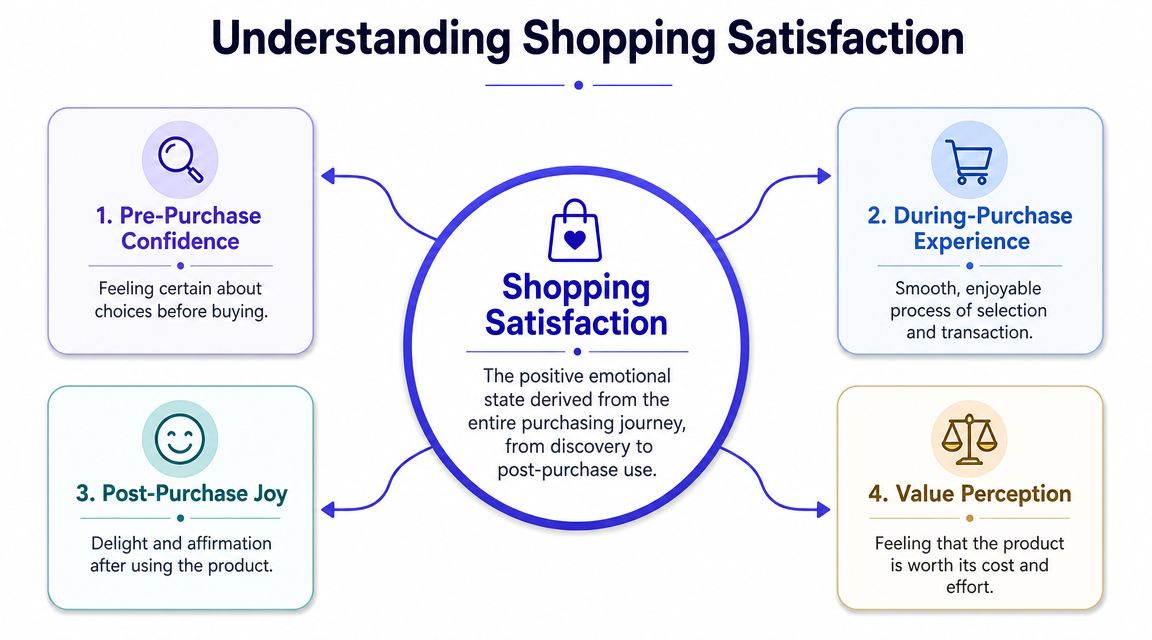
Shopping satisfaction is the overall feeling you get from the entire buying journey. Not one moment. Not just the unboxing. The whole experience from “that looks interesting” to “I'd buy from them again.”
It's a chain, not a single click
It's often thought that satisfaction happens after delivery. In real life, it builds in layers.
- Discovery feels easy: You can find what you want without digging through clutter.
- The item makes visual sense: The photos, angles, and styling help you understand what you're looking at.
- Checkout doesn't feel annoying: The purchase process feels smooth instead of suspicious or confusing.
- The product matches the promise: When it arrives, it still feels like the same item you chose online.
Break one link in that chain and the whole experience weakens.
Shopping now happens across channels
A lot of confusion comes from thinking shopping is linear. It isn't. You might see a look on social, save it, compare versions on a marketplace, check reviews on desktop, and finally buy on mobile.
Research on fashion retail found that ease of use, enjoyment, and consistency across channels strongly shape satisfaction, loyalty, and repeat purchases, as described in this omnichannel fashion shopping research. That's a fancy way of saying people notice when the experience feels connected, and they notice even more when it doesn't.
Here's the practical version:
| Part of the journey | What the shopper feels | What can go wrong |
|---|---|---|
| Browsing | Curiosity | Too many choices, weak photos |
| Comparing | Confidence or doubt | Inconsistent info across apps or devices |
| Buying | Relief | Clunky checkout, surprise friction |
| Receiving | Validation | The item looks different than expected |
A simple test: if you have to do a lot of mental work to imagine the outfit, the store is making you supply the missing confidence yourself.
That's why shopping satisfaction is bigger than convenience. It's about whether the experience helps you form a clear expectation. When that expectation is sharp, you feel calm. When it's blurry, every next step feels riskier.
Key Drivers of a Joyful Shopping Experience
Some drivers of shopping satisfaction are obvious. Clear prices help. Reliable shipping helps. Good customer service helps. But fashion adds another layer that people often underestimate. You're not only buying an object. You're buying a look.
Visual uncertainty changes everything
In e-commerce, product visualization quality directly affects satisfaction because it reduces pre-purchase uncertainty. Guidance on online retail experience notes that interactive visuals such as zoom, 360-degree views, and richer presentation help shoppers understand appearance and details better, which lowers returns and increases confidence, as explained in this piece on what factors determine customer satisfaction in online shopping.
That insight matters because fashion is unusually visual. A shopper doesn't just want to know that a dress exists. They want to know whether the silhouette feels sharp or soft, whether the coat looks dramatic or relaxed, whether the whole thing fits their style story.
A flat product shot can answer part of that. A styled campaign image can answer another part. But the brain still keeps asking: What will this look like on me?
The happiest carts usually remove guesswork
When people feel good about a purchase, it's often because the store helped them imagine the item clearly before checkout.
A few things tend to improve that feeling:
- Detailed visuals: Multiple angles, close-ups, and fabric detail shots reduce ambiguity.
- Consistent presentation: If the mobile page, desktop page, and marketplace listing tell the same visual story, trust rises.
- Style context: Seeing an item in a complete outfit helps shoppers judge mood, not just category.
- Low mental effort: The less imagination work a shopper has to do alone, the easier it is to decide.
That last point gets missed all the time. A lot of shopping friction is invisible because it happens in the shopper's head.
If the product page leaves you guessing, the purchase starts to feel like a gamble instead of a choice.
This is also where omnichannel design gets tricky. A shopper may first meet an item on one platform and buy on another. If you want a deeper look at the operational side of that challenge, this guide on Herausforderungen im Omnichannel-Kundenerlebnis meistern is a useful read.
The key idea is simple. Shopping satisfaction rises when the experience reduces uncertainty before the transaction, not only after it.
How Retailers Measure Shopping Happiness
Retailers can't see your facial expression when you close a tab, but they can study the signals you leave behind. That's why shopping satisfaction gets measured in several different ways.
Some methods are direct. A brand might ask whether you were satisfied after purchase. Others are indirect. If lots of people bail out at checkout, something probably felt wrong.
The listening tools behind the scenes
You'll often hear a few terms in ecommerce teams:
| Metric | What It Asks | Why It Matters |
|---|---|---|
| CSAT | Were you satisfied with this experience? | It captures immediate post-purchase feeling |
| NPS | Would you recommend this brand to someone else? | It shows whether satisfaction turns into advocacy |
| Conversion rate | Did browsing turn into a purchase? | It reveals whether confidence held long enough to buy |
| Return rate | Did the product meet expectations after arrival? | It highlights mismatch between promise and reality |
| Cart abandonment | Did shoppers leave before paying? | It exposes friction at the final buying step |
None of these tells the full story alone. Together, they give retailers a map of where confidence rises and where it collapses.
Checkout is often the loudest warning sign
One of the clearest signals comes right before payment. According to Statista coverage summarized on ecommerce customer satisfaction, 48% of U.S. online shoppers cited extra costs and fees as the top reason for cart abandonment in 2024. The same source notes that globally 30% cited extra checkout costs and 17% cited payment-method limitations, which you can review in this Statista ecommerce customer satisfaction overview.
That tells you something important. A shopper can like the item and still leave because the final step breaks trust.
Retailers often study this through a mix of survey responses and behavior:
- After checkout surveys show how people felt.
- Session behavior shows where people hesitated.
- Return patterns reveal expectation gaps.
- Repeat purchase behavior shows whether satisfaction lasted.
If you like seeing how strong stores present customer proof and shopper feedback, it's interesting to explore testimonials from advanced shops and notice how often they talk about clarity, ease, and trust.
For brands, this matters because satisfaction and retention are tightly connected. This article on customer retention in ecommerce explains why small moments of friction can echo long after a single purchase.
Your Strategy to Visualize and Buy with Confidence
You spot a jacket on your phone during lunch. The color looks right. The model styling looks convincing. Then the real question shows up: would it still look like you once it leaves the product page and enters your wardrobe?
That moment is where shopping satisfaction often gets decided. Long before checkout. Long before delivery. If you cannot picture the item on yourself, the purchase turns into a guess, and guesses are what lead to abandoned carts, backup purchases, and return labels.
A better strategy starts with visibility, not volume. More tabs rarely create more clarity. They usually create visual noise. What helps is reducing uncertainty early, while you are still deciding whether a piece fits your taste, proportions, and mood.
Start with inputs your eyes can trust
Your preview is only as good as the image you start with. Product photos work like ingredients in a recipe. If the ingredients are messy, the result is harder to judge.
A few habits make a big difference:
- Choose flat-lay clothing photos when possible. They usually show shape more clearly than heavily styled editorial shots.
- Favor clean, front-facing product images. Busy backgrounds and dramatic poses can hide the garment's actual lines.
- Compare similar pieces side by side. A trench, bomber, and oversized blazer may read similarly in thumbnails but create very different silhouettes.
- Save the looks that feel right. Over time, you start noticing your own pattern language, like sharper structure, softer drape, cropped lengths, or deeper tones.
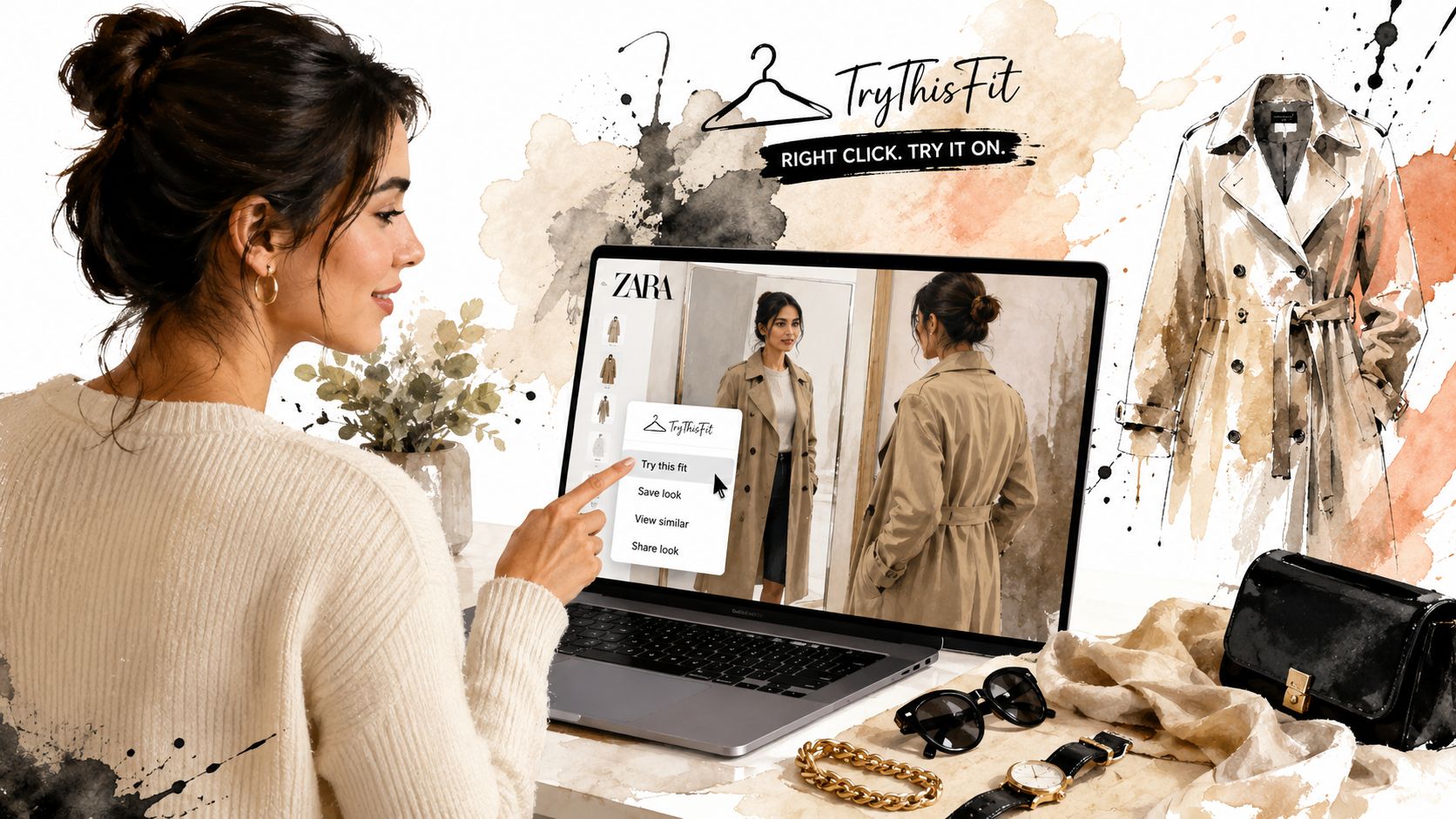
If visual uncertainty is your main blocker, a virtual try-on tool for previewing clothes on your own photo gives you a faster answer than mentally stitching together product shots, mirror memories, and wishful thinking. TryThisFit focuses on appearance before purchase, which is the gap many general shopping guides skip.
Keep the decision close to the product page
Confidence drops when the process gets clumsy. Open a new tab. Save an image. Lose the original tab. Forget which version looked better. By that point, the friction is doing the styling for you.
Using a browser extension shortens that loop. The free Chrome extension works through a right-click try-on action on stores and marketplaces you already browse, including Zara, H&M, Shein, Vinted, Depop, and other large marketplaces. If you want the fastest route, you can install the Chrome extension in seconds.
Here's a quick demo of that kind of visual workflow in action.
<iframe width="100%" style="aspect-ratio: 16 / 9;" src="https://www.youtube.com/embed/kba3W4-S7aE" frameborder="0" allow="autoplay; encrypted-media" allowfullscreen></iframe>Practical rule: preview the appearance of an item while you are still looking at its product page. You make better decisions when the context is still fresh.
Build a repeatable confidence routine
You do not need a complicated system. You need one you will use.
-
Shortlist first
Pick two or three items you like instead of collecting a maze of tabs. -
Preview the style
Check how each item looks on you, especially if the piece has a strong shape, unusual neckline, oversized cut, or dramatic length. -
Review what keeps winning
Look back at your saved previews and ask a simple question: what do these favorites have in common? That is often where your style becomes easier to name. -
Buy the item you understand clearly
The best choice is usually the one you can already place in real outfits, not the one that only looks exciting in isolation.
Brands use similar visual logic when they want shoppers to act with less hesitation. If you are curious about that side of the experience, this guide shares practical tips for shoppable video creation. It shows how motion, context, and presentation can make a product easier to picture before purchase.
This shift is simple. Shopping satisfaction gets stronger when you stop asking, “Do I like this item?” and start asking, “Can I already see myself wearing it?” That is the point where browsing starts to feel less like guessing and more like building a wardrobe on purpose.
The Future of Confident and Joyful Shopping
The future of shopping satisfaction won't belong to the stores with the most products. It'll belong to the experiences that create the clearest confidence.
That shift matters in fashion because shoppers aren't only filtering for price or trend. They're asking a much more personal question: Can I see myself in this? When that answer is fuzzy, shopping feels noisy. When that answer is clear, shopping feels fun again.
Confidence is becoming part of the product
The old version of online shopping asked you to imagine more than most product pages could show. That's why so many purchases felt like educated guesses.
The newer version is more visual, more immediate, and more personal. You can preview the appearance of a style before you commit. You can compare looks instead of relying on memory. You can build taste, not just carts.
A happier cart usually means a smaller one
This sounds backward, but it isn't. Confident shoppers don't need to buy five maybe-items to find one winner. They can buy fewer pieces with more intention.
That creates a better rhythm. Less impulse. Fewer regret purchases. More outfits that feel like your wardrobe, your mood, and your style.
The real win isn't buying more online. It's buying with a clearer picture of what you'll actually enjoy wearing.
That's why shopping satisfaction is such a useful idea. It reminds you that the goal isn't just to complete a transaction. The goal is to make a choice you still feel good about once the box is open and the mirror moment arrives.
Ready to discover your style? Try your first outfit now at TryThisFit, preview how pieces look before you buy, and revisit your saved looks anytime in your history.
Try Virtual Try-On Now
See how clothes look on you before you buy - works with any online store
Get Started Free