Clothing in Egypt: A Guide to Style, Culture & What to Wear
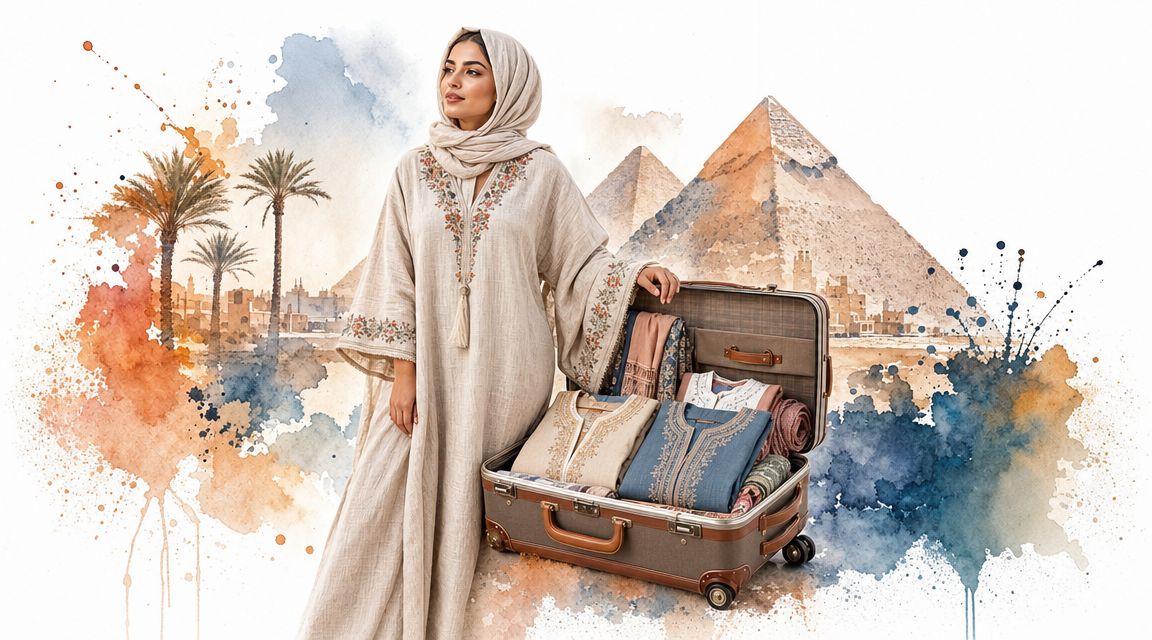
You've got the flights booked, the hotel pinned, and a folder full of screenshots of pyramids, Nile sunsets, and tiled courtyards in Cairo. Then the packing question shows up and suddenly feels much harder than booking the trip itself. What counts as appropriate clothing in Egypt today?
A lot of travelers hit the same wall. One article says “dress conservatively,” another shows breezy vacation outfits that look better suited to a beach club than a city street, and neither really explains what changes between Cairo, Luxor, a mosque, and a resort.
That's where most of the confusion comes from. Clothing in Egypt isn't one single rulebook. It's a mix of climate, local norms, setting, occasion, and personal style. If you're still building your itinerary, a practical Egypt destination guide helps put those clothing choices in context because what works for a Red Sea stay won't always feel right for a day in a busy city or at a religious site.
The good news is that you don't need to pack a whole new identity. You just need a few smart principles, a little cultural awareness, and outfits that feel like you while still showing respect.
What to Wear in Egypt A Modern Traveler's Dilemma
You might be staring at your suitcase right now with a linen shirt in one hand and a sleeveless dress in the other, wondering which version of “travel smart” applies. That's a very normal place to start.
Egypt can feel style-rich and rule-blurry at the same time. In one day, you might move from a fashionable neighborhood café to a historic mosque to a hotel terrace dinner. The outfit that feels perfect in one spot can feel off in another.
Why the advice online feels so inconsistent
Part of the problem is that broad advice collapses very different places into one image of Egypt. Urban daily wear, resort wear, traditional dress, and visitor etiquette often get blended together until nothing feels usable.
Practical rule: Don't ask, “What do people wear in Egypt?” Ask, “What do people wear in this part of Egypt, for this activity, at this time of day?”
That small shift makes everything easier.
The balance most travelers are really looking for
Travelers don't want to dress in costume, and they also don't want to feel disrespectful. They want clothes that are breathable, flattering, comfortable for walking, and appropriate for local settings.
That's the sweet spot this guide is built around:
- Respect first: Covering more skin usually makes everyday travel smoother in non-resort settings.
- Climate matters: Lightweight fabrics do more for comfort than trendy cuts.
- Context changes everything: Cairo, temples, mosques, and beach zones don't ask for the same wardrobe.
- Style still matters: You can absolutely look polished and expressive while dressing thoughtfully.
A Journey Through Time Ancient Egyptian Attire
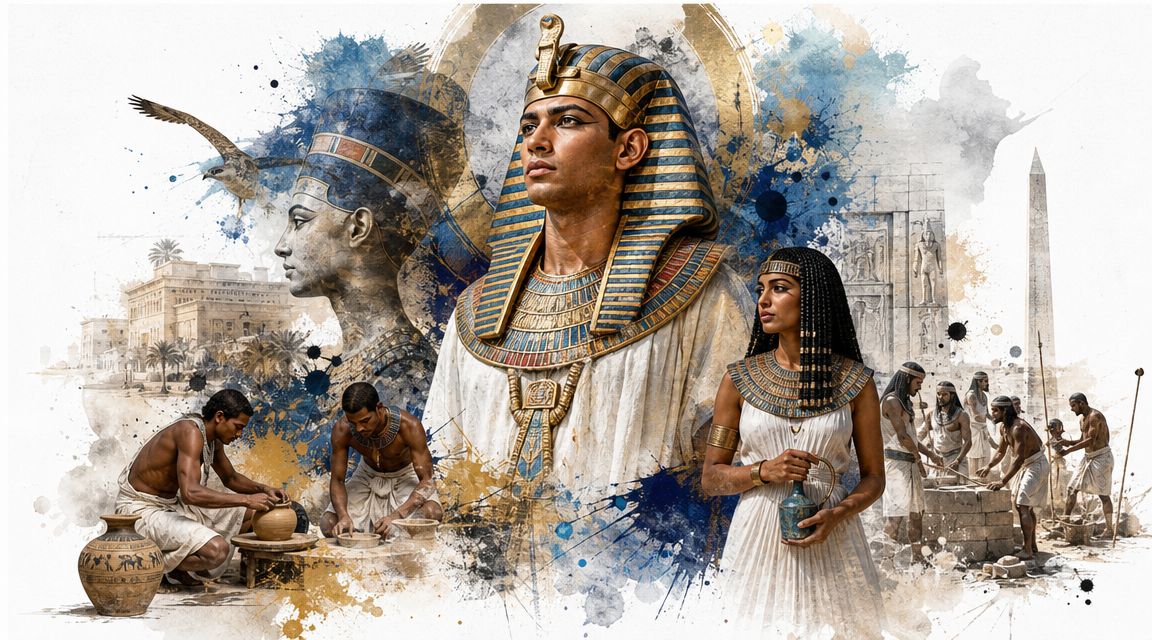
Step into a temple complex or museum in Egypt and a pattern starts to click. The draped lines, the pleats, the white linen, the jewelry. Ancient Egyptian clothing can look simple at first glance, but it followed a clear logic shaped by heat, labor, status, and ceremony. Learning that logic helps modern travelers read Egypt's visual history with a sharper eye.
Ancient Egypt also gives us one of the earliest surviving examples of constructed clothing. The Tarkhan Dress, discussed in Facts and Details on ancient Egyptian clothing, is widely described as the oldest known woven garment. That matters because it reminds us that Egyptian dress was never primitive or improvised. It came from a long, highly skilled textile tradition.
The fabric that shaped the look
Linen sat at the center of ancient Egyptian dress for a practical reason. Egypt is hot, dry, and bright for much of the year, so a light plant fiber made sense for daily wear. In that way, ancient clothing followed the same rule smart travelers still use today. The best outfit usually starts with fabric, not trend.
Clothing styles stayed recognizable for long stretches of Egyptian history. Tunics, kilts, sheath dresses, wrapped forms, and pleated garments appear again and again in art, with changes in cut, layering, and decoration rather than complete reinvention. If you want a visual reference for those silhouettes, this overview of ancient Egypt fashion and clothing styles is a helpful companion.
Simple shapes, layered meaning
The basic outline of many garments was clean and restrained. The meaning was not.
World History Encyclopedia's article on fashion and dress in ancient Egypt explains that dress varied by class, work, and period. Elite clothing used finer fabrics, more careful finishing, and more ornament. Working people wore garments built for movement and heat. In art, those differences can be easy to miss if you only focus on silhouette. Often, the distinction was in material quality, pleating, transparency, color, and adornment.
That is a useful mindset for visitors. Ancient Egyptian clothing worked a bit like modern outfits that share the same shape but signal very different things through fabric and styling. A loose white dress can read casual, ceremonial, expensive, or practical depending on the textile and accessories around it.
What ancient dress can teach a modern traveler
Ancient Egyptian attire is not a dress code for visitors today, and it should not be copied as costume for everyday sightseeing. What it does offer is context. It shows that Egyptian clothing history has long valued climate-aware fabrics, elegant drape, and garments that balance comfort with presentation.
A few ideas are especially helpful to carry forward:
- Fabric mattered as much as form. Breathable cloth shaped comfort.
- Clothing signaled social role. Dress communicated rank, work, and occasion.
- Minimal did not mean plain. Pleats, jewelry, texture, and finish added meaning.
- Climate shaped style. The environment influenced what people wore then, just as it does now.
That historical background makes modern Egypt easier to understand. You start to see continuity in the preference for airy fabrics, modest variation by setting, and clothing choices that respond to both heat and social context.
Traditional Garments Worn in Egypt Today
You step out for a day in Cairo expecting a street full of ancient-looking robes, then notice jeans, sneakers, long dresses, button-down shirts, headscarves, and the occasional flowing galabiya all in the same block. That mix is the key starting point.
Traditional clothing in Egypt is still present, but it works more like a living wardrobe language than a single everyday uniform. What you see depends on region, age, occasion, family habits, and setting. For travelers, that distinction matters because it helps you read what is around you instead of relying on postcard expectations.
The galabiya in daily and regional life
The galabiya is the piece many visitors spot first. It is loose, breathable, and practical in heat, which helps explain why it has lasted for generations. A galabiya works a bit like garments in many hot-climate cultures. Comfort is part of the design, not an afterthought.
You are more likely to notice it in Upper Egypt, rural towns, local markets, at-home settings, and some social gatherings than in business districts filled with global brands. Men may wear plain everyday versions or more polished styles for visits and celebrations. Women's versions can range from simple house wear to embroidered pieces with much more visual presence.
For readers who want a clearer visual sense of how traditional and current styles overlap, this guide to Egyptian men's clothing is a useful reference point.
Kaftans, jalabiyas, and dressier tradition
The kaftan often sits in a more formal category. You may see it at festive dinners, holiday gatherings, weddings, or in stylish home entertaining. In modern wardrobes, it can appear as heritage-inspired fashion rather than strict daily wear.
That is where travelers sometimes get confused. A garment can be traditional without being the default outfit for an ordinary weekday. Egyptian clothing works a lot like many other fashion cultures in that way. Some pieces belong to daily routine, some to hospitality, and some to moments when people want to look especially put together.
If you enjoy studying shape, fabric, and embellishment before a trip, the Pandemonium kaftan buyer's guide offers useful visual cues for noticing artisanal details in flowing garments.
Hijab is part of the picture, not the whole picture
The hijab is another area where outsiders often oversimplify. In Egypt, it can reflect religious practice, family custom, personal conviction, style preference, or a mix of those factors. It does not carry one universal meaning that a visitor can decode from a distance.
Large cities make this especially clear. On the same street, you may see women in hijab, women without head coverings, women in abayas, and women in long coats with Western-style accessories. The visual variety can feel confusing at first, but it becomes easier once you stop looking for one national formula.
A respectful approach helps:
- Read clothing by context, not stereotype. A university campus, village street, hotel lobby, and wedding each have different visual norms.
- Treat traditional dress as lived culture. It is not a costume category for tourist photos.
- Notice styling details. Fabric, tailoring, embroidery, shoes, and scarves often tell you more than the garment name alone.
What many visitors call “traditional Egyptian dress” is really a set of garments that shift meaning with place, purpose, and personal choice. That is what makes clothing in Egypt so interesting to observe and, for travelers planning outfits, so useful to visualize in advance.
Navigating Modern Dress Codes and Etiquette
You step out of a hotel in Cairo wearing something that felt perfectly reasonable while packing at home. Ten minutes later, after a metro ride, a mosque stop, and lunch in a neighborhood café, you realize Egypt does not ask for one outfit formula. It asks for context.
That is the key idea to keep in mind. Clothing in Egypt works a bit like volume control, not an on-off switch. In some places the dial sits at everyday city modesty. In others, especially religious spaces, it turns up toward fuller coverage. Inside private resorts, it often drops again.
A simple rule that works in real life
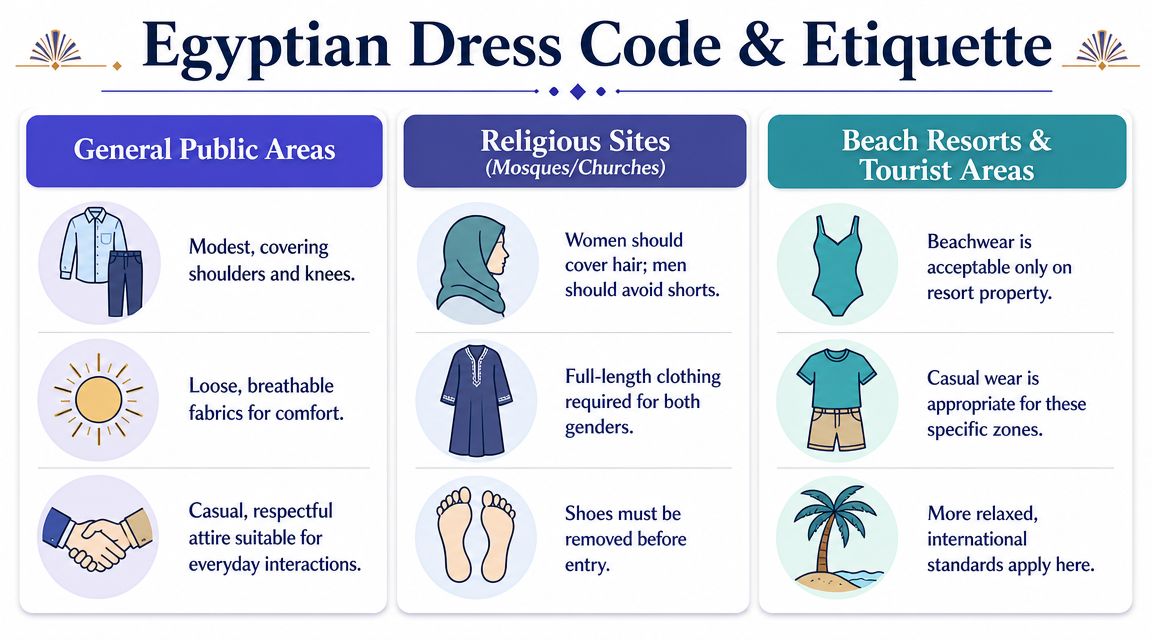
Start with this baseline: covered in public, more covered at religious sites, relaxed only in clearly tourist-oriented resort spaces.
That guideline is not about fear. It is about reading the room. Visitors usually feel more comfortable, and attract less unwanted attention, when their clothes match the setting instead of pushing against it.
Egyptian dress code cheat sheet
| Location | For Women | For Men |
|---|---|---|
| General public areas | Tops with sleeves usually feel safer than strappy styles. Bottoms that cover the knees are a smart default. Looser shapes often blend in better than very body-hugging outfits. | T-shirts or shirts with sleeves work well. Long trousers are usually the easiest choice in cities and standard public settings. |
| Religious sites | A scarf is useful, especially for mosque visits. Clothing that covers arms and legs is the safest option. Even if a site is flexible, fuller coverage shows respect. | Skip shorts. Wear clothes that cover shoulders and legs. Be ready to remove shoes before entering some spaces. |
| Beach resorts and tourist areas | Swimwear is usually fine within resort property. Add a cover-up before heading into lobbies, streets, or nearby shops. | Shorts and casual resort wear are usually fine inside resort zones. Outside them, standard street clothes are the better choice. |
What people actually wear in different parts of Egypt
Cairo and Alexandria usually give you the widest visual mix. You may see jeans, long skirts, abayas, sneakers, structured blazers, uncovered hair, and headscarves all within one block. For travelers, polished and moderately covered outfits tend to feel easiest here, especially during daytime sightseeing.
Luxor, Aswan, and smaller towns often read more conservative in daily public life. You do not need a whole separate wardrobe. You will usually be glad you packed longer hemlines, looser trousers, and tops with sleeves.
Mosques and churches deserve your most respectful outfit of the trip. A good test is simple. If you have to argue that an outfit is probably fine, choose the more covered option instead.
Resort zones follow a different rhythm. Pool wear, breezy cover-ups, and bare shoulders may feel normal inside the property, then feel out of place a few steps beyond the gate.
One lightweight scarf can solve half your packing stress. It can cover hair for a mosque, add chest coverage over a sleeveless top, block sun in open areas, or make a breezy outfit feel more appropriate in a traditional neighborhood.
If you want help visualizing how a flowing layer will work over travel outfits, this Pandemonium kaftan buyer's guide is useful for thinking through drape, opacity, and layering before you buy.
A final etiquette point matters as much as the clothing itself. Clean, intentional outfits read better than clothes that look sloppy, sheer by accident, or overly beachy in ordinary city settings. In Egypt, respect often shows up in the details.
Choosing the Right Fabrics for the Egyptian Climate
When people struggle with clothing in Egypt, it's often not because they packed the wrong silhouette. It's because they packed the wrong fabric.
Ancient Egyptian clothing was optimized for the hot, arid climate. Linen, spun from flax, dominated because it is lightweight, breathable, and better at reducing heat buildup than heavier animal fibers. Linen processing began in the Nile River Valley around 5000 BCE, showing how long climate-driven textile choices have shaped dress in Egypt, according to Egypt Tours Portal's article on ancient Egyptian clothing.
Why linen keeps winning
Linen has that crisp, airy quality that makes hot days feel less sticky and less trapped. It doesn't mean every linen garment is perfect, but it does explain why so many smart Egypt packing lists revolve around it.
Good cotton can work beautifully too, especially when it's lightweight and not overly clingy.
Fabrics that usually make travel harder
Some clothes look breathable on a hanger and turn miserable once you're walking through heat, sun, and traffic. Synthetics are the biggest repeat offender.
A simple way to choose:
- Pick linen first: Shirts, loose trousers, shirt dresses, and cover-ups all benefit.
- Use cotton as backup: Especially for soft tops, tees, and lighter layers.
- Skip heat-trapping blends when possible: If a fabric feels slick, dense, or sweaty at home, it probably won't improve in Egypt.
- Check opacity in sunlight: Thin whites and pale neutrals can behave very differently outdoors.
Comfort is part of respectful dressing
This is the part travelers underestimate. If you're overheated, you're more likely to wish you had packed less coverage. But the right breathable coverage usually feels better than exposed skin under strong sun.
For anyone building a warm-weather wardrobe beyond Egypt, this guide to cool and stylish summer fabrics offers a useful fabric-first lens.
The goal isn't to wear more clothing. It's to wear smarter clothing.
Shopping for Clothing in Egypt Like a Pro
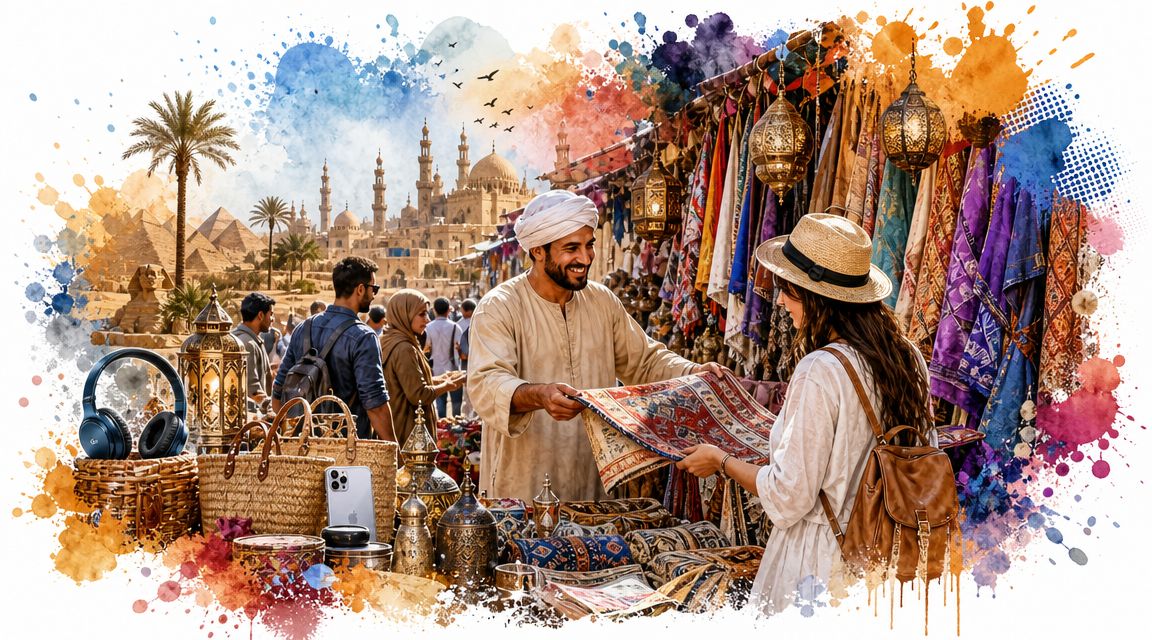
You spot a breezy embroidered tunic in a Cairo market, picture yourself wearing it all trip, buy it on the spot, and later realize the fabric feels hot, the seams twist, and it does not match anything in your bag. Egypt is a wonderful place to shop for clothing, but it rewards the traveler who pauses for one extra minute before reaching for their wallet.
What to look for in souks and markets
Markets are full of temptation in the best way. You will see scarves, galabeyas, kaftans, slippers, embroidered bags, cotton dresses, and light layers that seem perfect under warm Egyptian light. The trick is to shop with the same logic you use for packing. If a piece cannot earn its place in your suitcase or your real life at home, it is probably a souvenir first and clothing second.
A good market check is simple:
- Touch the fabric: Airy-looking fabric is not always breathable. If it feels slick or heavy in your hand, it may feel worse in afternoon heat.
- Inspect the construction: Look at seams, hems, buttons, zippers, and lining. A beautiful print can hide rushed finishing.
- Test opacity: Hold pale fabrics toward the light so you do not get surprised outdoors.
- Picture three outfits: If you can pair the item with three things you already own, it is much more likely to get worn.
- Ask yourself where you would wear it: On a Nile dinner, in Luxor, back home in summer, or nowhere except in the shop.
That last question matters more than travelers expect.
There is also a human side to shopping that is easy to miss in a busy souk. Clothing is never just color and silhouette. It comes from labor, skill, and supply chains. That older story has deep roots in Egypt too, as discussed in this essay on fashion and hidden labor in ancient Egypt. It is a useful reminder to ask who made a garment and what kind of craftsmanship you are paying for.
Malls, boutiques, and online shopping before departure
If you like fixed prices, air conditioning, and a more familiar retail rhythm, malls and boutiques can be a better fit than bargaining in a market. They are especially useful for practical pieces such as loose trousers, simple dresses, shirts with sleeves, and polished evening basics.
Shopping before departure can be even smarter. That gives you time to compare cuts, check fabric details, and build outfits instead of collecting random pieces one by one. A kaftan bought online is much more useful when you already know which sandals, bag, and layer you will wear with it.
I sometimes use TryThisFit to preview how a garment might look before buying online, especially for pieces that are slightly outside my normal wardrobe. If you want to map outfits rather than guess from product photos, a wardrobe planning tool for trip outfits can help you sort likely combinations before you leave. Flat-lay clothing photos usually give the clearest previews.
If you want to revisit looks you've already tested, the saved try-ons in your history are handy when you're narrowing down travel outfits.
A quick visual walkthrough can help before you start browsing more seriously:
<iframe width="100%" style="aspect-ratio: 16 / 9;" src="https://www.youtube.com/embed/lAqBn_0lU_E" frameborder="0" allow="autoplay; encrypted-media" allowfullscreen></iframe>Smart shopping habits that travel well
The best Egypt shopping strategy is to build a compact wardrobe that works across different settings. A scarf can cover your shoulders at a mosque and soften a simple outfit at dinner. Loose trousers can handle long walking days and repeat with multiple tops. A crisp overshirt can add polish, sun protection, and a little modesty without feeling heavy.
That is how experienced travelers shop here. They do not chase a fantasy version of Egyptian style. They choose pieces that respect the setting, suit the climate, and still feel like themselves.
Visualize Your Perfect Egyptian Wardrobe Before You Go
Packing gets easier once you stop trying to guess from flat product photos and mood boards. The question is whether an outfit feels like your style while still matching the setting.
That's especially true for Egypt, where the most useful wardrobe often includes pieces you may not wear every day at home. Longer skirts, looser trousers, airy overshirts, elbow-length sleeves, scarf layers, and occasion kaftans can all look very different on your body than they do on a model or mannequin.
Build a small wardrobe, not a giant suitcase
A smart Egypt wardrobe is usually compact. Think mix-and-match, not endless variety.
You'll probably get the most use from:
- A few breathable tops: Preferably with sleeves.
- Two or three bottoms: Loose and easy to re-style.
- One polished outfit: For dinners or special evenings.
- A scarf or light layer: For coverage, sun, and transitions.
- Comfortable shoes: Chosen for long walking days, not just photos.
If you want to map looks in advance, wardrobe planning for trips and outfits is a practical place to organize what you already know you'll wear.
Why visual planning helps so much
Travel packing anxiety usually comes from uncertainty, not lack of options. You own clothes. You just don't know which combinations will feel right once you're there.
Seeing the style in advance helps you decide faster. It can also save time, cut down on impulse buying, and make it easier to spot gaps before the trip instead of after you land.
If an outfit already looks right to you before departure, you're much more likely to wear it confidently on the trip.
Try a few combinations before you zip the suitcase. Compare a linen shirt with wide-leg trousers. Preview a long dress with a scarf. Check whether a resort cover-up still feels wearable if you add city-appropriate layers. That kind of prep makes the whole trip smoother.
Frequently Asked Questions About Clothing in Egypt
Can tourists wear shorts in Cairo
They can, but many travelers feel more comfortable in longer clothing. In regular city settings, trousers, midi skirts, or longer dresses tend to feel more in step with public norms.
Do women need to wear a headscarf everywhere
No. It isn't a general requirement for all public spaces. For mosques, though, bringing a scarf is the smart move because hair covering may be expected there.
Are bikinis acceptable at hotel pools and resorts
In resort and hotel beach settings, swimwear is generally fine. Outside those zones, it's better to cover up before heading into town or public streets.
Is traditional clothing required for tourists
No. Visitors don't need to dress in traditional Egyptian garments. Respectful modern clothing usually makes the most sense.
What colors work best
Lighter shades are often more comfortable in strong sun. Practicality matters too, so many travelers also like a few pieces that hide dust and repeated wear well.
Can men wear tank tops
In resort areas, casual beachwear may be fine. In cities, markets, and religious spaces, shirts with sleeves are the safer and more respectful choice.
Is clothing in Egypt the same everywhere
Not at all. That's the biggest point to remember. A beach resort, a Cairo street, a rural town, and a mosque can all ask for different choices.
Should I buy clothes in Egypt or pack everything in advance
Either can work. Packing the basics first usually reduces pressure. Then you can shop for something special once you're there if you find a piece you really love.
If you want to feel more confident before the trip, try a few outfit ideas at TryThisFit. You can preview how travel pieces look on you in seconds, no account needed, and the free Chrome extension makes it easy to right-click clothing photos on shopping sites and see the style before you buy.
Try Virtual Try-On Now
See how clothes look on you before you buy - works with any online store
Get Started Free