Retail Technology: Your 2026 Shopping Future
You know that moment when you're six tabs deep into Zara, Vinted, H&M, and Amazon fashion, and everything starts to blur together? A blazer looks amazing on the model, a vintage jacket seems like a steal, and a Halloween costume is either genius or a terrible idea. The hard part isn't finding clothes anymore. It's figuring out how they'll look in your life.
That's where retail technology shows up, even if it isn't recognized as such. It's the machinery behind the browse button, the checkout flow, the stock alert, the payment tap, the personalized recommendation, and the tools that help you preview an outfit before buying it. If you've ever shopped online and thought, "I wish I could see the style on me before I commit," you've already run into the exact problem modern retail tech is trying to solve.
What Is Retail Technology Anyway
Retail technology sounds like one of those giant industry phrases that belongs in a conference room. In real life, it's much simpler. It's the collection of tools stores use to sell things, process payments, track products, and make shopping feel smoother.
That includes old-school tools and futuristic ones. A cash register is retail technology. A card terminal is retail technology. So is the system that tells a shop whether your size is still available, the app that remembers what you viewed, and the virtual try-on tool that helps you see how a look might appear before you order it.
The simple shopper version
If you're buying clothes online, retail technology is doing several jobs at once:
- Showing products: The storefront, filters, search bar, and product pages all help you discover pieces.
- Tracking inventory: The store needs to know whether that black midi skirt is in stock before you hit buy.
- Handling payment: Card processing, digital wallets, and checkout flows move your order from "thinking about it" to "placed."
- Connecting channels: If you browse on your phone and buy later on your laptop, the brand wants that experience to feel consistent.
- Reducing doubt: Reviews, styling suggestions, and virtual previews help you feel more confident.
A lot of confusion comes from the word "technology" itself. People hear it and picture robots, giant warehouses, or AI buzzwords. But retail technology is also the quiet convenience you notice when a site remembers your cart, offers pickup options, or lets you compare styles without starting over.
Practical rule: If a tool removes friction between "I like this" and "I know what to do next," it's probably retail technology.
Fashion makes all of this more interesting because clothes are visual and personal. You aren't only asking, "Can I buy this?" You're asking, "Does this feel like me?" That's why customer-facing tools matter so much in apparel. They don't just process a transaction. They help you make a style decision.
The Engine Room of Modern Retail
Most retail technology lives behind the scenes. You don't usually see it the way you see a dress, a sneaker, or a checkout button. But it's there, running like the engine in a car.
If the engine misfires, the whole shopping trip feels weird. Products show up as available when they're not. Payments fail. Orders get delayed. Loyalty points disappear. The sleek front end only works when the hidden systems underneath stay connected.
Where it all started
Retail tech didn't begin with apps. It began with basic transaction control. In 1883, James Ritty invented the first mechanical cash register, which standardized sales recording and reduced transaction errors. Then in 1958, Bank of America launched BankAmericard, the foundation for modern credit cards, changing retail checkout from cash-heavy exchanges into card-based payments, as described in BigCommerce's history of retail.
That history matters because the core mission hasn't changed much. Stores still need to record sales, accept payment, and move people through checkout without chaos. The tools have become digital, but the underlying jobs are familiar.
The parts under the hood
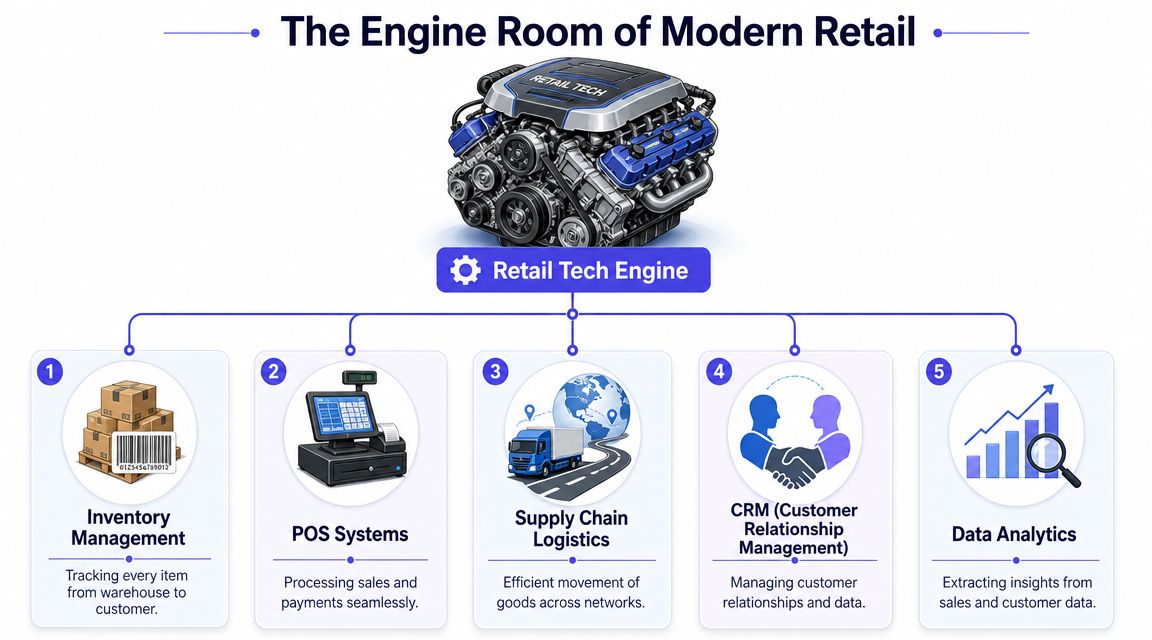
Think of a modern retailer like a fashion car with five main systems working together.
| Component | What it does for the shopper |
|---|---|
| POS system | Records sales and processes payments in store or on mobile devices |
| Inventory system | Tracks whether items are available in warehouses, stores, or both |
| Logistics tools | Help products move from supplier to shelf to doorstep |
| Customer data tools | Remember purchases, preferences, and loyalty activity |
| Analytics tools | Help retailers spot what sells, what stalls, and what needs attention |
A POS system, or point of sale system, is the retail version of the ignition. It's the moment a browser becomes a buyer. In a physical store, that's the register or mobile checkout device. Online, it's the checkout stack that confirms your payment and order.
Then there's inventory management, which shoppers notice mostly when it fails. If a site says your size is available and then cancels the order later, that's often an inventory visibility problem. Good retail tech keeps product counts updated across stores, warehouses, and digital channels.
The glamorous side of shopping starts after a retailer gets the unglamorous side right.
Why fashion shoppers should care
In apparel, tiny system issues can create big style headaches. A delayed inventory sync can mean the jacket you wanted is gone. A weak payment flow can make checkout feel sketchy. A disconnected return process can make trying new styles feel risky.
That's why "boring" retail tech isn't boring at all. It's the reason shopping can feel fast, trustworthy, and low-stress instead of messy and uncertain.
Bringing the Store to Your Screen
Online shopping used to feel separate from "real" shopping. Now it often is real shopping. The website, the app, the store visit, the pickup counter, and the customer account are all parts of the same retail experience.
That's where one of the biggest ideas in retail technology comes in. Omnichannel sounds technical, but the shopper version is easy to understand. It means a retailer tries to make every channel feel like one connected store instead of a pile of disconnected touchpoints.
What omnichannel looks like in real life
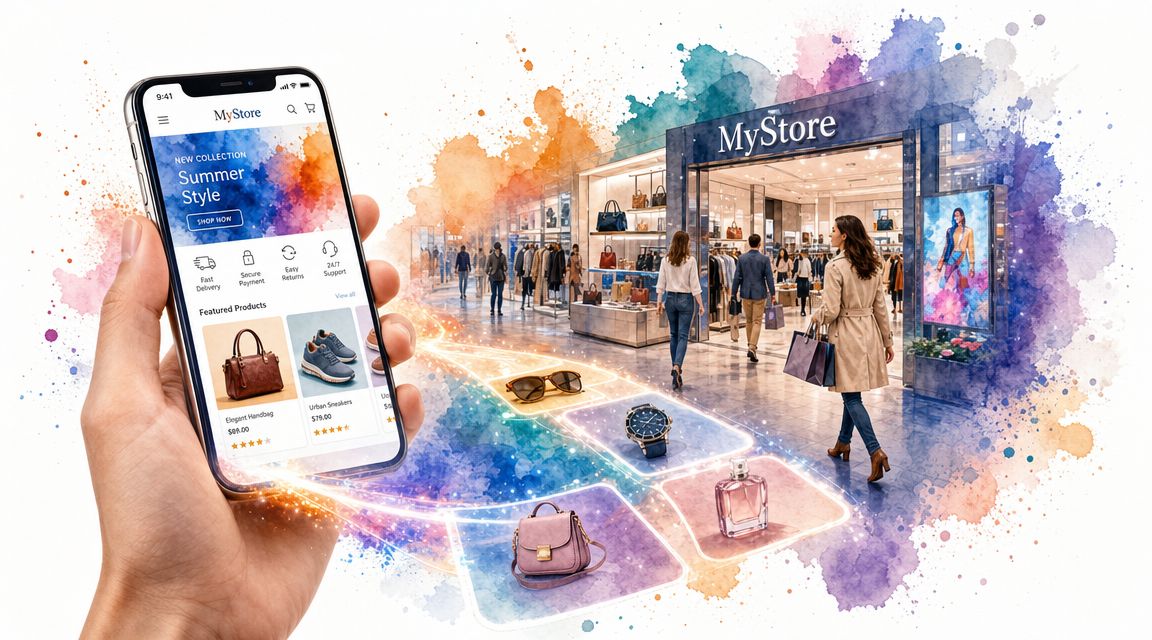
You browse a coat on your phone during lunch. That evening, you open the same brand's laptop site and your cart is still there. The next day, you check whether your nearest store has it. If the retailer has its systems lined up, that whole journey feels natural.
Under the hood, this works because retail technology increasingly depends on unified commerce data pipelines. When POS, e-commerce, and inventory systems are integrated, retailers can move from static reporting to dynamic decisions on assortment, pricing, and promotions, as explained in Green Retail Consulting's overview of retail technology best practices.
Why unified data changes the shopping experience
This is often a point of confusion for readers. "Unified data" sounds abstract until you connect it to something frustrating you've already experienced.
Without integration, stores can run into problems like these:
- Mixed signals on stock: The app says your size exists, but the store can't find it.
- Broken promotions: A discount works online but not in store.
- Confused personalization: The brand keeps recommending categories you've already purchased.
- Awkward service: Customer support can't see your full history across channels.
With integration, the store can treat your browsing, buying, and returning as part of one story. That's useful for the retailer, but it's also useful for you. It cuts repetition and guesswork.
E-commerce is more than a website
A fashion site isn't just a digital catalog. It's a storefront, fitting room substitute, merchandiser, payment desk, and brand experience all packed into one screen.
That's why the best e-commerce experiences don't just look pretty. They help you decide. Good navigation, clear images, saved carts, flexible pickup options, and consistent inventory all make the digital storefront feel less flat.
If you're curious how brands get discovered in the first place, this comprehensive guide for retail SEO managers gives useful context on how search visibility connects to the rest of the online shopping journey.
A smooth shopping journey doesn't happen because one page looks polished. It happens because many systems agree with each other.
Fashion retailers feel this pressure more than most categories. When you're deciding between a blazer from Zara, a knit from H&M, and a secondhand find from Depop, small bits of friction add up fast. The brands that win usually make it easy to move from discovery to confidence.
The Rise of Smart and Immersive Shopping
You're shopping for a jacket on your phone during a lunch break. One tab has a clean camel trench. Another has a cropped leather style. A third is a secondhand find with only two photos and a vague description. The hard part is not finding options. It's figuring out which one fits your taste before you pay.
That is where smart and immersive retail tech becomes real for shoppers. It helps answer the questions that product grids alone cannot. Will this suit my style? Does this shape feel like me? Is this worth adding to cart, or am I setting up a return?
When shopping feels more tailored
Personalization is often described in abstract terms, but the shopper-facing version is simple. A store notices patterns in what you click, save, buy, and ignore, then uses those signals to show more relevant products and messages.
In fashion, that matters because choice can become noise fast. A useful recommendation system acts more like a good shop assistant than a billboard. It narrows a huge catalog into a smaller rack that fits your style direction, price range, and shopping habits.
Done well, this kind of technology does not feel creepy or overly clever. It feels practical. You spend less time filtering out pieces you would never wear and more time comparing items you might love.
Why visual confidence matters more than novelty
Clothing has a special online shopping problem. A title, a size chart, and a polished studio photo still leave a lot unanswered. Shape, proportion, styling, and overall vibe are visual decisions.
That is why immersive tools matter. Virtual try-on, AR previews, and image-based styling tools help shoppers move from guessing to judging. The shift is similar to what happens in home shopping, where seeing an object in context makes the decision easier. The same idea appears in this article on generating stunning furniture imagery. Better visualization leads to better judgment.
Analysts at EBS Integrator describe the same logic in fashion and retail. Their discussion of retail technology and data explains why virtual fitting-room experiences can improve conversion compared with standard e-commerce browsing. The number is interesting. The bigger takeaway is easier to trust. Shoppers buy with more confidence when they can preview appearance instead of relying on imagination.
A practical example in fashion shopping
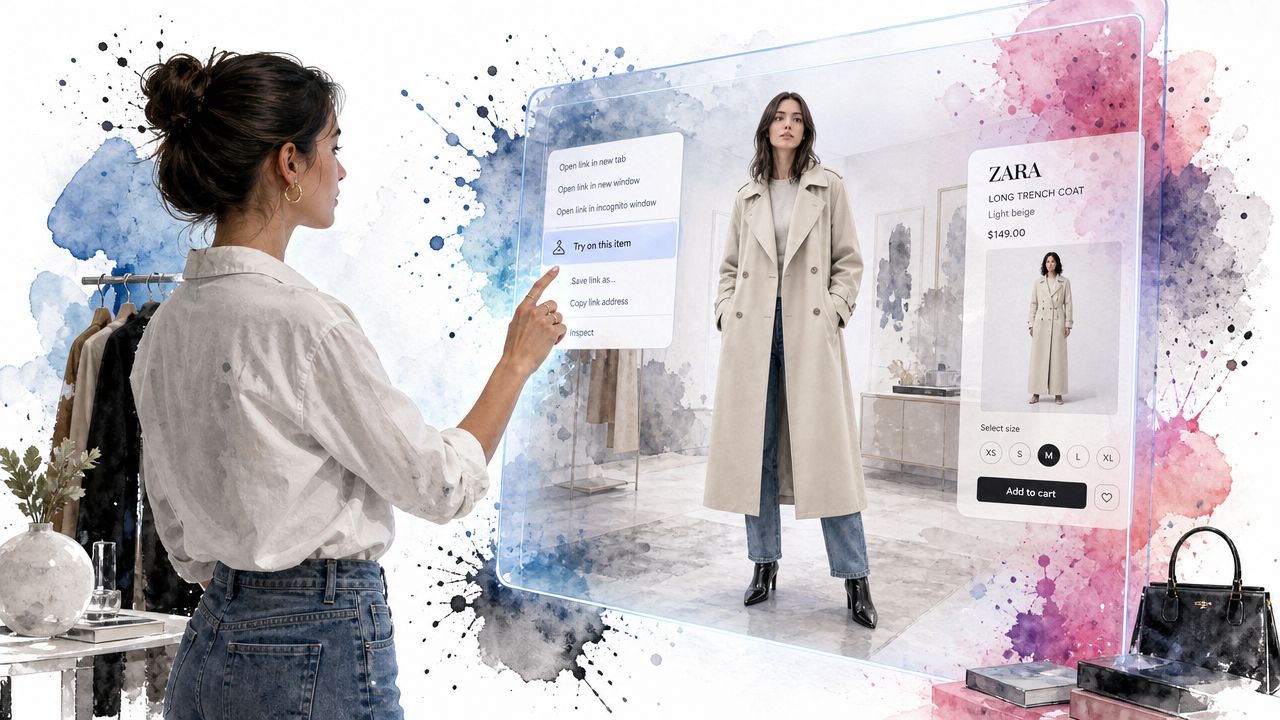
A good way to understand this category is to look at a real tool. TryThisFit lets shoppers upload a photo and preview how clothing looks on them using product images. That makes it useful for style comparison, especially when the question is visual rather than technical.
For example, you might be choosing between a relaxed blazer and a fitted one, or deciding whether a vintage slip dress feels elegant or costume-like on your frame. In those moments, you are not asking software to replace tailoring advice. You are using it as a digital fitting-room shortcut to get a clearer visual answer.
If you want to see how these image-based tools are developing, TryThisFit Media Lab AI for visual fashion experiments shows the broader direction of this technology.
A short demo makes the shift feel concrete:
<iframe width="100%" style="aspect-ratio: 16 / 9;" src="https://www.youtube.com/embed/b5i3fqr3n_w" frameborder="0" allow="autoplay; encrypted-media" allowfullscreen></iframe>What shoppers often misunderstand
Immersive shopping tech is not automatically useful. A flashy feature that adds spectacle without helping you choose is still friction, just dressed up in newer graphics.
The more grounded use cases are easier to spot:
- Online fashion shopping: Preview a style before adding it to cart.
- Secondhand marketplaces: Get more clarity on one-off items with limited photography.
- Fast comparisons: Judge several looks without downloading images or opening a dozen tabs.
- Occasionwear and costumes: Check the overall effect before committing to something bold.
The best test is simple. Does the tool reduce doubt?
If it helps you picture the item on you, compare options faster, or avoid a purchase that was never right in the first place, then it is doing something useful. That is the version of retail technology shoppers feel.
Measuring Success in Modern Retail
Shoppers judge retail technology by feel. Was the site easy to use? Did checkout work? Did the recommendation make sense? Retailers need another lens. They need to know whether the technology changed the business in a measurable way.
That doesn't mean every useful thing can be reduced to one number. It does mean stores look for signals that connect technology to outcomes like more confident purchases, fewer abandoned carts, and lower return pressure.
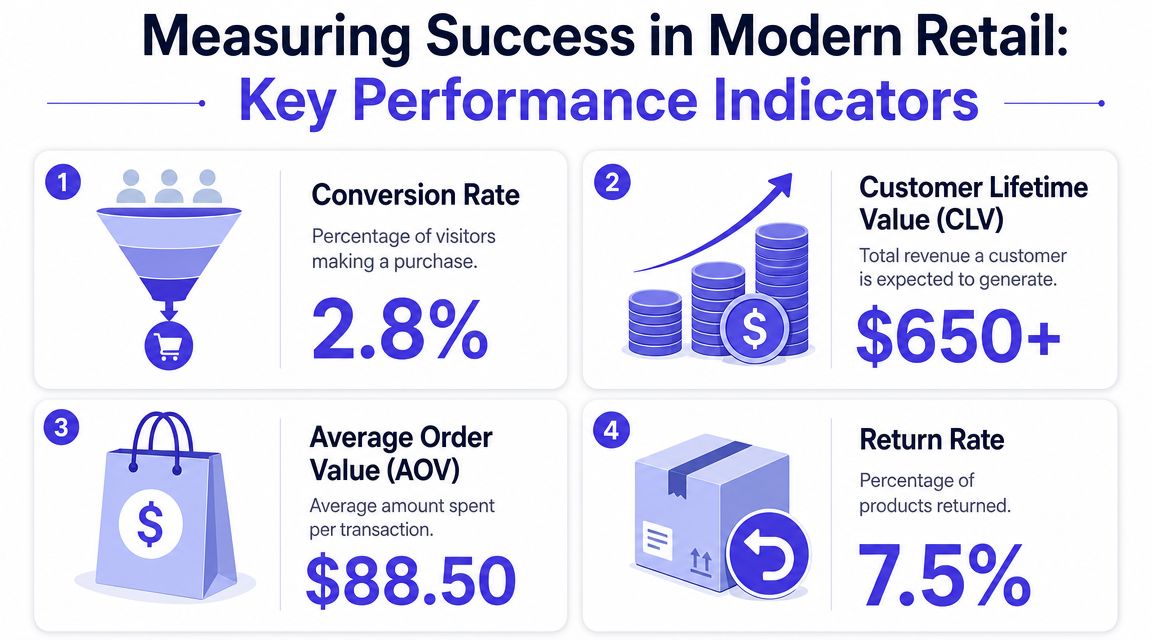
The metrics that matter most
In fashion retail, teams often watch a short list of practical indicators:
- Conversion rate: Are visitors turning into buyers more often?
- Average order value: Are shoppers building stronger baskets?
- Customer lifetime value: Do people return and keep purchasing over time?
- Return rate: Are customers sending back fewer items because they chose with more confidence?
Those indicators don't work in isolation. A recommendation engine might help discovery. A smoother checkout flow might reduce hesitation. A visual preview tool might help a shopper decide between two styles and feel more certain about the one they pick.
Why companies keep investing
Retailers aren't pouring money into technology just because it sounds modern. The category is large and active. HG Insights projects retail industry technology spending at $131.6 billion over the next 12 months, with 44% going to IT services and 28% to software. Deloitte also reports that 67% of retail executives expect to have AI-driven personalization capabilities within the next year, as summarized in the NetChoice report on retail data and technology history.
That projection tells you something important. Retail technology isn't a side project anymore. It's operating infrastructure.
A fashion-specific way to think about success
For apparel, return rate often carries unusual weight because style decisions are emotional and visual. If a technology helps a shopper picture a look more clearly before purchase, that can improve confidence. More confidence can support better decisions. Better decisions can ease return pressure.
The same logic shows up in retention. If a store consistently helps people discover styles they like, those customers are more likely to come back. This is one reason customer experience work and technology work overlap so much. If you're thinking about that broader relationship, this guide on improve customer satisfaction strategies gives helpful context.
For a more apparel-specific angle, this article on customer retention in ecommerce connects repeat purchases to confidence, convenience, and post-purchase experience.
Retailers don't need more dashboards for the sake of dashboards. They need proof that a tool helps people buy with more clarity and less friction.
Adopting New Retail Technology Challenges
Not every new retail tool deserves a place in the stack. That's the part people skip when they get excited about AI, automation, or the latest immersive demo.
The biggest mistake isn't moving too slowly. It's adopting technology that creates extra steps for shoppers, extra complexity for staff, or extra maintenance for teams that were already stretched thin. Fashion retail feels this quickly because customers make taste-driven decisions fast. If the experience becomes clunky, they leave.
Where things get difficult
A retailer can love a new feature and still struggle to use it well. Common obstacles usually look like this:
- Legacy systems: Older POS or inventory software may not connect cleanly with newer tools.
- Tech debt: Teams inherit layers of past decisions that make simple upgrades surprisingly hard.
- Training gaps: Store associates and support teams need workflows that make sense on day one.
- Privacy concerns: Customer data has to be handled carefully and transparently.
- Feature overload: Too many disconnected tools can make the experience worse, not better.
These aren't glamorous issues, but they shape whether a technology succeeds.
The better question to ask
Instead of asking, "What's the hottest retail trend?" a stronger question is, "What friction does this remove?" That's especially useful in apparel, where uncertainty drives hesitation.
Honeywell notes that the most useful technologies are the ones that reduce returns and decision fatigue. In that context, AR and VR virtual try-on can help shoppers visualize an item's style before purchase, increasing confidence and reducing returns. The strongest business case is tied to fewer returns, not novelty, according to the Honeywell retail technology vision report.
That idea is a great filter. If a tool helps a shopper visualize the style of a garment, decide faster, or feel more certain, it has a practical role. If it only adds spectacle, it may not survive contact with real behavior.
Where human judgment still matters
Retail technology can support decision-making, but it doesn't replace taste, trust, or service. A recommendation engine can surface a dress. A stylist, friend, or your own instinct still decides whether it feels right for the occasion.
The same applies inside the business. Automation can speed up repetitive tasks. People still matter for creative direction, customer care, merchandising judgment, and resolving edge cases that systems can't handle neatly.
If you're looking at the customer side of friction, this guide on reducing shopping cart abandonment is useful because it focuses on hesitation points that often appear before checkout.
New technology earns its place when shoppers feel less stuck, not when a demo looks impressive.
The Future of Your Shopping Cart
You open a shopping app on your phone during lunch, save a jacket, revisit it on your laptop that night, and still hesitate at checkout because you cannot quite picture how it will look in real life. The next phase of retail technology is about reducing that hesitation. For shoppers, progress will feel less like science fiction and more like better timing, clearer visuals, and fewer dead ends.
That shift matters most in fashion because clothing is personal. Size is only one part of the decision. You are also judging shape, proportion, color, mood, and whether a piece fits the version of yourself you want to show up as. Retail tools are getting better at supporting that decision, especially on the customer-facing side, where people feel the friction.
A few changes are becoming easier to spot:
- Discovery gets more specific: recommendations will reflect browsing patterns, saved items, and style preferences with more accuracy.
- Visual tools get more useful: virtual try-on, richer product imagery, and side-by-side comparison tools will help shoppers judge style with less guesswork.
- Shopping stays connected across devices and channels: carts, wish lists, pickup options, and returns will feel more consistent from phone to store to desktop.
- Pre-purchase confidence improves sustainability: clearer decisions before checkout can mean fewer unnecessary returns and less over-ordering.
- Stores take on a different job: physical locations can act as fit checkpoints, pickup points, and places to confirm a decision that started online.
The brands that stand out will usually be the ones that remove uncertainty. Flash gets attention for a moment. Clarity keeps people shopping.
That is true whether someone is buying a black blazer for work, comparing vintage-inspired dresses, or trying to solve a last-minute event outfit without ordering three versions of the same thing. The useful side of retail technology is not the jargon. It is the set of tools that helps a shopper move from browsing to deciding with more confidence.
If you want a practical example, TryThisFit focuses on that customer-facing problem. It lets shoppers preview clothing visually, review past try-ons in try-on history, and use a Chrome browser tool to test looks while browsing retail sites. As noted earlier, those tools are easiest to judge by one question: do they make choosing clothes feel clearer? If the answer is yes, that is where the future of the shopping cart is headed.
Try Virtual Try-On Now
See how clothes look on you before you buy - works with any online store
Get Started Free